1862 to 1918
How Much Is a Large-Size $2 Bill Worth?
Far more than two dollars, even worn. On the sales on file, the lowest Average is $152.09, for a worn 1917 Legal Tender Note (4,261 worn sales), and the highest is $61,200.00, for an 1890 Treasury Note in Top Grade (13 sales). Each large-size series follows in turn: what it is, how to tell it from its neighbors, and what it has sold for. For the history and the engravers behind each design, see The Large-Size Era, 1862 to 1918.
Large-Size $2 Bill Value by Series and Grade
The table counts the large-size $2 notes on file sold one at a time at Heritage, Stack's Bowers, Scotsman, Kagin's and on eBay: graded notes by their grade, ungraded eBay notes by the condition the listing shows. Each cell gives the Average, the middle sale at today's prices, then how many notes sold in that grade and over which years. The figures are the large-size rows of the Sold Prices page, where each sale behind them is listed with its date, price and photo. Error notes, uncut sheets, multi-note lots and Confederate notes are kept out, and the table is rebuilt from the sales files each time they are refreshed.
Last updated November 17, 2026. 16,227 large-size sales on file, January 5, 2016 to November 16, 2026. Prices measured through November 2026.
| Note | Worn ! | Crisp ! | Uncirculated ! | Top Grade ! |
|---|---|---|---|---|
| 1862 Legal Tender Note (Hamilton) | $753.00 432 Sales, 2016 to 2026 |
$3,600.00 77 Sales, 2016 to 2026 |
$5,280.00 25 Sales, 2016 to 2026 |
$32,520.00 8 Sales, 2018 to 2026 |
| 1869 Legal Tender Note (Rainbow) | $1,491.75 233 Sales, 2016 to 2026 |
$6,000.00 28 Sales, 2016 to 2026 |
$9,207.75 26 Sales, 2016 to 2026 |
$29,868.00 15 Sales, 2016 to 2026 |
| 1869 Legal Tender Note (Rainbow), Star Notes | $3,105.00 1 Sale, August 2025 |
No recorded sale | No recorded sale | No recorded sale |
| 1874 to 1880 Legal Tender Notes | $713.41 334 Sales, 2016 to 2026 |
$1,569.60 133 Sales, 2016 to 2026 |
$2,303.50 176 Sales, 2016 to 2026 |
$4,120.20 84 Sales, 2016 to 2026 |
| 1875 National Bank Note (Lazy Deuce) | $3,480.00 482 Sales, 2016 to 2026 |
$8,400.00 46 Sales, 2016 to 2026 |
$13,420.00 44 Sales, 2016 to 2026 |
$33,358.00 8 Sales, 2017 to 2025 |
| 1886 Silver Certificate (Hancock) | $800.00 355 Sales, 2016 to 2026 |
$2,847.04 59 Sales, 2016 to 2026 |
$4,068.00 116 Sales, 2016 to 2026 |
$7,344.00 102 Sales, 2016 to 2026 |
| 1890 Treasury Note (McPherson) | $1,664.14 179 Sales, 2016 to 2026 |
$9,792.00 17 Sales, 2017 to 2025 |
$23,580.00 5 Sales, 2018 to 2026 |
$61,200.00 13 Sales, 2018 to 2025 |
| 1890 Treasury Note (McPherson), Star Notes | $2,166.66 2 Sales, 2024 to 2025 |
No recorded sale | No recorded sale | No recorded sale |
| 1891 Treasury Note (McPherson) | $795.00 344 Sales, 2016 to 2026 |
$2,464.50 39 Sales, 2016 to 2026 |
$3,450.30 47 Sales, 2016 to 2026 |
$6,303.60 54 Sales, 2016 to 2026 |
| 1891 Treasury Note (McPherson), Star Notes | $649.06 2 Sales, 2024 to 2025 |
No recorded sale | No recorded sale | No recorded sale |
| 1891 Silver Certificate (Windom) | $1,040.25 254 Sales, 2016 to 2026 |
$3,225.60 41 Sales, 2016 to 2026 |
$5,174.40 20 Sales, 2017 to 2025 |
$15,756.00 40 Sales, 2016 to 2025 |
| 1896 Educational Silver Certificate | $1,128.60 682 Sales, 2016 to 2026 |
$5,697.72 67 Sales, 2016 to 2026 |
$7,833.00 68 Sales, 2016 to 2026 |
$16,758.00 98 Sales, 2016 to 2026 |
| 1899 Silver Certificate (Washington) | $350.00 3,067 Sales, 2016 to 2026 |
$1,252.80 281 Sales, 2016 to 2026 |
$2,157.60 244 Sales, 2016 to 2026 |
$3,619.20 233 Sales, 2016 to 2026 |
| 1899 Silver Certificate (Washington), Star Notes | $1,426.44 69 Sales, 2016 to 2026 |
$2,342.62 2 Sales, 2022 to 2024 |
$5,612.00 9 Sales, 2019 to 2026 |
$11,322.00 7 Sales, 2016 to 2024 |
| 1917 Legal Tender Note | $152.09 4,261 Sales, 2016 to 2026 |
$379.84 591 Sales, 2016 to 2026 |
$650.88 415 Sales, 2016 to 2026 |
$1,389.90 143 Sales, 2016 to 2026 |
| 1917 Legal Tender Note, Star Notes | $372.45 147 Sales, 2016 to 2026 |
$1,234.08 16 Sales, 2018 to 2026 |
$2,318.00 9 Sales, 2023 to 2026 |
$5,385.60 4 Sales, 2016 to 2023 |
| 1918 Federal Reserve Bank Note (Battleship) | $818.99 1,355 Sales, 2016 to 2026 |
$1,996.25 202 Sales, 2016 to 2026 |
$3,015.87 222 Sales, 2016 to 2026 |
$5,289.60 122 Sales, 2016 to 2026 |
| 1918 Federal Reserve Bank Note (Battleship), Star Notes | $2,562.00 53 Sales, 2016 to 2026 |
$7,180.50 8 Sales, 2022 to 2026 |
$7,320.00 7 Sales, 2019 to 2026 |
$16,254.00 4 Sales, 2019 to 2026 |
Sources: Heritage, Stack's Bowers, Scotsman, Kagin's and eBay. Auction prices include the buyer's fee; eBay prices are the item price before shipping.
Two things move a large-size price more than the series does. Grade is the first: each row with sales in more than one grade climbs from Worn to Top Grade. The second is the exact variety, which the table does not split. Most series cover several Friedberg numbers, each a different pair of signatures, seal or bank, and each sale on the Sold Prices page names its own. A star row appears wherever star sales are on file. Some cells stand on one or two sales, such as the 1869 Legal Tender Note star row and the 1890 and 1891 Treasury Note star rows, and show what those notes brought rather than a settled price.
Source: 2dollar.us Sold Prices, the large-size rows, and the sales files behind it. Grade bands as defined on that page: Worn is graded 4 to 45 or sold as circulated, Crisp 50 to 58 or sold as crisp, Uncirculated 60 to 64 or sold as uncirculated, Top Grade 65 to 70 by PCGS or PMG only. Each Heritage sale in the sections below is a realized sale read from its sale page, as the Editorial Standards page defines the term. No figure on this page is an appraisal of a particular note.
1862 $2 Bill Value (Hamilton Legal Tender Note)
- What It Is
- The first $2 the federal government issued, a Legal Tender Note, also called a United States Note.
- How to Tell It Apart
- The only $2 with Alexander Hamilton, shown in profile, and a small red seal with rays. Heritage catalogs it as Fr. 41, with the varieties Fr. 41a, 41b, 41c and 41e.
- What It Sells For
- Heritage sold a Fr. 41a graded PMG Choice Fine 15 for $561.20 on October 27, 2026, and a PMG Choice Uncirculated 63 EPQ for $7,200.00 on October 10, 2025. The serial number one note, a Fr. 41a graded PCGS Very Good 8, was "estimated at $125,000" when Heritage offered it in September 2008, an auction estimate rather than a sale. Averages by grade: the 1862 row of the table.
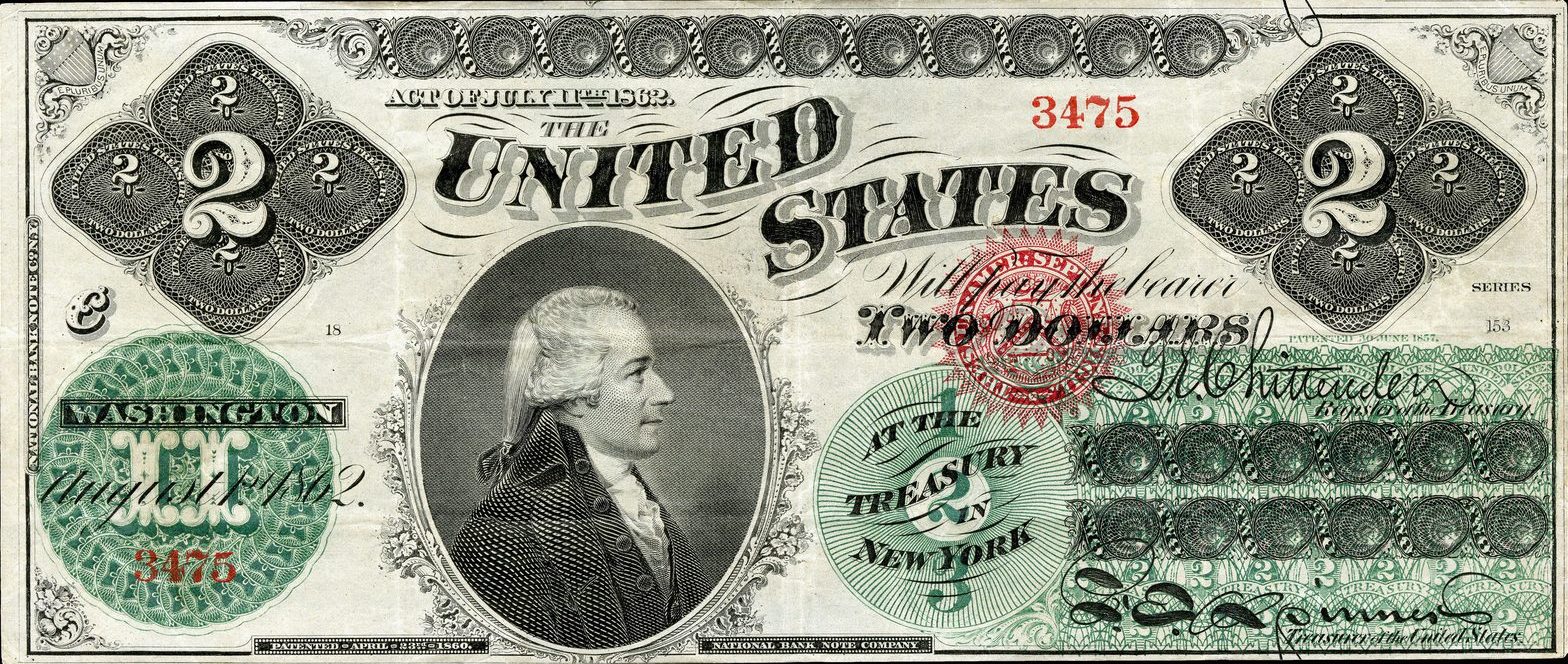
Sources: Wikipedia, "United States two-dollar bill" (portrait, seal) · Friedberg numbers and sales as Heritage titles and records them in its currency archive · CoinNews (the serial number one estimate)
1869 Rainbow $2 Bill Value
- What It Is
- The first $2 with Thomas Jefferson, a Legal Tender Note that collectors call the Rainbow Note. Jefferson has been on the $2 ever since.
- How to Tell It Apart
- Jefferson at left and the U.S. Capitol at center, like the notes of 1874 to 1917, but with a large red seal and a face that, in CoinWeek's words, combines "green, blue, and red hues." It has a single catalog number, Fr. 42.
- What It Sells For
- Heritage sold a PMG Very Good 10 for $610.00 on October 27, 2026, and a PCGS Banknote Gem Unc 65 PPQ for $15,860.00 on October 9, 2026. CoinWeek reports a PMG Gem Uncirculated 65 EPQ at "$31,200 in Stack's Bowers' March 23, 2023 auction." Averages by grade: the 1869 row.
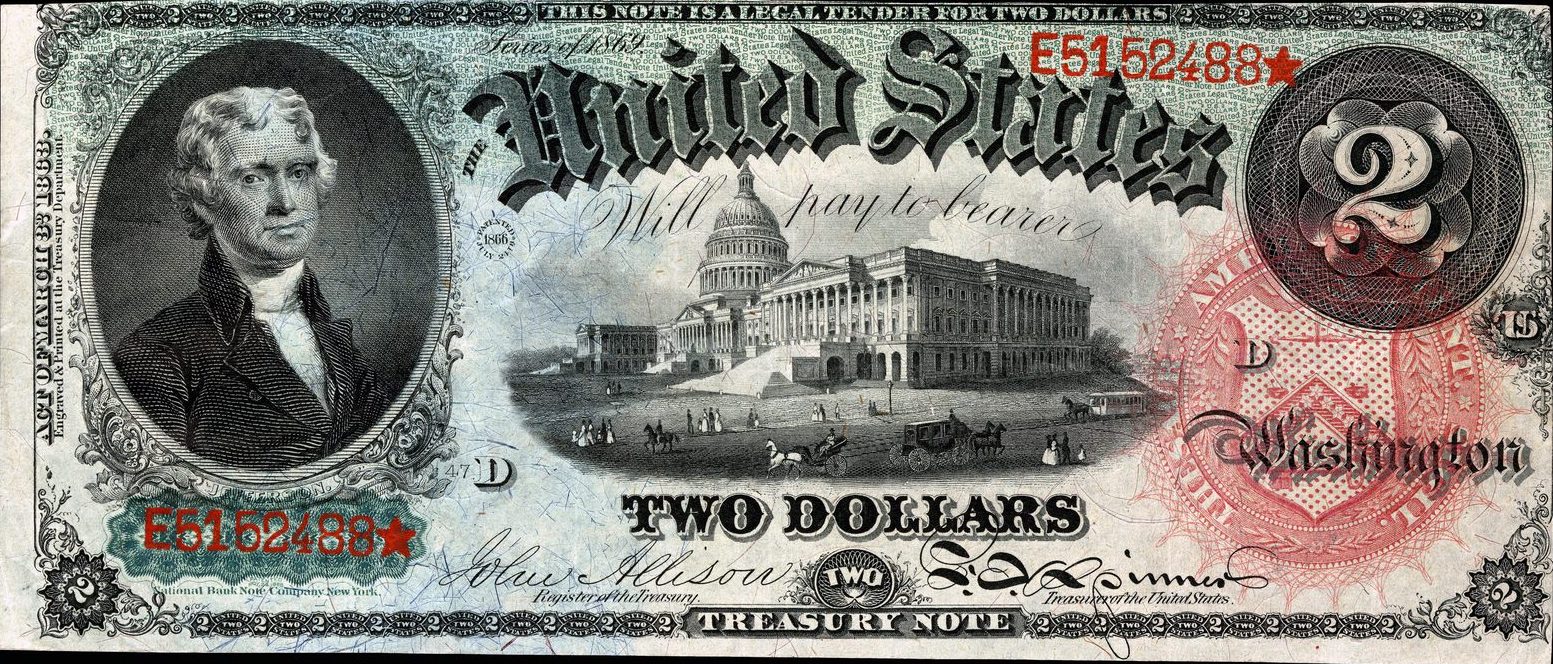
Sources: Wikipedia (design, seal) · Jefferson since 1869 per the Large-Size Era page · CoinWeek on the 1869 Rainbow note (colors, the Stack's Bowers sale) · Heritage sale pages linked above
1874 to 1880 Legal Tender Notes
- What It Is
- Four series of the Jefferson and Capitol Legal Tender Note, 1874, 1875, 1878 and 1880, priced together in one row.
- How to Tell It Apart
- The series year is printed on the face. Series 1874 added "a red floral design around WASHINGTON D.C.," and the 1875 and 1878 notes keep it, with a small red seal with rays. Series 1880 drops the floral design and has a large brown or red seal, or a small red scalloped one. Heritage numbers them Fr. 43 to Fr. 56. A Series 1875 Legal Tender Note is not the 1875 National Bank Note in the next section.
- What It Sells For
- Heritage sold a Fr. 43 Series 1874 graded PMG Very Fine 30 for $1,098.00 on November 3, 2026, and a Fr. 45 Series 1875 graded PCGS Banknote Gem Unc 65 PPQ for $19,520.00 on October 9, 2026. Averages by grade: the 1874 to 1880 row.
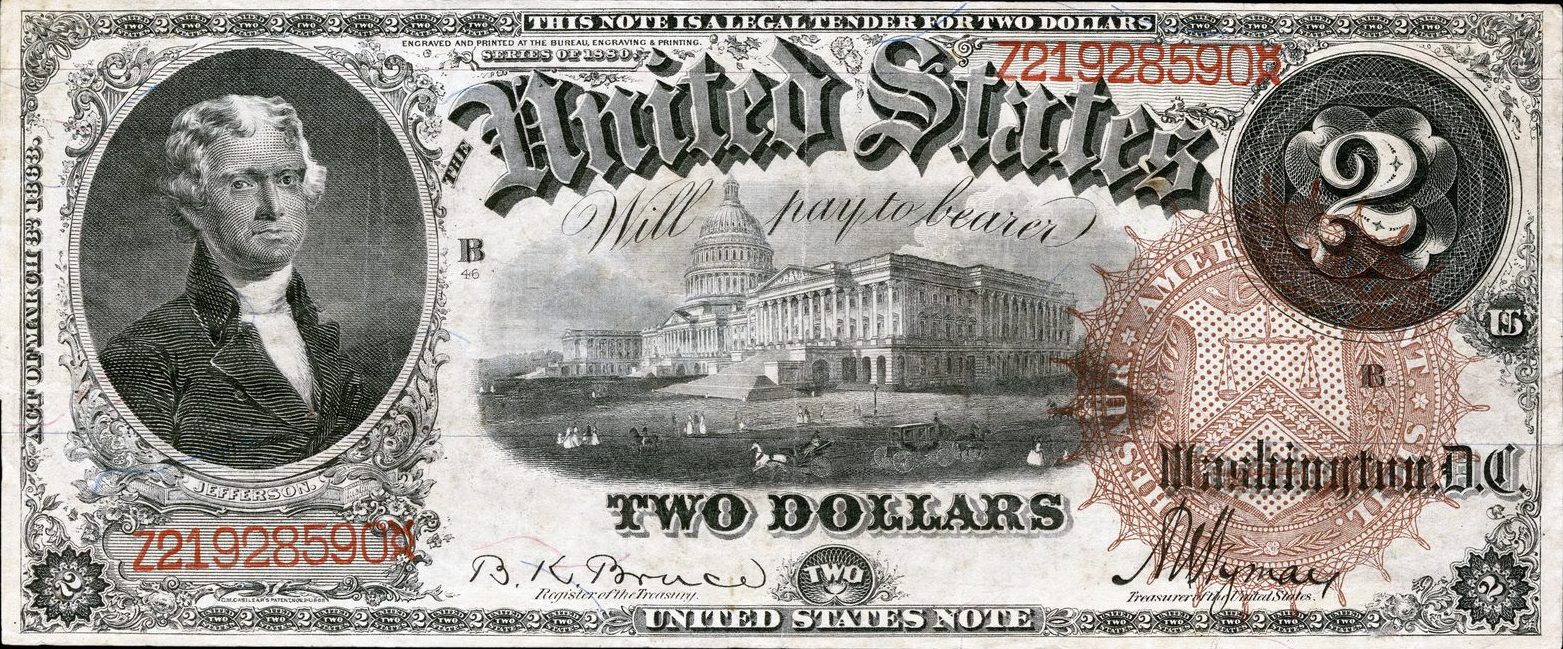
Sources: Wikipedia (the floral design, seals) · Friedberg numbers and sales from Heritage's currency archive, sale pages linked above
1875 Lazy Deuce National Bank Note
- What It Is
- A $2 issued by a chartered local bank on a shared national design. The bank's name, town and charter number are on the face.
- How to Tell It Apart
- "A woman unfurling a flag" and a large 2 lying on its side, which gave the note its nickname, with Sir Walter Raleigh on the back. Heritage titles the earlier notes "Original" (Fr. 387 to Fr. 389) and the later ones "1875" (Fr. 390 to Fr. 393).
- What It Sells For
- The bank and state move the price. One price reference says that "On a Western State an 1875 $2 dollar bill is a rare and wonderful note," and that a Raleigh, North Carolina note "brought 43k" in 2006. Heritage sold a Hyannis, Massachusetts note, Fr. 393, PMG Fine 12 for $4,148.00 and a Hartford, Connecticut note, Fr. 391, PMG Choice Uncirculated 63 EPQ for $18,300.00, both on October 7, 2026. The table puts all banks in one row: the 1875 National Bank Note row.
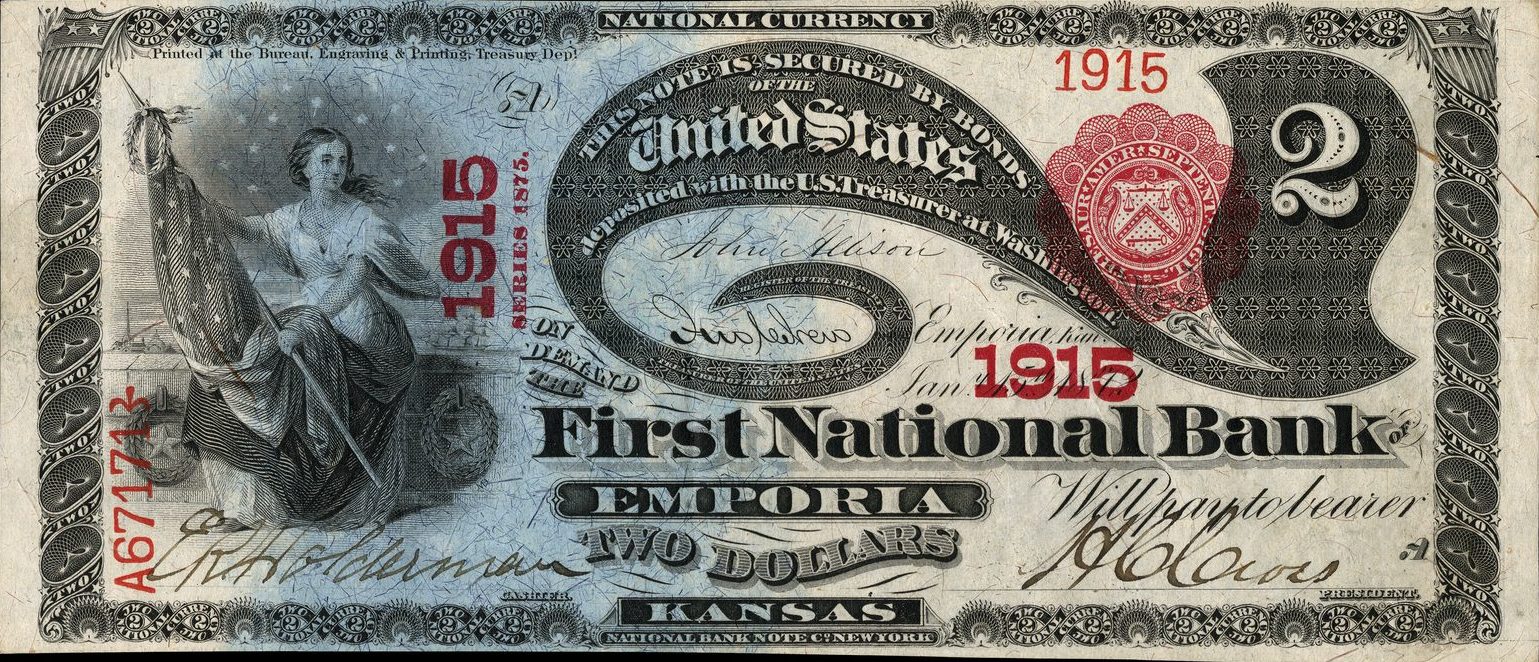
Sources: Wikipedia (design) · bank, town and charter number as Heritage titles each sale · National Currency Values, Series 1875 $2 (the Western States and Raleigh lines, a secondary figure) · Heritage sale pages linked above
1886 $2 Silver Certificate Value (Hancock)
- What It Is
- The first $2 Silver Certificate, a receipt for silver dollars held by the Treasury.
- How to Tell It Apart
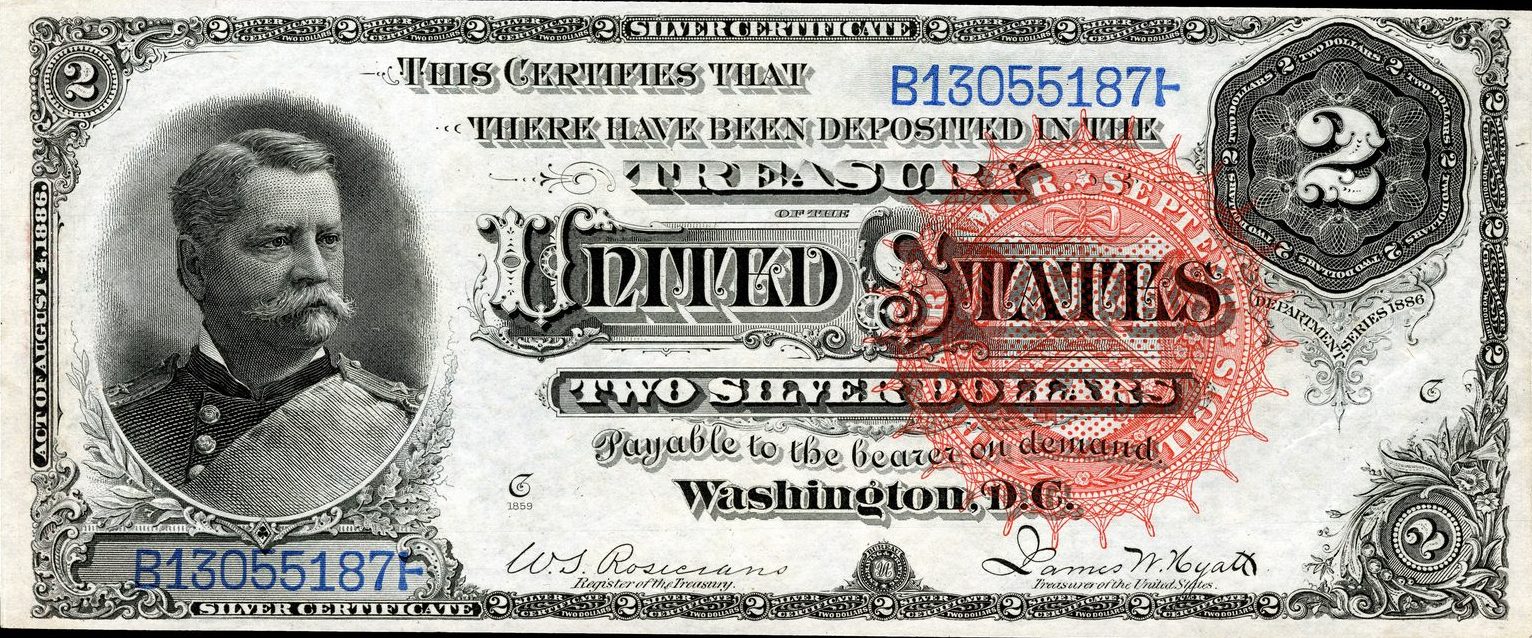
- General Winfield Scott Hancock's portrait "on the left of the obverse," with a large brown or red seal, or a small red scalloped one. Heritage numbers it Fr. 240 to Fr. 244.
- What It Sells For
- Heritage sold a Fr. 244 graded PMG Fine 12 for $536.80 on October 27, 2026, and a Fr. 241 graded PMG Gem Uncirculated 66 EPQ for $9,150.00 on October 9, 2026. Averages by grade: the 1886 row.
Sources: Wikipedia (portrait, seals) · Heritage's currency archive (Friedberg numbers, the sales linked above)
1890 and 1891 Treasury Notes (McPherson)
- What It Is
- A Treasury Note, also called a Coin Note, issued to pay for silver bullion, in two series, 1890 and 1891. Each series has its own row.
- How to Tell It Apart
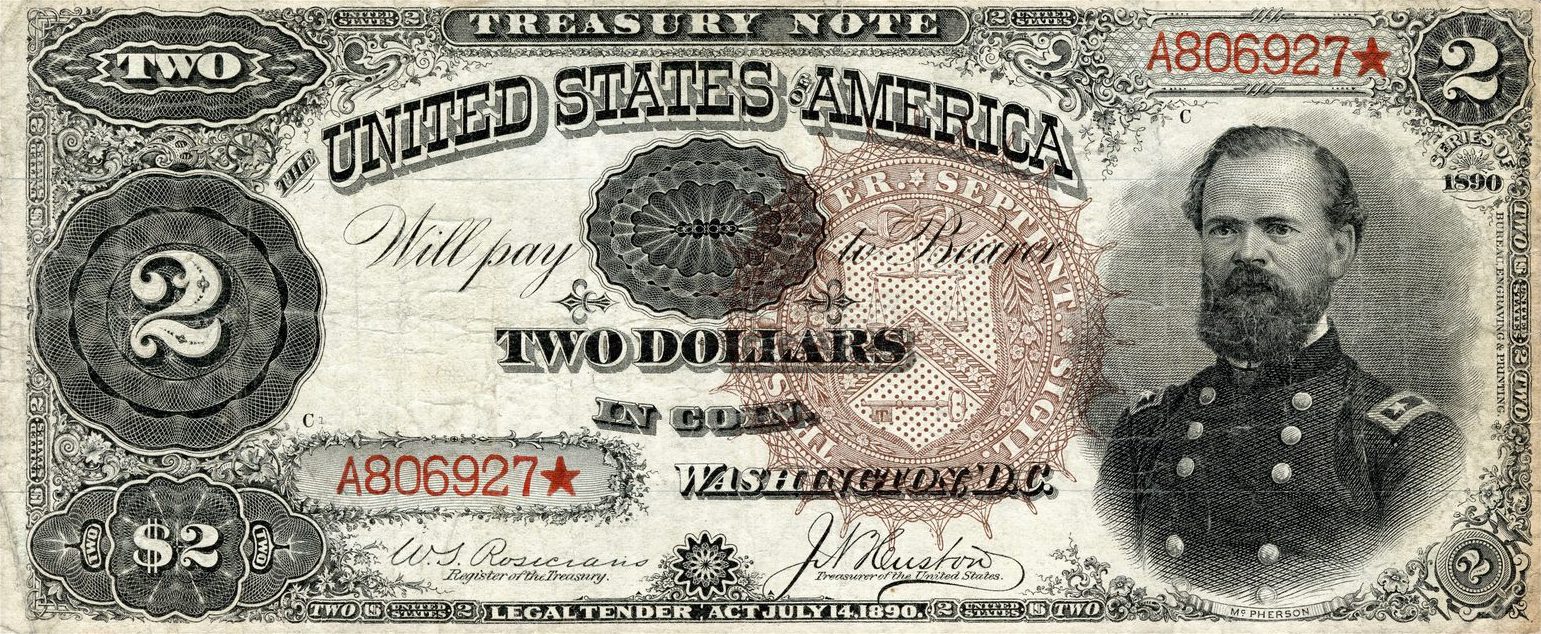
- General James McPherson's portrait on both series. The 1890 back has "large wording of TWO in the center and a numeral 2 to the right"; the 1891 back was redesigned with "more open space." Heritage numbers Series 1890 Fr. 353 to Fr. 355 and Series 1891 Fr. 356 to Fr. 358.
- What It Sells For
- Heritage sold an 1890 Fr. 353 graded PMG Fine 12 for $793.00 on November 3, 2026, an 1890 Fr. 355 graded PCGS Banknote Choice Unc 64 for $16,470.00 on October 9, 2026, and an 1891 Fr. 358 graded PMG Gem Uncirculated 65 EPQ for $5,368.00 on January 16, 2026. For Fr. 354, Greysheet says "only thirty-nine examples known." Averages by grade: the 1890 Treasury Note row and the 1891 Treasury Note row.
Sources: Wikipedia (portrait, the two backs) · McPherson on both series per the Large-Size Era page · Greysheet, Fr. 354 · Heritage's currency archive (Friedberg numbers, the sales linked above)
1891 $2 Silver Certificate (Windom)
- What It Is
- The 1891 Silver Certificate, with Treasury Secretary William Windom. It shares its year with the 1891 Treasury Note above, and each has its own row: the 1891 Silver Certificate row and the 1891 Treasury Note row.
- How to Tell It Apart
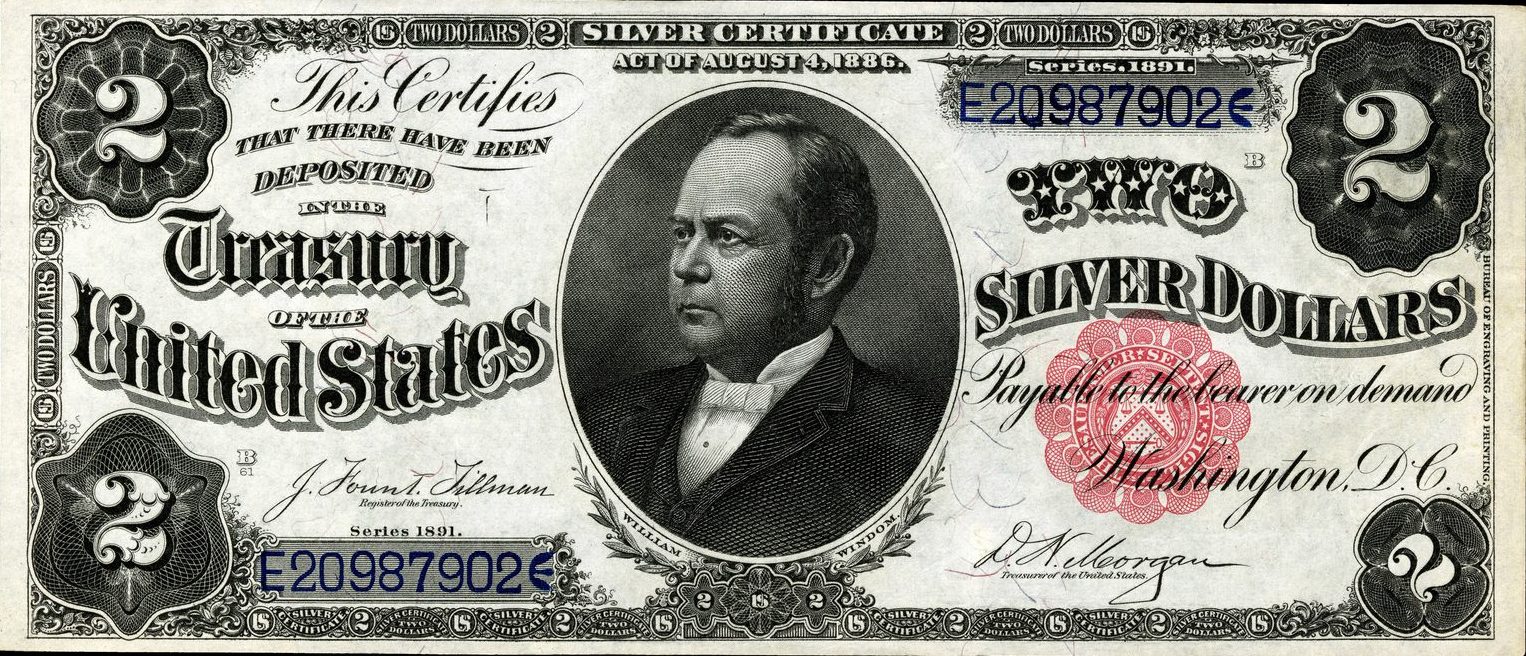
- Windom's portrait sits "in the center of the obverse," with a large red seal or a small red scalloped one; the 1891 Treasury Note carries McPherson instead. Heritage numbers the Silver Certificate Fr. 245 and Fr. 246.
- What It Sells For
- Heritage sold a Fr. 246 graded PMG Choice Very Fine 35 for $2,257.00 on October 8, 2026. An auction sale goes to its row by its Friedberg number, whatever year the house files it under; an eBay sale goes by the year and the kind of note its title names.
Sources: Wikipedia (portraits, seals) · Heritage's currency archive (Friedberg numbers, the sale linked above) · the Friedberg numbers in the sales files behind the Sold Prices page
1896 Educational $2 Bill Value
- What It Is
- The $2 of the 1896 Educational Series of Silver Certificates, which the Bureau calls "some of the most beautiful notes ever produced."
- How to Tell It Apart
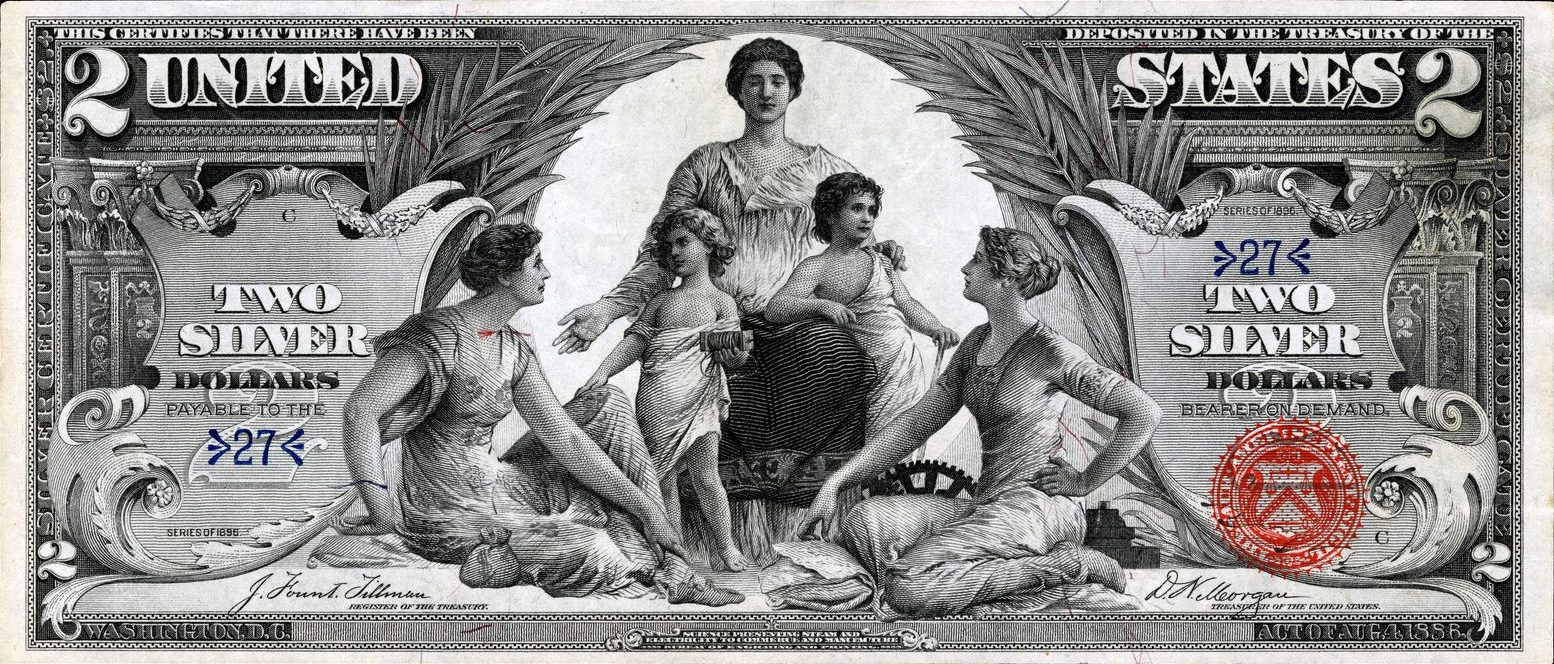
- No portrait on the face, which shows "an allegorical figure of science presenting steam and electricity to commerce and manufacture," and "portraits of Robert Fulton and Samuel F. B. Morse" on the back. A small red seal with rays. Heritage numbers it Fr. 247 and Fr. 248.
- What It Sells For
- Heritage sold a Fr. 247 graded PMG Very Fine 20 for $1,769.00 on November 10, 2026, and a Fr. 248 graded PMG Choice Uncirculated 64 EPQ for $10,675.00 on October 9, 2026. Averages by grade: the 1896 row.
Sources: Wikipedia (face and back, seal) · BEP, "Historical Highlights: $2 Note" (PDF), as quoted on the Large-Size Era page · Heritage's currency archive (Friedberg numbers, the sales linked above)
1899 $2 Silver Certificate Value (Washington)
- What It Is
- The last $2 Silver Certificate and the only $2 with George Washington. The Treasury counted 538,734,000 of them.
- How to Tell It Apart
- "A small portrait of George Washington" between "allegorical figures representing agriculture and mechanics," and a blue seal, the only $2 Silver Certificate with one. Heritage numbers it Fr. 249 to Fr. 258, by signature pair.
- What It Sells For
- Heritage sold a Fr. 249 graded PMG Choice Very Fine 35 EPQ for $976.00 on November 10, 2026, and a Fr. 249 graded PMG Gem Uncirculated 65 EPQ for $3,172.00 on October 8, 2026. Averages by grade, plain and star: the 1899 rows.
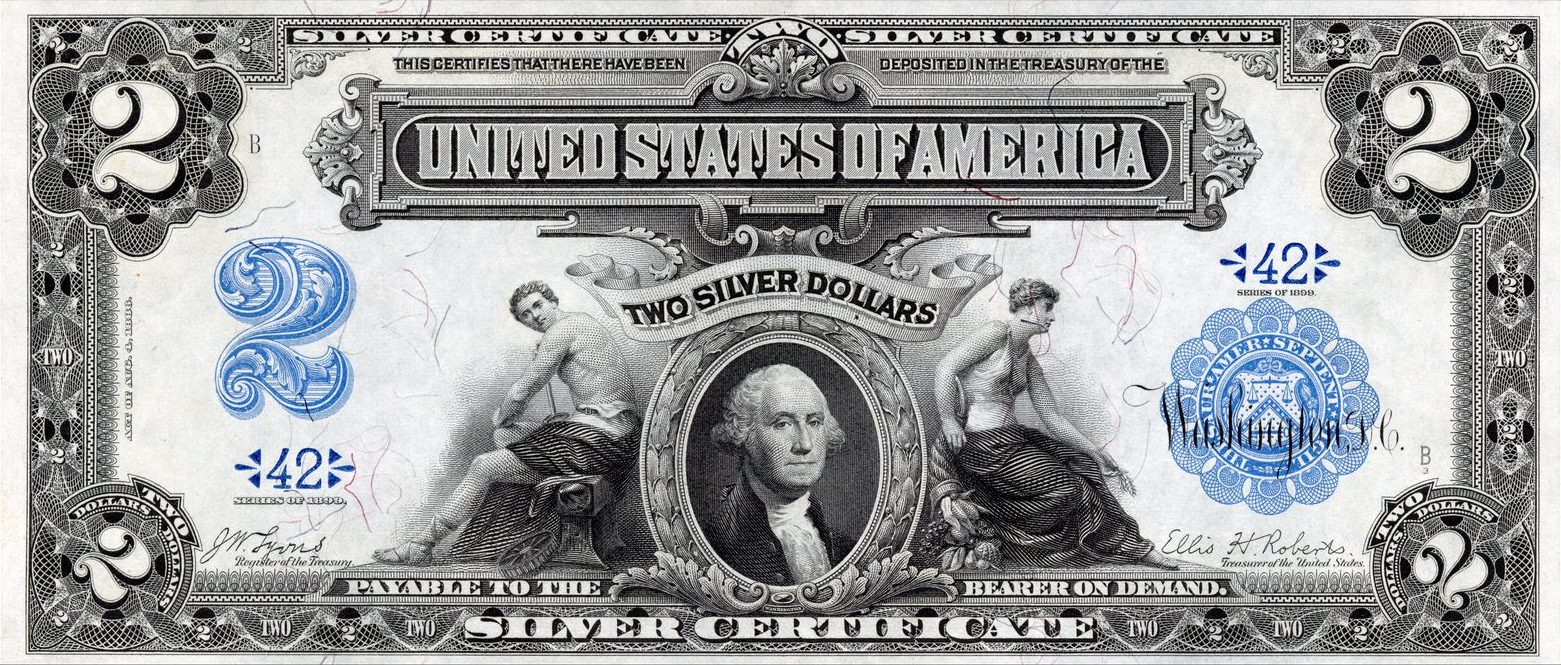
Sources: Wikipedia (design, seals) · Richmond Fed 1976 Economic Review (PDF), Table I (538,734,000) · Heritage's currency archive (Friedberg numbers, the sales linked above)
1917 $2 Bill Value (Legal Tender Note)
- What It Is
- The last large-size $2 Legal Tender Note, the Jefferson and Capitol design one final time, printed in large numbers: 317,416,000.
- How to Tell It Apart
- The Jefferson and Capitol face with the 1917 series date, a small red scalloped seal and, by then, red serial numbers. Heritage numbers it Fr. 57 to Fr. 60.
- What It Sells For
- Heritage sold a Fr. 60 graded PMG Choice Very Fine 35 EPQ for $427.00 and a Fr. 60 graded PMG Choice Uncirculated 63 EPQ for $732.00, both on November 10, 2026. Averages by grade, plain and star: the 1917 rows.
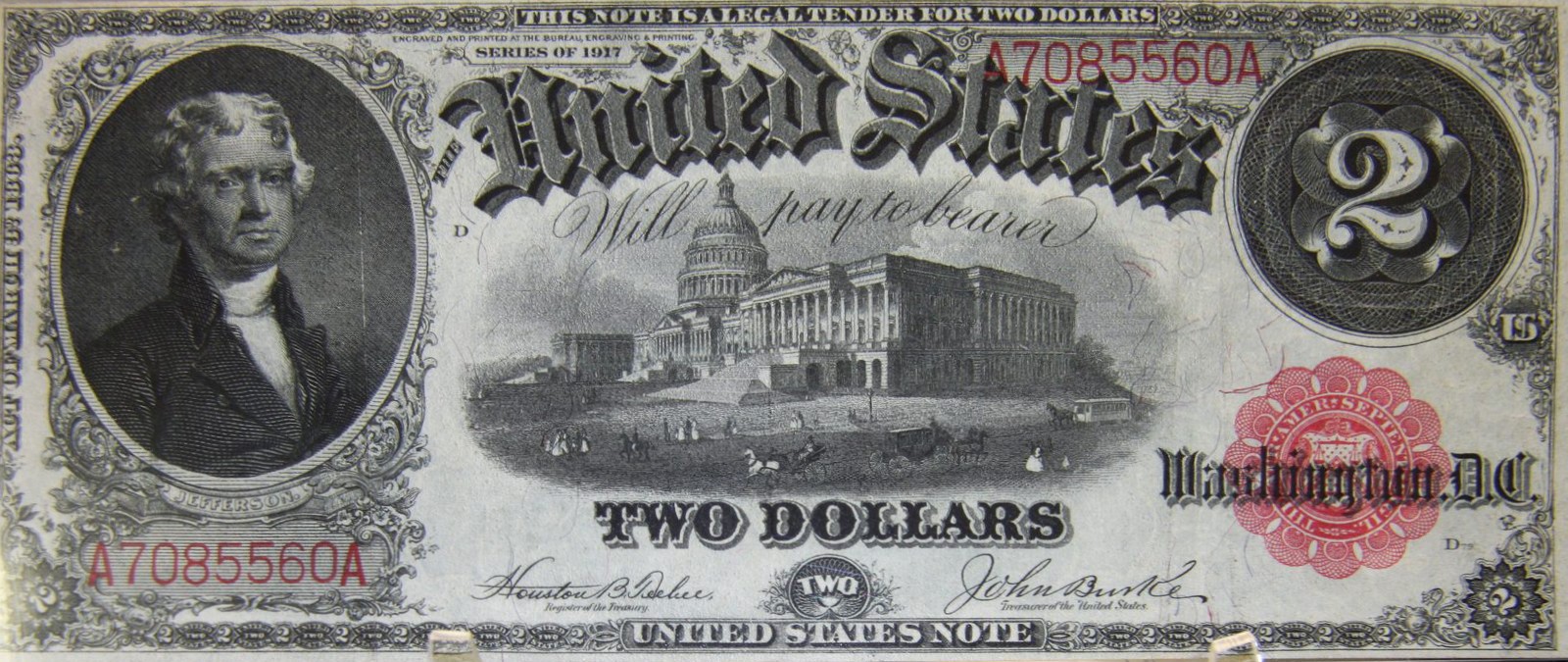
Sources: Wikipedia (seal, serial color) · Richmond Fed 1976, Table I (317,416,000) · Heritage's currency archive (Friedberg numbers, the sales linked above)
1899 and 1917 Mules: What They Sold For
A mule's back was printed from a plate made for another series or set of signers, so its two plate numbers don't match. It is a variety, not an error: the note was printed as the Bureau meant. Friedberg lists the 1899 and 1917 mules under their own numbers, w/ an m (Fr. 258m, Fr. 59m, Fr. 60m), and the grading services name them on the holder.
| Note and Grade | Mule, Auction Sales | Mule, eBay Sales | Regular Note, Auction Sales | Mule Against Regular |
|---|---|---|---|---|
| 1899, Worn | Average$336.00 SalesSee All 59 PhotosHeritage: 51 Sales, Median Paid $324.00
Stack's Bowers: 8 Sales, Median Paid $618.00
| Average$549.78 SalesSee All 17 PhotoseBay: 18 Sales, Median Paid $549.78
| Average$396.00 | 15% Less |
| 1899, Crisp | Average$1,761.68 SalesSee All 9 PhotosHeritage: 9 Sales, Median Paid $1,761.68
| Average$1,595.00 | Average$900.00 | 96% More |
| 1899, Uncirculated | Average$3,072.00 SalesSee All 2 PhotosHeritage: 2 Sales, Median Paid $3,072.00
| Average$2,499.95 | Average$1,453.20 | Not Enough Sales |
| 1899, Top Grade | Average$2,520.00 | No recorded sale | Average$2,880.00 | Not Enough Sales |
| 1899 Star, Worn | Average$1,708.00 SalesSee All 3 PhotosHeritage: 3 Sales, Median Paid $1,708.00
| No recorded sale | Average$1,512.00 | 13% More |
| 1917, Worn | Average$228.00 SalesSee All 27 PhotosHeritage: 25 Sales, Median Paid $228.00
Scotsman: 1 Sale, Median Paid $1,298.00
Stack's Bowers: 1 Sale, Median Paid $216.00
| Average$228.27 SalesSee All 4 PhotoseBay: 4 Sales, Median Paid $228.27
| Average$198.00 | 15% More |
| 1917, Crisp | Average$384.00 SalesSee All 8 PhotosHeritage: 8 Sales, Median Paid $384.00
| Average$390.00 | Average$336.00 | 14% More |
| 1917, Uncirculated | Average$660.00 SalesSee All 7 PhotosHeritage: 5 Sales, Median Paid $630.00
Stack's Bowers: 2 Sales, Median Paid $690.00
| Average$475.00 SalesSee All 3 PhotoseBay: 3 Sales, Median Paid $475.00
| Average$528.00 | 25% More |
| 1917, Top Grade | Average$2,595.00 SalesSee All 4 PhotosHeritage: 3 Sales, Median Paid $1,830.00
Stack's Bowers: 1 Sale, Median Paid $3,360.00
| No recorded sale | Average$960.00 | 2.7x |
| 1917 Star, Worn | Average$528.00 SalesSee All 12 PhotosHeritage: 12 Sales, Median Paid $528.00
| Average$1,050.00 | Average$366.00 | 44% More |
| 1917 Star, Crisp | Average$2,280.00 SalesSee the PhotoStack's Bowers: 1 Sale, Median Paid $2,280.00
| No recorded sale | Average$1,560.00 | Not Enough Sales |


166 mule sales on file, buyer's premium included, as paid. An eBay mule counts when its PMG or PCGS holder names it; 27 more eBay listings call a raw note a mule and stay out of every figure, as do 4 ungraded sales. Regular notes: auction sales of the same series and grade. Definition: PMG, Learn Grading: What Is a Mule?
1918 $2 Battleship Note Value
- What It Is
- The last large-size $2, a Federal Reserve Bank Note: an obligation of the one Reserve Bank named on it, issued for all twelve districts.
- How to Tell It Apart
- "A borderless portrait of Thomas Jefferson to left," the bank's name across the face, a blue seal, and "a World War I battleship" on the back. Heritage numbers it Fr. 747 to Fr. 780, by district and signatures.
- What It Sells For
- Heritage sold a Fr. 751 graded PMG Very Fine 25 for $976.00 on November 10, 2026, and a Fr. 765 graded PCGS Gem New 66PPQ for $4,392.00 on October 8, 2026. Averages by grade, plain and star: the 1918 rows.
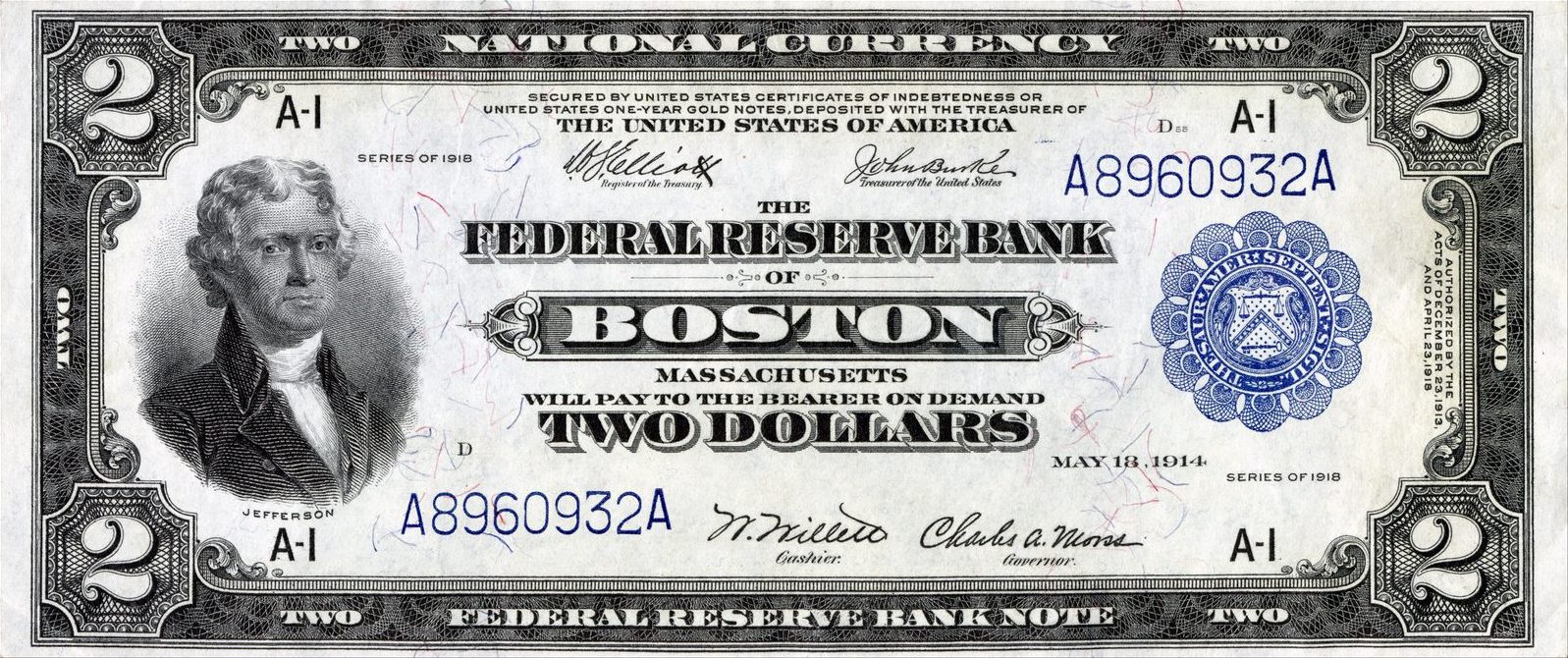
Sources: Wikipedia (design, seal) · the twelve districts per the Large-Size Era page · Heritage's currency archive (Friedberg numbers, the sales linked above)
Questions About Large-Size $2 Bill Value
How Much Is an Old $2 Bill Worth?
If it is a large-size note, 1862 to 1918, far more than two dollars, even worn. The lowest Average in the table is $152.09, for a worn 1917 Legal Tender Note; Heritage sold one graded PMG Choice Very Fine 35 EPQ for $427.00 in November 2026. In Top Grade, six series and the 1899 and 1918 star rows have five-figure Averages. Notes from 1928 on are priced on the How Much Is a $2 Bill Worth? page.
What Is an 1869 Rainbow $2 Bill Worth?
A worn one has an Average of $1,491.75 from 233 worn sales. In Top Grade the Average is $29,868.00 from 15 sales. Heritage sold a PCGS Banknote Gem Unc 65 PPQ for $15,860.00 in October 2026, and CoinWeek reports a PMG Gem Uncirculated 65 EPQ at "$31,200" in a Stack's Bowers auction of March 23, 2023.
What Is a Lazy Deuce $2 Worth?
The 1875 National Bank Note, named for the 2 lying on its side, has the highest Worn Average in the table, $3,480.00 from 482 worn sales. The bank and state move the price. One price reference reports a Raleigh, North Carolina note that "brought 43k" in 2006.
What Is an 1896 Educational $2 Bill Worth?
A worn one has an Average of $1,128.60 from 682 worn sales, and an Uncirculated one $7,833.00 from 68 Uncirculated sales. Heritage sold a Fr. 248 graded PMG Choice Uncirculated 64 EPQ for $10,675.00 in October 2026.
What Is an 1899 $2 Silver Certificate Worth?
A worn one has an Average of $350.00 from 3,067 worn sales. A worn star note has an Average of $1,426.44 from 69 worn sales. Heritage sold a Fr. 249 graded PMG Gem Uncirculated 65 EPQ for $3,172.00 in October 2026.
What Is a 1918 $2 Battleship Note Worth?
A worn one has an Average of $818.99 from 1,355 worn sales, and a worn star note $2,562.00 from 53 worn sales. Heritage sold a Fr. 765 graded PCGS Gem New 66PPQ for $4,392.00 in October 2026.
Sources: the Sold Prices page for the Averages, and the sections above for each sale and quote.