F 00000001 *
How Much Is a 2013 $2 Bill Worth?
Two dollars, almost always. Series 2013 was printed for six years and every district, which makes it the note most people find in a bank strap. This page gives the figures by condition, every district's run, the three star runs and the caveat on one of them, and what the sold records show against what the headlines claim.
The Fast Answer
Every figure below is quoted from the source in its row. The evidence column uses the tiers on the Editorial Standards page: a realized sale is what somebody paid, with the venue and date; a dealer asking price is what a dealer lists; a secondary figure is a press summary, an aggregator, a price guide, or an estimate. No house-reported sale of a Series 2013 $2 was found, and the reason is stated at the end of the page.
| Note | Reported Figure | Evidence Type | Source |
|---|---|---|---|
| Circulated, ordinary serial | "Most of these bills in circulated condition will only be worth their face value of $2"; a value site agrees, "face value of $2"; a press summary says a $2 bill is "typically worth $2 if it was produced between 1976 and 2013" | Dealer asking price; secondary (press) | Silver Recyclers, 2013 $2 value guide, Scripps News |
| Uncirculated, ordinary serial | "around $4 in uncirculated condition with an MS 63 grade"; "$3-$5" per a value site; an aggregator's UNC-63 figure is $5.99 from 43 records | Dealer asking price; secondary (aggregator) | Silver Recyclers, 2013 $2 value guide, Serial Worth |
| Gem grades, ordinary serial | "$25-$100+" for "Gem Uncirculated (PMG 65+)" per a value site; the aggregator's figures are $24.49 at GEM-66 (4 records), $27.99 at GEM-67 (4 records), and $55.00 at GEM-68 (5 records) | Dealer asking price; secondary (aggregator) | 2013 $2 value guide, Serial Worth |
| Star note, Atlanta (F), 640,000 printed | "around $45 in uncirculated condition with an MS 63 grade" per a dealer; "$25-$160+ uncirculated" per a value site, which says a PMG 67 "recently sold for $49" and a low serial "commanded $160"; a price guide gives 2013 stars "$2.50-$4.25" in F-XF and "$5.+" uncirculated; a Very Fine example was estimated $6 to $10 by a small house in August 2021 | Dealer asking price; secondary (price guide, dealer-reported sale, estimate) | Silver Recyclers, 2013 $2 value guide, U.S. Currency Auctions, Invaluable |
| Star note, New York (B), 3,200,000 printed | "around $20 in uncirculated condition with an MS 63 grade" per a dealer; "$5-$15 uncirculated" per a value site; an aggregator's figures for 2013 stars of any district are $6.50 circulated, $9.99 uncirculated, and $25.99 at "premium" grades | Dealer asking price; secondary (aggregator) | Silver Recyclers, 2013 $2 value guide, Serial Worth |
| Star note, San Francisco (L), 1,408,000 reported | "around $20 in uncirculated condition with an MS 63 grade"; no other source on this site prices the San Francisco star separately, and its run size carries the caveat below | Dealer asking price | Silver Recyclers |
| Fancy serial number | $1,320 for A02222222A, a binary one digit short of a solid (July 2022); $780 for A02222220A, a radar (July 2022); $504 for L04444440A, a radar (November 2021); $480 for C00777777A (July 2022) | Secondary (aggregator) | Serial Worth |
| Low serial number | No sale of a plain 2013 note with a low serial was found; a value site reports an Atlanta star with a low serial at $160 | Secondary (dealer-reported sale) | 2013 $2 value guide |
| Genuine printing error | No house-reported error sale was found. A value site says a "dramatically miscut bill" was "listed for $1,499 on eBay," which is an asking price, not a sale | Secondary (asking price) | 2013 $2 value guide, Errors and Auction Records |
Sources are linked in each row. The sales are repeated with dates and grades in the table further down. No figure on this page is an appraisal of a particular note; each is what another note brought or what a dealer asked.
How to Identify a Series 2013 Note
Read the Series Line
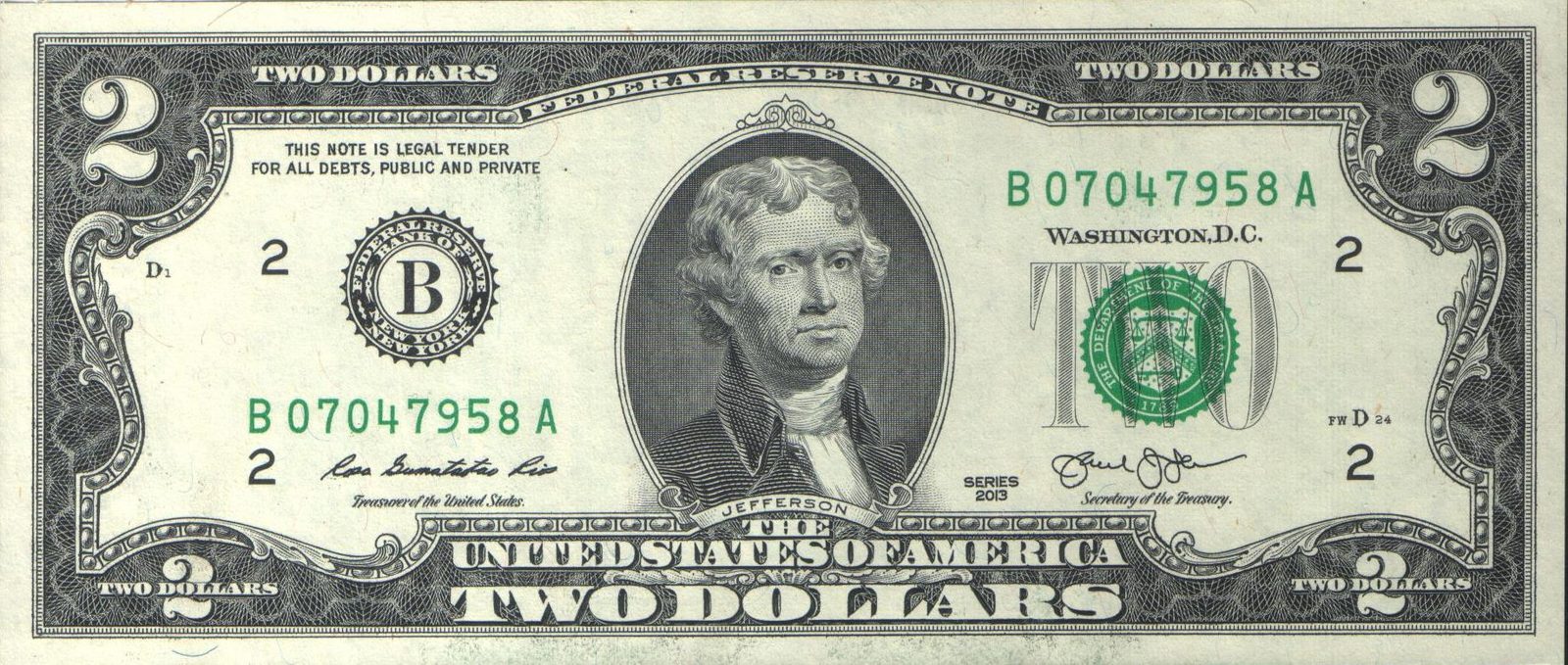
"SERIES 2013" is printed to the right of Jefferson's portrait. The signatures are Rios (Treasurer) at lower left and Lew (Secretary of the Treasury) at lower right: Rosie Rios and Jacob J. Lew, the only pair used on the series.
Read the District
The black seal at left names the Federal Reserve Bank and the same letter, A through L, begins the serial number. Series 2013 was issued for all twelve districts, so the letter alone does not make a note scarce; the print run behind it, in the table below, does. A star in place of the suffix letter marks a replacement note.
Look for FW
"All Series 2013 $2's were printed at Fort Worth, TX," so every genuine note carries the small "FW" beside the face plate number. Catalogs list the series as Friedberg 1940 with the district letter as a suffix, Fr. 1940-A through Fr. 1940-L, and a star for replacements.
Sheet Notes Carry the K Block
Uncut sheets of Series 2013 were printed in the Dallas (K) block "with higher serials" than the circulation notes, and the Bureau put the Series 2013 $2 sheet on sale February 22, 2016. A Dallas note with a serial above 96000000 came from a sheet; it is genuine, and the Uncut Sheets page explains why.
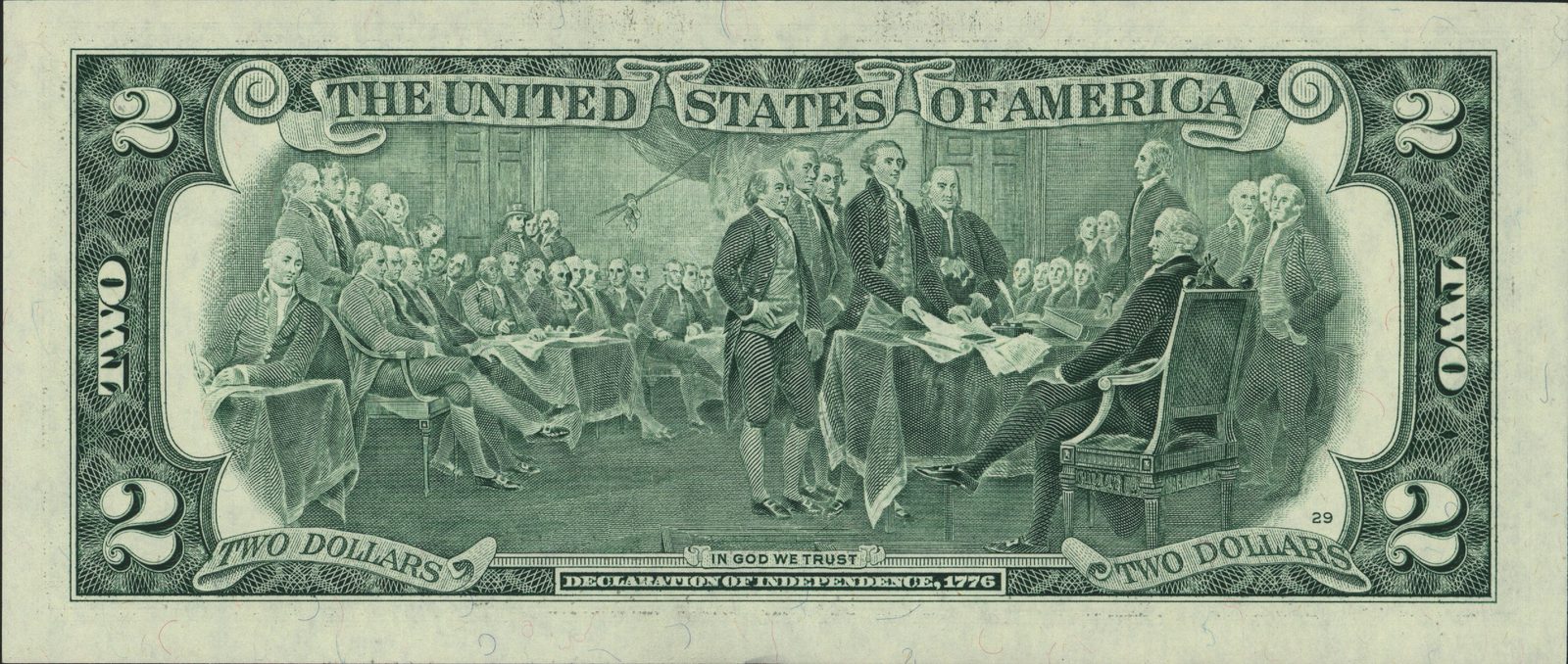
Sources: USPaperMoney.info, Series 2013 $2 (print months, signatures, Fort Worth, sheets) · 2013 $2 value guide (the signers' full names) · USPaperMoney.info, uncut sheets (the K block) · sheet release date per the Uncut Sheets page · BEP, Serial Numbers
The Longest Modern Run
Series 2013 was printed from November 2013 to August 2019, longer than any other $2 series, because the Federal Reserve ordered $2 notes in fits and starts. Its orders were 44,800,000 for fiscal 2014, 32,000,000 for 2015, and 179,200,000 for 2016, then nothing for 2017 and 2018 because "the FY 2016 order included notes needed to meet demand for multiple years." The Bureau's annual reports show the same shape: 32,000,000 notes in fiscal 2014 and again in 2015, 179,200,000 in 2016, and 160,000,000 in 2019, when the last Series 2013 notes and the first Series 2017A notes were printed in the same year. The month-by-month runs are on USPaperMoney.info; the totals per district are below.
| District | Printed | Regular Notes | Star Notes |
|---|---|---|---|
| A Boston | June 2016 | 6,400,000 | 0 |
| B New York | January 2015, May and June 2016; stars June 2016 | 57,600,000 | 3,200,000 |
| C Philadelphia | June 2016 and August 2019 | 12,800,000 | 0 |
| D Cleveland | June 2016 | 6,400,000 | 0 |
| E Richmond | October and December 2015 | 12,800,000 | 0 |
| F Atlanta | November 2013, July 2016, November 2018; stars November 2013 | 44,800,000 | 640,000 |
| G Chicago | July 2016 | 12,800,000 | 0 |
| H St. Louis | July 2016 | 6,400,000 | 0 |
| I Minneapolis | July 2016 | 6,400,000 | 0 |
| J Kansas City | July 2016 | 6,400,000 | 0 |
| K Dallas | June 2014, January, September, and October 2015 | 38,400,000 | 0 |
| L San Francisco | January and May 2016, November 2018; stars November and December 2015 | 89,600,000 | 1,408,000 reported |
| Total | 300,800,000 | 5,248,000 |
Six districts got a single run of 6,400,000: Boston, Cleveland, St. Louis, Minneapolis, Kansas City, and Philadelphia's first run. That is the smallest regular run of the series, and it is still 6.4 million notes; no Series 2013 district is scarce in absolute terms, and no source on this site prices one district's regular notes above another's.
Sources: USPaperMoney.info, Series 2013 $2 (every run and month, the statistics table) · Federal Reserve print orders and BEP annual figures as tabulated on the Series and Production page, from the Board's 2017 order and the BEP Annual Production Reports
The Three Star Runs
Series 2013 has three star districts, and they are not alike. Atlanta's 640,000 stars were printed with the first regular notes in November 2013. New York's 3,200,000, printed in June 2016, are the common 2013 star and the one most often found in straps. San Francisco's two runs are the ones with an asterisk on the asterisk.
| District | Printed | Serial Range | Notes | Status |
|---|---|---|---|---|
| F Atlanta | November 2013 | F00000001* to F00640000* | 640,000 | Confirmed |
| L San Francisco, run 1 | November 2015 | L00000001* to L00128000* | 128,000 | Confirmed; one of the two smallest confirmed modern $2 star runs |
| L San Francisco, run 2 | December 2015 | L03200001* to about L04480000* | 1,280,000 estimated | Reported; the end of the range is a guess |
| B New York | June 2016 | B00000001* to B03200000* | 3,200,000 | Confirmed |
Reported-Range Caveat
USPaperMoney.info: "Run #2 of the San Francisco star notes was reported as ending at L 044 00000 *, but higher serials have been observed. The estimated ending serial given in the table is a guess; reports of additional notes that would help to pin down the length of this run would be helpful." The 1,408,000 San Francisco total on this site, and on the Star Notes page, is therefore 128,000 confirmed plus an estimate. A second compilation, MyCurrencyCollection, carries the same two runs with the second marked "1,280,000 est," so no source settles it. The star lookup on the Star Notes page labels this run "Reported" for that reason.
What the run sizes mean for price is less than the numbers suggest. The dealer guidance quoted on the Star Notes page puts a real premium on runs "under 640,000"; the Atlanta run sits exactly at that line and the San Francisco first run is well under it, yet the same dealer asks "around $45" for an Atlanta star and "around $20" for a San Francisco star, and the aggregator's uncirculated figure for a 2013 star of any district is $9.99. A 128,000-note run is small on paper and still 128,000 notes.
Sources: USPaperMoney.info, Series 2013 $2 (ranges, months, the caveat) · MyCurrencyCollection, $2 star note production tables (the second compilation) · Silver Recyclers · Serial Worth · run-size guidance per GovMint as quoted on the Star Notes page
Condition and Grading
Series 2013 notes are still in bank straps, so an unfolded note is the normal case and the grade a service assigns is what separates $4 from $55. The aggregator's ladder for an ordinary serial runs $5.99 at UNC-63 (43 records), $24.49 at GEM-66 (4 records), $27.99 at GEM-67 (4 records), and $55.00 at GEM-68 (5 records); the value site's "$25-$100+" for PMG 65 and up covers the same ground with a wider top. In PMG's definitions a 65 Gem Uncirculated "may have one or two minor distractions as a result of minor handling. The centering must be above average"; a 64 Choice Uncirculated has centering "off on one or two sides" but "no folds in the design"; a 58 is "often a note with a single fold that crosses the design." One center fold takes a note out of the uncirculated grades, and with it out of every figure above face value on this page.
Sources: Serial Worth · 2013 $2 value guide · PMG Grading Scale
Hype Versus Demonstrated Premium
Every year or so a headline announces that a $2 bill "could be worth thousands," and Series 2013 notes, the ones most people have, get searched. The articles are not wrong about the notes they describe; they are about different notes. The Atlanta Journal-Constitution's November 2023 version, citing Heritage, says a serial number 1 on a 1976 note "would be worth $20,000 or more," that large-size notes from before 1918 are "much more collectible," and that for 1920s bills and later "well over 99% are going to be worth marginally over face value." A Scripps News summary of the same auction-house chart goes further than the evidence in the other direction: "a $2 bill is typically worth $2 if it was produced between 1976 and 2013. Even an uncirculated $2 bill won't be worth more than face value if it was printed after 1976." A consumer guide updated June 2026 puts it plainly: "the widely-shared claim that every old $2 is worth hundreds is simply false," and lists 2013 among the series "printed in enormous quantities" whose notes are "worth exactly $2."
The demonstrated premium sits between those two poles, and it is documented. An uncirculated ordinary note asks "around $4" and the aggregator's UNC-63 figure is $5.99, so Scripps' "not worth more than face value" understates it by a few dollars. The highest price on record for any Series 2013 $2 on this site is $1,320, for a binary serial (A02222222A) at GEM-67; the next are radars at $780 and $504. The highest for a star is the value site's $160 for an Atlanta star with a low serial, and its $49 for a PMG 67 Atlanta star is the only graded-star sale it names. Nothing found approaches "thousands," and no Series 2013 note appears in any house-reported sale on this site. A 2013 note is worth more than $2 when it is uncirculated, and worth hundreds only when its serial number is one collectors chase.
Sources: The Atlanta Journal-Constitution, November 10, 2023 · Scripps News · Follow the Money, "Are $2 Bills Worth Anything?" · Silver Recyclers · Serial Worth · 2013 $2 value guide
Sales on Record
Every row is an aggregator's record, which carries the serial, grade, date, and price but not the auction house, and is listed as secondary evidence for that reason, or a small house's estimate. Five rows fall on July 24, 2022, the date of Heritage's Skourtes Collection sale of fancy-serial $2 notes.
| Date | Note | Grade | Price | Evidence | Source |
|---|---|---|---|---|---|
| July 24, 2022 | A02222222A, binary, one digit short of a solid (Skourtes sale date) | GEM-67 | $1,320 | Secondary (aggregator) | Serial Worth |
| July 24, 2022 | A02222220A, radar (Skourtes sale date) | GEM-69 | $780 | Secondary (aggregator) | Serial Worth |
| November 16, 2021 | L04444440A, radar | GEM-67 | $504 | Secondary (aggregator) | Serial Worth |
| July 24, 2022 | C00777777A, binary (Skourtes sale date) | GEM-65 | $480 | Secondary (aggregator) | Serial Worth |
| July 24, 2022 | K01011010A, radar (Skourtes sale date); the same note brought $312 on April 16, 2024 | GEM-66 | $336 | Secondary (aggregator) | Serial Worth |
| July 24, 2022 | K07000070A, radar (Skourtes sale date); the same note brought $228 on September 3, 2024 | GEM-67 | $264 | Secondary (aggregator) | Serial Worth |
| November 16, 2021 | D03000000A, binary | UNC-64 | $264 | Secondary (aggregator) | Serial Worth |
| July 24, 2022 | B21111112A, radar (Skourtes sale date) | GEM-68 | $252 | Secondary (aggregator) | Serial Worth |
| Undated | Atlanta star, PMG 67, "recently sold for $49"; an Atlanta star with a low serial "commanded $160" | PMG 67; not stated | $49; $160 | Secondary (dealer-reported sales) | 2013 $2 value guide |
| August 7, 2021 | Atlanta star F00534267*, PhoenixxExchange, Okeechobee, Florida; the price realized is not shown without a login | Very Fine | $6 to $10 estimate | Secondary (estimate) | Invaluable |
What Could Not Be Sourced
Heritage's and Stack's Bowers' lot archives, GreatCollections, PCGS, and Greysheet answered HTTP 403 when this page was written, so no aggregator row above is confirmed against a house record and no lot numbers are given, and no house-reported realized sale of any Series 2013 $2 note, star or plain, was found through PMG, the ANA, the numismatic press, or a dealer's report. No sale of a Series 2013 serial number 1, ladder, solid, or repeater was found. Population report counts for the series were not available. The only Series 2013 duplicate-serial error PMG has written about is a $1 note, not a $2.
Sources are linked in each row. Serial Worth is a value aggregator; its rows are listed as secondary evidence because it does not name the auction house or lot. The July 24, 2022 date matches Heritage's Skourtes Collection sale, per the Collectors Universe forum thread that previewed it. PMG's duplicate serial number article concerns Series 2013 $1 stars.
Questions About the 2013 $2 Bill
How Much Is a 2013 $2 Bill Worth?
Face value if it has been folded. Uncirculated, "around $4" in MS 63 per a dealer guide, $5.99 at UNC-63 per an aggregator, and $25 to $55 in the gem grades. The only Series 2013 notes on record above $500 carried a binary or radar serial number.
Is a 2013 $2 Star Note Worth Anything?
A small premium. A dealer asks "around $45" for an Atlanta star and "around $20" for a New York or San Francisco star in MS 63; an aggregator's figure for an uncirculated 2013 star of any district is $9.99; the highest star sale a value site names is $160, for an Atlanta star with a low serial.
Which 2013 $2 Star Note Is the Rarest?
By print count, the first San Francisco run: 128,000 notes, L00000001* to L00128000*, printed November 2015, one of the two smallest confirmed modern $2 star runs. The second San Francisco run's size is an estimate because notes have been seen past its reported end. Atlanta's 640,000 is next; New York's 3,200,000 is the common star. No source on this site prices the small San Francisco run above the Atlanta star.
Are 2013 $2 Bills Worth Thousands?
No sale found says so. The headlines that say "thousands" are about serial number 1 notes from 1976 and large-size notes from before 1918. The highest Series 2013 record on this site is $1,320 for a binary serial in gem grade; an ordinary uncirculated note brings a few dollars.
Sources: as cited in the sections above, chiefly Silver Recyclers, Serial Worth, 2013 $2 value guide, USPaperMoney.info, and The Atlanta Journal-Constitution.