L 00000002 A
Legal Tender and the Rules
What the statute actually says, what the Federal Reserve actually does, and the one rule most $2 fans get wrong.
Do Stores Have to Accept $2 Bills?
No, and the reason is the same for every bill. The legal tender statute, 31 U.S.C. 5103, reads in full: "United States coins and currency (including Federal reserve notes and circulating notes of Federal reserve banks and national banks) are legal tender for all debts, public charges, taxes, and dues. Foreign gold or silver coins are not legal tender for debts."

Legal tender means the money is a valid offer for a debt. A store sale is not a debt until the store agrees to it. The Federal Reserve's FAQ spells it out: "There is no federal statute mandating that a private business, a person, or an organization must accept currency or coins as payment for goods or services," and "Private businesses are free to develop their own policies on whether to accept cash unless there is a state law that says otherwise." So a clerk can refuse your $2, the same way they can refuse a $100. What they cannot do is call it counterfeit. The Currency Education Program's own $2 sheet: "All U.S. currency remains legal tender, regardless of when it was issued."
Sources: 31 U.S.C. 5103 (Cornell LII) · Federal Reserve FAQ, "Is it legal for a business in the United States to refuse cash as a form of payment?" · U.S. Currency Education Program, $2 note features (PDF)
How a $2 Gets From the Fed to Your Hand
You cannot buy currency from the Federal Reserve: "Federal Reserve Banks provide currency only to depository institutions, which then distribute it to members of the public." Banks order through FedLine, and the Fed's answer to the obvious question is short: "Where can I get $2 bills? Local banks should have $2 bills. If your bank does not have any current inventory, it can order $2 bills from the Federal Reserve Bank."
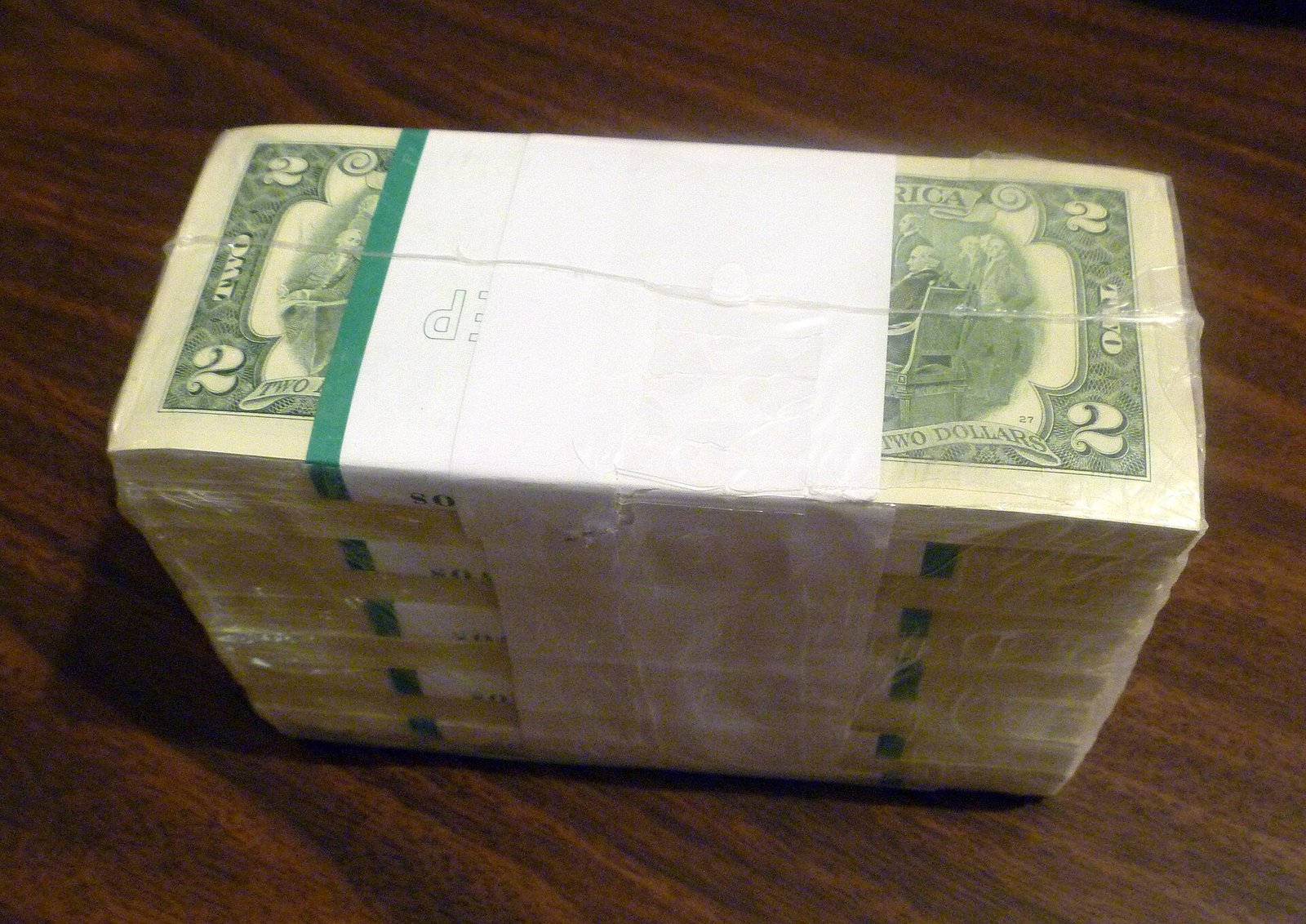
- Strap
- "A strap is a package of 100 notes," so a strap of twos is $200. It weighs 3.52 ounces.
- Bundle
- "A bundle consists of 1,000 notes of the same denomination in ten equal straps of 100 notes each," $2,000 in twos, 2.20 pounds.
- Band Color
- Bands "must be color-coded (along the edges) to conform to existing standards of the American Bankers Association." The Fed's Cash Services Manual of Procedures lists the code: Ones blue, Twos green, Fives red, Tens yellow, Twenties violet, Fifties brown, Hundreds mustard.
- Minimum Order
- The same manual shows the standard strap for twos as "N/A" with a standard bundle of $2,000, which is why a bank that orders twos gets a thousand of them.
Sources: Federal Reserve Financial Services, Currency and Coin FAQ · Currency Depositing and Ordering · Visual Reference Guide · Cash Services Manual of Procedures, March 1, 2019 (PDF), pages 6 and 8
Counterfeiting, Briefly
The $2 has never been redesigned because nobody bothers to fake it: "Because the $2 note is infrequently counterfeited, the government has no plans to redesign this note." The Secret Service says the $20 is the most counterfeited denomination and that "it's unlikely someone will ever encounter a counterfeit banknote" at all. In this site's research, no prosecuted case involving counterfeit $2 notes turned up; the only $2 "counterfeiting" stories in the news involve genuine notes that failed a pen. How to check one properly.
Sources: U.S. Currency Education Program, $2 features (PDF) · U.S. Secret Service, November 20, 2025
Vending Machines
Most bill validators can read a $2; whether they accept one is a setting the operator turns on. The evidence is thin but real: vending changer spec sheets list models that accept "$1, $2, $5" and "$1, $2, $5, $10, $20," and the Federal Reserve Banks' own sorting equipment obviously handles the note. If a machine spits your two back, it is a configuration choice, not a rejection of the money.
The Rule $2 Fans Get Wrong: Photographing Money
Federal law permits color pictures of U.S. currency only under three conditions, in the Bureau of Engraving and Printing's words: the illustration is "of a size less than three-fourths or more than one and one-half, in linear dimension, of each part of the item illustrated"; "the illustration is one-sided"; and the files used to make it "are destroyed and/or deleted or erased after their final use." The citations are 18 U.S.C. 504(1) and 31 CFR 411.1. Black and white reproductions only need to meet the size rule.
The harder line is 18 U.S.C. 475, which forbids using "any business or professional card, notice, placard, circular, handbill, or advertisement in the likeness or similitude of any obligation or security of the United States," and forbids printing or attaching any advertisement to a note. Stamping a tiger paw on a $2 is a Clemson tradition; stamping your business name on one is a federal offense. This site shows each side of a note as a separate image and never places a notice on a note. It is a reference, not legal counsel.
Sources: Bureau of Engraving and Printing, Currency Image Use · U.S. Currency Education Program, Currency Image Use · 18 U.S.C. 475 · 18 U.S.C. 504