A 45360001 A
How Much Is a 1953 $2 Bill Worth?
A few dollars folded, twenty or so crisp, and more only for a star, a gem grade, or a serial number somebody wanted. This page separates Series 1953, 1953A, 1953B, and 1953C by signature and print run and attaches every figure to its source and its evidence type.
The Fast Answer
Every figure below is quoted from the source in its row. The evidence column uses the tiers on the Editorial Standards page: a realized sale is what somebody paid, with the venue and date; a dealer asking price is what a dealer lists; a secondary figure is a press summary, an aggregator's record, or an auction estimate. The four letter series share one design and one set of prices for ordinary notes; the letters matter for star notes and for the print runs further down.
| Note | Reported Figure | Evidence Type | Source |
|---|---|---|---|
| Circulated, ordinary serial, any letter | "$11" in very fine for each of the four series per a dealer guide; an aggregator's figure for VF-20 notes is $7.00 from 103 records; CoinWeek's summary is "approximately face value" | Dealer asking price; secondary (aggregator); secondary summary | Silver Recyclers, Serial Worth, CoinWeek |
| Uncirculated, ordinary serial, any letter | "$23" in MS 63 per a dealer guide; an aggregator's figures are $16.50 for UNC-63 (55 records), $27.00 for GEM-65 (47 records), and $123.38 for GEM-67 (27 records); CoinWeek's range is $20 to $40 and up | Dealer asking price; secondary (aggregator); secondary summary | Silver Recyclers, Serial Worth, CoinWeek |
| Star note, by letter | Dealer guide: "$27" very fine for every letter; MS 63 "$70" for 1953 and 1953A, "$55" for 1953B, "$75" for 1953C. Numismatic News: "stars can be purchased in Gem condition for $100 or less." The aggregator's top star sales run $528 to $747.50 for PMG or PCGS 68 examples | Dealer asking price; secondary summary; secondary (aggregator) | Silver Recyclers, Numismatic News, Serial Worth |
| Solid serial number | The 1953 note A11111111A, PMG 64 EPQ, was offered by Lyn Knight in November 2018 with an estimate of $18,000 to $30,000; the catalog notes that "A total of only eight solid serial numbered $2 1953 - 1963 Legal Tender Notes were printed." A 1953C A77777777A, PMG 35, was estimated $4,000 to $7,000 in the same sale | Secondary (auction estimate) | Lyn Knight, November 2018 catalog |
| Genuine printing error | An inverted overprint on a 1953 note is "extremely rare" per Coin World; an aggregator records a 1953 star with a gutter fold, PMG 68, at $488.75 (January 10, 2011) | Secondary summary; secondary (aggregator) | Coin World, Serial Worth |
| Provenance: Gene Cernan's flown note | $91,519 for a folded Series 1953 note carried on three spaceflights, RR Auction, April 23, 2026. A price for a space artifact, not for a 1953 $2 bill | Realized sale | RR Auction, The $2 Bill in Space |
Sources are linked in each row. The aggregator's grade figures are the values it reports for that grade from the record count shown; its individual sales are repeated with dates and grades further down. No figure on this page is an appraisal of a particular note.
How to Identify a Series 1953 Note
Red Seal, Red Serials, Small Seal
A Series 1953 $2 is a United States Note: red Treasury seal and red serial numbers. Against Series 1928 the seal is smaller and sits to the right over a gray "TWO," and the legal tender obligation sits over a gray numeral 2 at the left. The back is Monticello, unchanged since 1928, without a motto.
Read the Letter and the Signatures
"SERIES 1953," "1953 A," "1953 B," or "1953 C" is printed to the right of the portrait. Each letter is one signature pair: Priest and Humphrey (1953), Priest and Anderson (1953A), Smith and Dillon (1953B), Granahan and Dillon (1953C). Catalogs number them Friedberg 1509 through 1512.
Check for a Star
A replacement note carries a red star in place of the suffix letter at the end of the serial. Every 1953 star serial begins with an asterisk and the block is the same for all four letters, so the letter on the face, not the serial, says which star run a note belongs to.
No Motto Means Not 1963
"IN GOD WE TRUST" above Monticello marks a Series 1963 note, and the 1963 face drops "WILL PAY TO THE BEARER ON DEMAND." A note with the small seal but no motto is 1953. The later series has its own guide.
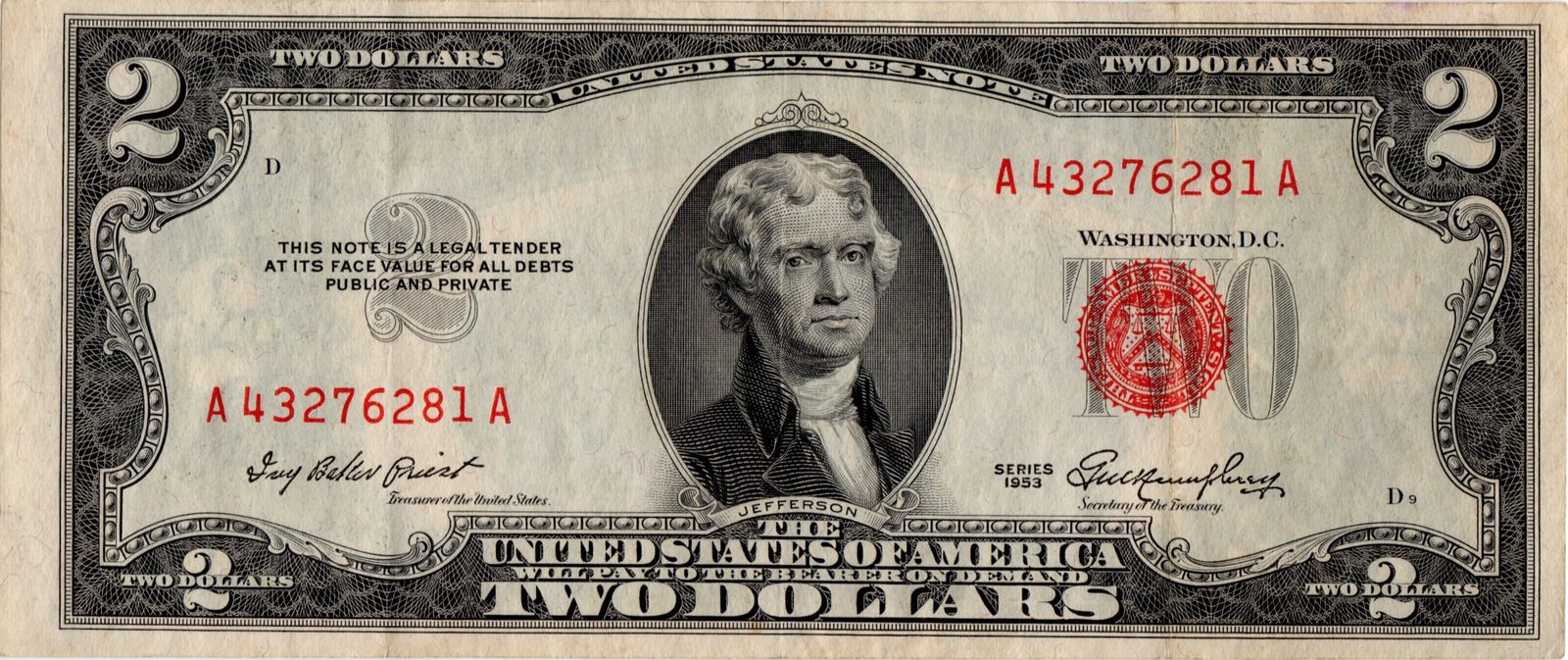
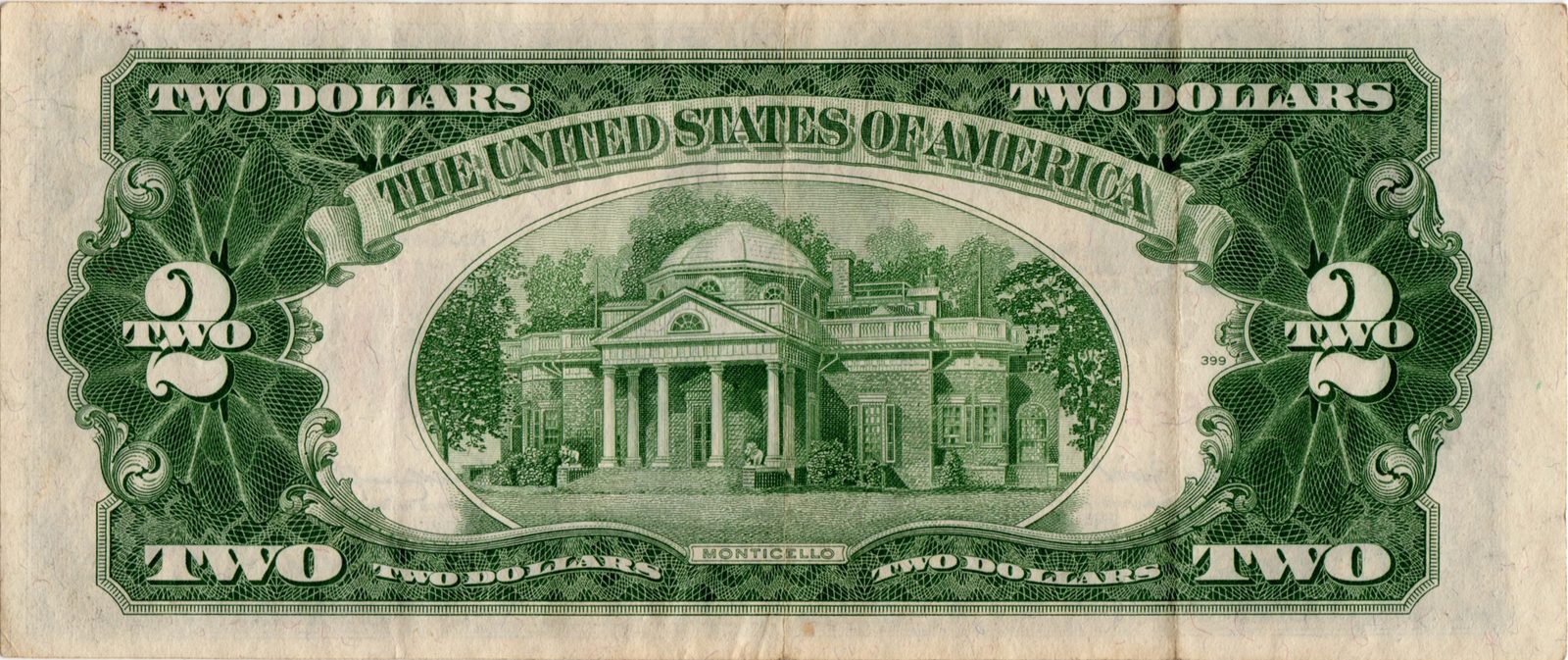
Sources: USPaperMoney.info, Series 1953 $2 (signatures, serial blocks) · design changes per Wikipedia · Friedberg numbers as used by Lyn Knight and PMG
The Four Letters: Signatures and Print Runs
The Treasury's total for the 1953 series is 79,920,000 notes, quoted on the Red Seal Era page from the Federal Reserve Bank of Richmond. USPaperMoney.info's compilation of the Bureau's records splits it by letter and adds the star runs, which total 3,960,000. The letters were printed one after another in a single serial block, so a Series 1953C note has a higher serial number than any 1953.
| Series | Signatures | Delivered to the Treasury | Regular Notes | Star Notes | Serial Block |
|---|---|---|---|---|---|
| 1953 | Priest, Humphrey | "between May 1953 and August 1957" | 45,360,000 | 2,160,000 | A00000001A to A45360000A; stars *00000001A to *02160000A |
| 1953A | Priest, Anderson | "between February 1958 and September 1960" | 18,000,000 | 720,000 | A45360001A to A63360000A; stars *02160001A to *02880000A |
| 1953B | Smith, Dillon | "between September 1961 and July 1962" | 10,800,000 | 720,000 | A63360001A to A74160000A; stars *02880001A to *03600000A |
| 1953C | Granahan, Dillon | "in October and November 1963" | 5,760,000 | 360,000 | A74160001A to A79920000A; stars *03600001A to *03960000A |
| Total | 79,920,000 | 3,960,000 |
The 1953C star run of 360,000 is the smallest of the four and the one dealers price highest, at "$75" in MS 63 against "$70" for a 1953 or 1953A star and "$55" for a 1953B star. The regular 1953C run of 5,760,000 is also the smallest, but the dealer guide prices all four regular notes the same, which is the market saying that survivors are plentiful for every letter.
Sources: USPaperMoney.info, Series 1953 · Series 1953A · Series 1953B · Series 1953C (delivery dates, counts, serial blocks) · Federal Reserve Bank of Richmond, 1976, Table I (the 79,920,000 total) · star prices per Silver Recyclers
Condition and Grading
Almost every dollar of difference between two ordinary 1953 notes is the grade. The aggregator's figures for a plain note step from $7.00 at VF-20 to $16.50 at UNC-63, $27.00 at GEM-65, and $123.38 at GEM-67, with the record counts (103, 55, 47, and 27) showing how much thinner the top grades are. In PMG's definitions a 65 Gem Uncirculated "may have one or two minor distractions as a result of minor handling. The centering must be above average"; a 58 is "often a note with a single fold that crosses the design"; a 40 Extremely Fine has "three or more folds." A note that has been folded once is out of the uncirculated grades.
Two cautions before paying a gem price. First, red is the only correct color: PMG rejected a 1953B whose seal and serials had been chemically turned yellow, noting that on a genuine note they "ought to be a robust shade of red," and declined to certify it. Second, the top of the population is thin but not empty. The D. Brent Pogue Collection held a 1953A star, Friedberg 1510*, at PMG 67 EPQ, and the aggregator's records include PMG or PCGS 68 stars for 1953, 1953B, and 1953C and 69s for 1953A, 1953B, and 1953C.
Sources: Serial Worth, 1953 (grade figures and counts) · PMG Grading Scale · PMG, "Counterfeit Detection: Altered $2 Legal Tender Note," July 20, 2021 · PMG, D. Brent Pogue Collection list
Documented Sales by Letter
The first block is what an auction house itself published: offerings with estimates, because the house archives that hold the hammer prices could not be reached when this page was written. The second block is an aggregator's records, which carry the serial, grade, date, and price but do not name the house, and are listed as secondary evidence for that reason. Every row is dated and graded.
| Date | Note | Grade | Price | Evidence | Source |
|---|---|---|---|---|---|
| April 23, 2026 | Series 1953, serial A10241591A, Gene Cernan's note flown on Gemini 9A, Apollo 10, and Apollo 17, RR Auction | Circulated, folded | $91,519 | Realized sale | RR Auction |
| November 13, 2018 | Series 1953, A11111111A, "The pinnacle of all solid serial numbers," Lyn Knight Fall in Kansas sale, lot 28478 | PMG 64 Choice Uncirculated EPQ | $18,000 to $30,000 estimate | Secondary (estimate) | Lyn Knight catalog |
| November 13, 2018 | Series 1953C, A77777777A, "Arguably the second most desirable solid serial number in this sale," lot 28479 | PMG 35 Choice Very Fine | $4,000 to $7,000 estimate | Secondary (estimate) | Lyn Knight catalog |
| June 15, 2019 | Series 1953B, ten consecutive star notes, Friedberg 1511*, Lyn Knight IPMS sale, lot 51642 | Choice to Gem CU | $500 to $1,000 estimate | Secondary (estimate) | Lyn Knight catalog |
| May 4, 2022 | Series 1953B star, Friedberg 1511*, "A fresh unc with average centering," Lyn Knight, lot 101551 | CU | $30 to $60 estimate | Secondary (estimate) | Lyn Knight catalog |
| January 22, 2021 | Series 1953 star, serial 00000002, listed with an overprint error, aggregator record | VF-30 | $9,000 | Secondary (aggregator) | Serial Worth, 1953 |
| January 7, 2011 | Series 1953 star, serial 01507277, aggregator record | GEM-68 | $747.50 | Secondary (aggregator) | Serial Worth, 1953 |
| December 17, 2019 | Series 1953, plain serial A35214514A, aggregator record | GEM-67 | $492 | Secondary (aggregator) | Serial Worth, 1953 |
| January 10, 2014 | Series 1953A star, serial 02561785, aggregator record | GEM-67 | $1,645 | Secondary (aggregator) | Serial Worth, 1953A |
| May 10, 2024 | Series 1953A, plain serial A60590430A, aggregator record | GEM-69 | $1,080 | Secondary (aggregator) | Serial Worth, 1953A |
| January 6, 2012 | Series 1953B star, serial 03549395, aggregator record | GEM-69 | $2,990 | Secondary (aggregator) | Serial Worth, 1953B |
| July 20, 2022 | Series 1953B, plain serial A73430434A, aggregator record | GEM-69 | $1,800 | Secondary (aggregator) | Serial Worth, 1953B |
| July 24, 2022 | Series 1953B, repeater serial A70777077A, aggregator record | GEM-67 | $528 | Secondary (aggregator) | Serial Worth, 1953B |
| September 18, 2020 | Series 1953C star, serial 03601345, aggregator record; the same note is recorded at $1,410 on January 10, 2014 | GEM-69 | $1,440 | Secondary (aggregator) | Serial Worth, 1953C |
| January 12, 2015 | Series 1953C, plain serial A75436654A, aggregator record | GEM-69 | $940 | Secondary (aggregator) | Serial Worth, 1953C |
| January 15, 2023 | Series 1953C star, serial 03865951, aggregator record | GEM-68 | $660 | Secondary (aggregator) | Serial Worth, 1953C |
What Could Not Be Sourced
Heritage's, Stack's Bowers', and GreatCollections' own lot archives answered HTTP 403 when this page was written, so no realized sale for an ordinary 1953 note is reported here by the house that sold it, and the aggregator rows above are not confirmed against house records. The hammer price of the A11111111A note could not be traced to any published report. A May 2025 newsletter gives "$12-$30" for an uncirculated note and "$75-$100" for an uncirculated star but names no venue or date for its examples, so those ranges are not in the table.
Sources are linked in each row. Serial Worth is a value aggregator; its rows name no auction house or lot. Newsletter ranges per Proof and Planchet, May 30, 2025.
Genuine Errors
An error is a mistake the Bureau's inspection missed; a star note is the replacement for one and is not an error. The 1953 errors on record are few. Doris A. Bart's collection of $2 United States Note errors, shown at the International Paper Money Show in June 2018, made her, in Coin World's words, "the second person in history to own inverted overprints on all three series dates of United States notes," meaning 1928, 1953, and 1963, and the paper called the 1953 inverted overprint "the extremely rare 1953 note." The aggregator records a 1953 star with a gutter fold, PMG 68, at $488.75 in January 2011, and a 1953 star serial 00000002 with an overprint error at $9,000 in January 2021.
Buy any error graded. PMG's EPQ and PCGS's PPQ designations certify that the paper was not "physically, chemically, or materially processed," which is what separates a genuine error from a note altered afterward; the yellow-seal 1953B that PMG refused to certify is the cautionary case. The full error catalog with grade definitions is on the Errors and Auction Records page.
Sources: Coin World, "Errors highlight $2 note collection at show," May 7, 2018 · Serial Worth, 1953 · PMG Grading Scale · PMG, Altered $2 Legal Tender Note
1953 Against 1928 and 1963
Three details date a red seal $2 at a glance. Series 1928 has a large Treasury seal at the left of the face and the obligation at the right; Series 1953 shrank the seal, moved it to the right over a gray "TWO," and set the obligation over a gray 2 on the left; Series 1963 kept that layout, added "IN GOD WE TRUST" above Monticello on the back, and removed "WILL PAY TO THE BEARER ON DEMAND" from the face. The 1953 series was delivered from May 1953 to November 1963; the 1963 series followed from March 1964 and was the last, discontinued in August 1966 when the $2 "accounted for approximately one-third of one percent of total currency outstanding." The identification matrix for every letter from 1928 to 1963A is on the Red Seal Era page; the neighbors have their own guides, 1928 $2 Bill Value and 1963 $2 Bill Value.
Sources: design changes per Wikipedia · delivery dates per USPaperMoney.info · discontinuation per Federal Reserve Bank of Richmond, "The $2 Bill Returns," 1976 (PDF)
Questions About the 1953 $2 Bill
How Much Is a 1953 $2 Bill Worth?
A dealer guide asks "$11" for a very fine note and "$23" for an MS 63 of any letter; an aggregator's records put VF-20 notes at $7.00 and UNC-63 notes at $16.50. Gem 67 to 69 notes have brought $492 to $1,800 in the aggregator's records. The large sums belong to serial numbers (the A11111111A note was estimated $18,000 to $30,000) and to provenance.
Is a 1953 $2 Star Note Worth More?
Yes, modestly. Dealer asking prices are "$27" very fine and "$55" to "$75" in MS 63 depending on the letter, with 1953C, the 360,000-note run, highest. Numismatic News says gem stars "can be purchased in Gem condition for $100 or less"; the aggregator's 68 and 69 stars brought $528 to $2,990.
Which 1953 $2 Bill Is the Rarest?
By print run, 1953C: 5,760,000 regular notes and 360,000 stars against 45,360,000 and 2,160,000 for the plain 1953. The dealer guide prices all four regular notes identically, so scarcity shows up only in the star prices and the top grades.
Why Is the Seal Red?
Because it is a United States Note, a class of currency issued directly by the Treasury, not a Federal Reserve Note. Every $2 from 1928 through 1963A is red seal and, per the Bureau of Engraving and Printing, "All U.S. currency remains legal tender, regardless of when it was issued." A yellow or gold seal on a 1953 $2 is an alteration, not a variety.
Sources: as cited in the sections above, chiefly Silver Recyclers, Serial Worth, Numismatic News, USPaperMoney.info, and the BEP FAQ.