B 00000001 *
How Much Is a 2009 $2 Bill Worth?
An ordinary Series 2009 note is worth little more than its $2 face value: its Average on the site's Sold Prices page is $3.72, whether it is worn, crisp, or uncirculated. Stars, Dallas and New York counted together, have an Average of $30.01 uncirculated and $49.99 graded 65 to 70. The top prices on file go to notes graded 70 and to serials collectors chase: Heritage sold a Chicago note at PMG 70 EPQ for $2,400.00, and an aggregator records $17,625.00 for B00000001*, the first New York star. The series was printed in 2012, for seven of the twelve districts.
2009 $2 Bill Value by Type of Note
Every figure below is quoted from the source in its row. The evidence column uses the tiers on the Editorial Standards page: a realized sale is what somebody paid, with the venue and date; a dealer asking price is what a dealer lists; a secondary figure is a price guide, an aggregator, or an estimate.
| Note | Reported Figure | Evidence Type | Source |
|---|---|---|---|
| Circulated, ordinary serial | "Most of these bills in circulated condition will only be worth their face value of $2" | Dealer asking price | Silver Recyclers |
| Uncirculated, ordinary serial | "worth around $5 in uncirculated condition with an MS 63 grade"; an aggregator's UNC-63 figure is $6.00 from 19 records | Dealer asking price; secondary (aggregator) | Silver Recyclers, Serial Worth |
| Gem grades, ordinary serial | The aggregator's figures are $60.00 at GEM-65 (5 records), $63.00 at GEM-66 (9 records), and $48.25 at GEM-67 (6 records); Heritage sold two Chicago notes at PMG 70 EPQ for $2,400.00 (November 8, 2022) and $1,560.00 (December 27, 2022) | Secondary (aggregator); realized sale | Serial Worth, Heritage November, December |
| Star note, Dallas (K), 512,000 printed | "worth around $35 in uncirculated condition with an MS 63 grade"; the aggregator gives Series 2009 stars of either district "$11.24 - $19.99" uncirculated and "$55.50" at premium grades | Dealer asking price; secondary (aggregator) | Silver Recyclers, Serial Worth |
| Star note, New York (B), 128,000 printed | "worth around $45 in uncirculated condition with an MS 63 grade"; Heritage sold New York stars for $399.50 (PMG 68 EPQ, October 11, 2016) and $204.00 (PCGS 68 PPQ, July 24, 2022) | Dealer asking price; realized sale | Silver Recyclers, Heritage 2016, 2022 |
| Star note, San Francisco (L) | A price guide says "around $100" in MS 63, but the run it prices was never printed; see the caveat below. No genuine Series 2009 San Francisco star exists | Dealer asking price, for a note that does not exist | Silver Recyclers, USPaperMoney.info |
| Serial number 1 | $17,625.00 for B00000001*, the first New York star, at XF-45 (April 24, 2015) | Secondary (aggregator) | Serial Worth |
| Fancy serial number | $780.00 for A09999990A, a radar; $576.00 for L07777770A, a radar; $552.00 for G03030303A, a repeater (all July 2022) | Secondary (aggregator) | Serial Worth |
Sources are linked in each row. Silver Recyclers names A Guide Book of United States Paper Money as its source. Serial Worth is a value aggregator that says its figures are "based on actual eBay and Heritage Auctions data"; its rows are secondary evidence because it does not name the house or sale. No figure on this page is an appraisal of a particular note.
What 2009 $2 Bills Sell for by Grade
The site's Sold Prices page counts Series 2009 notes sold one at a time at Heritage, Stack's Bowers, Scotsman, Kagin's and on eBay, and gives an Average for each grade: the middle sale at today's prices. These are its Series 2009 figures. The star column holds Dallas and New York stars together, because the sales are filed by series.
| Grade | Regular Note Average | Regular Sales | Star Note Average | Star Sales |
|---|---|---|---|---|
| Worn (4 to 45) | $3.72 | 49, November 2023 to October 2026 | $10.39 | 24, November 2023 to October 2026 |
| Crisp (50 to 58) | $3.72 | 68, November 2023 to November 2026 | $20.00 | 56, November 2023 to November 2026 |
| Uncirculated (60 to 64) | $3.72 | 667, October 2023 to November 2026 | $30.01 | 156, August 2019 to November 2026 |
| Top Grade (65 to 70) | $104.04 | 8, April 2016 to December 2022 | $49.99 | 152, October 2016 to November 2026 |
Below Top Grade, condition does not move a regular note's Average at all, and the price guide's uncirculated figure sits a little above it. Stars are a different market: their Average rises with each grade band. The regular top-grade Average stands on eight sales, the two PMG 70 EPQ Chicago notes among them, so treat it as a short record rather than a price for a gem note.
Source: 2dollar.us Sold Prices, Series 2009 row, which this table is rebuilt from at every update; each sale behind each figure is listed there with its date, price, and photo. Grade bands as defined on that page: Worn is graded 4 to 45 or sold as circulated, Crisp 50 to 58 or sold as crisp, Uncirculated 60 to 64 or sold as uncirculated, Top Grade 65 to 70 by PCGS or PMG only.
Is a 2009 $2 Bill Rare?
Not a regular note. No district is scarce in absolute terms: the smallest regular run is 12.8 million notes, and no source on this site prices one district's regular notes above another's. The scarcer notes are the stars, at a star rate of 0.48%.
The 2009 Print Run, District by District
Series 2009 was printed from February to August 2012. The Dallas stars came first, in February; regular notes began with New York in April and finished with San Francisco in August. Boston, Cleveland, Atlanta, Chicago, and Dallas each got a single run of 12,800,000. Philadelphia, Richmond, St. Louis, Minneapolis, and Kansas City got no Series 2009 $2 notes for circulation.
| District | Printed | Regular Notes | Star Notes |
|---|---|---|---|
| A Boston | June 2012 | 12,800,000 | 0 |
| B New York | April and June 2012; stars April 2012 | 32,000,000 | 128,000 |
| D Cleveland | June 2012 | 12,800,000 | 0 |
| F Atlanta | July 2012 | 12,800,000 | 0 |
| G Chicago | July 2012 | 12,800,000 | 0 |
| K Dallas | July 2012; stars February 2012 | 12,800,000 | 512,000 |
| L San Francisco | July and August 2012 | 38,400,000 | 0 |
| Total | Star rate 0.48% | 134,400,000 | 640,000 |
Sources: USPaperMoney.info, Series 2009 $2 (every run and month, the statistics table, the star rate) · totals as tabulated on the Series and Production page
How to Identify a Series 2009 Note
Read the Series Line
"SERIES 2009" is printed to the right of Jefferson's portrait. The signatures are Rios (Treasurer) at lower left and Geithner (Secretary of the Treasury) at lower right, the only pair on the series. Series 2013 kept Rios and changed the Secretary to Lew, so the right-hand signature tells the two apart at a glance.
Read the District
The first letter of the serial number, and the seal at left, give the district. Circulation notes exist for only seven: A Boston, B New York, D Cleveland, F Atlanta, G Chicago, K Dallas, and L San Francisco. Catalogs list the series as Fr. 1939, with the district letter as a suffix.
Look for FW
"All Series 2009 $2's were printed at Fort Worth, TX," so every genuine note carries the small "FW" beside the face plate number.
Sheet Notes Have Their Own Serials
Uncut sheets of Series 2009 were printed in the A, B, and Dallas K blocks with serials above the circulation runs, and "some Series 2009 $2 sheets were printed with serials in the 8888xxxx range." A sheet note is genuine; the Uncut Sheets page explains them and their prices.
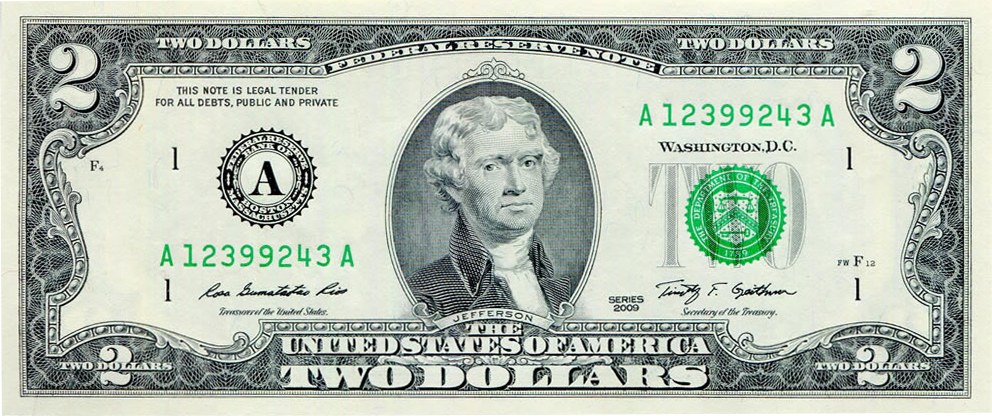
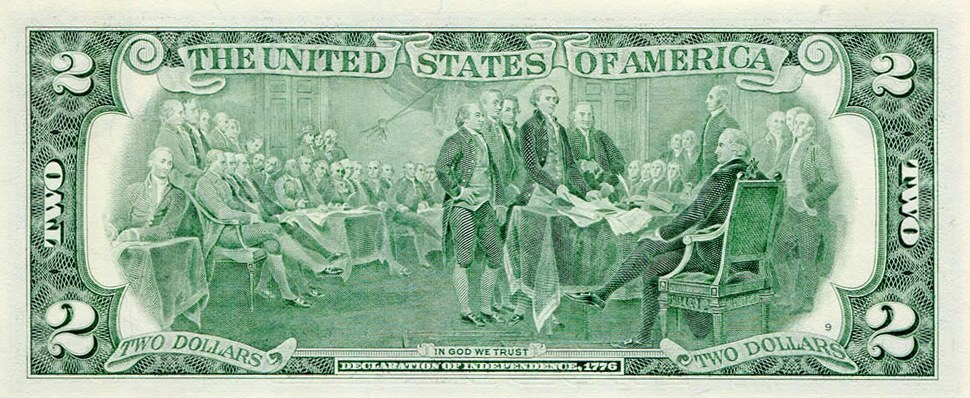
Sources: USPaperMoney.info, Series 2009 $2 (signatures, districts, Fort Worth) · USPaperMoney.info, uncut sheets (the sheet blocks and the 8888 serials) · Series 2013 signatures per the 2013 $2 Bill Value guide · Friedberg numbers as Heritage titles its Series 2009 sales
Star Notes, and the Run Never Printed
Series 2009 has two star runs. Dallas printed 512,000 in February 2012, before any regular note of the series. New York printed 128,000 in April 2012, one of the two smallest confirmed modern $2 star runs; the other is the first Series 2013 San Francisco run, the same size.
| District | Printed | Serial Range | Notes | Status |
|---|---|---|---|---|
| K Dallas | February 2012 | K00000001* to K00512000* | 512,000 | Confirmed |
| B New York | April 2012 | B00000001* to B00128000* | 128,000 | Confirmed; one of the two smallest confirmed modern $2 star runs |
| L San Francisco | April 2012, as reported | None | 0 | Reported in error; never printed |
Never Printed
USPaperMoney.info: "A run of 128,000 San Francisco star notes appeared in the BEP production report for April 2012, but in response to a FOIA request the BEP produced documentation showing that these notes were never printed, but were reported in error." Silver Recyclers still prices "The 2009 series $2 star note issued from the Federal Reserve Bank of San Francisco" at "around $100." This page shows that figure and adopts nothing from it: anyone offering a Series 2009 $2 star with an L serial is offering a note that does not exist.
The price guide asks more for a New York star than a Dallas one, while the sales on file pool the two districts. Heritage has four New York star sales on file, the lowest $39.00 and the highest the PMG 68 EPQ note in the sales table below. How stars are priced across the series is on the Star Notes page.
Sources: USPaperMoney.info, Series 2009 $2 (ranges, months, the FOIA finding) · the run comparison per the star table on the Star Notes page · Silver Recyclers · Serial Worth · Heritage sale pages of 2016 and 2022
What Makes a 2009 $2 Bill Valuable?
Four things lift a Series 2009 note above the regular Average in the figures on this page.
- A star. Stars sell above regular notes from worn through uncirculated, and New York's smaller run is priced higher by the guide.
- A fancy serial number. The five radar and repeater serials in the sales table below brought $266.40 to $780.00 in the aggregator's records.
- Serial number 1. B00000001* is the highest Series 2009 record on this site, though its XF-45 grade falls in the Worn band. See what counts as a low serial.
- A top grade. Regular notes graded 65 to 70 have an Average of $104.04, a short record of eight sales that includes the two PMG 70 EPQ notes, not a price for a gem note.
Sources: Serial Worth (the serial-number sales) · Silver Recyclers (the star figures) · 2dollar.us Sold Prices (the Averages) · every sale is dated in the next section
Sales on Record
Heritage rows are realized sales read from the sale page, buyer's fee included. Aggregator rows give the serial, grade, date, and price but not the house, so they are secondary evidence. Four rows fall on July 24, 2022, the date of Heritage's Skourtes Collection sale of fancy-serial $2 notes.
| Date | Note | Grade | Price | Evidence | Source |
|---|---|---|---|---|---|
| April 24, 2015 | B00000001*, New York star, serial number 1 | XF-45 | $17,625.00 | Secondary (aggregator) | Serial Worth |
| November 8, 2022 | Chicago, Fr. 1939-G; the aggregator records the same-day sale as G05934899A | PMG 70 EPQ | $2,400.00 | Realized sale (Heritage) | Heritage |
| December 27, 2022 | Chicago, Fr. 1939-G; the aggregator records the same-day sale as G05934898A | PMG 70 EPQ | $1,560.00 | Realized sale (Heritage) | Heritage |
| July 24, 2022 | A09999990A, radar (Skourtes sale date) | GEM-66 | $780.00 | Secondary (aggregator) | Serial Worth |
| July 24, 2022 | L07777770A, radar (Skourtes sale date) | GEM-67 | $576.00 | Secondary (aggregator) | Serial Worth |
| July 24, 2022 | G03030303A, repeater (Skourtes sale date) | UNC-64 | $552.00 | Secondary (aggregator) | Serial Worth |
| October 11, 2016 | New York star, Fr. 1939-B*; the aggregator records the same-day sale as B00032199* | PMG 68 EPQ | $399.50 | Realized sale (Heritage) | Heritage |
| April 16, 2024 | A00700700A, radar; the same note brought $312.00 on July 24, 2022 (Skourtes sale date) | UNC-64 | $336.00 | Secondary (aggregator) | Serial Worth |
| May 1, 2018 | F10101010A, repeater | GEM-66 | $266.40 | Secondary (aggregator) | Serial Worth |
| July 24, 2022 | New York star, Fr. 1939-B* (Skourtes sale) | PCGS 68 PPQ | $204.00 | Realized sale (Heritage) | Heritage |
Two PMG 70s
Heritage's description of the December sale calls it one of two graded 70 by PMG. The aggregator gives the two sales consecutive serials, G05934899A and G05934898A, so they appear to be that pair rather than one note sold twice. The asterisk in both Heritage titles, "70 EPQ*," is PMG's Star designation for eye appeal, not a star note.
Sources are linked in each row. The July 24, 2022 date matches Heritage's Skourtes Collection sale, per the Collectors Universe forum thread that previewed it. Serial Worth's records are on its Series 2009 page.
Questions About the 2009 $2 Bill
How Much Is a 2009 $2 Bill Worth?
A dealer guide says most circulated notes "will only be worth their face value of $2," and the sales on file are not far above it: an ordinary note has an Average of $3.72 on the Sold Prices page whether worn, crisp, or uncirculated (667 of those sales are uncirculated). A star, serial number 1, a fancy serial, or a grade of 70 brings more.
Is a 2009 $2 Bill Rare?
Not a regular note. The stars are scarcer, and New York's run of 128,000 is one of the two smallest confirmed modern $2 star runs. A Series 2009 star with an L serial does not exist; that run was never printed.
What Is a 2009 $2 Bill Star Note Worth?
More than a regular note from worn through uncirculated. Stars, Dallas and New York counted together, have an Average of $30.01 uncirculated (156 sales) and $49.99 graded 65 to 70 (152 sales) on the Sold Prices page. A price guide asks "around $35" for a Dallas star and "around $45" for a New York star in MS 63.
What Serial Numbers Make a 2009 $2 Bill Valuable?
Serial number 1, B00000001*, is the highest Series 2009 record on this site, and the five radar and repeater serials on this page each brought hundreds of dollars in the aggregator's records.
How Many 2009 $2 Bills Were Printed?
134,400,000 regular notes and 640,000 stars, all at Fort Worth from February to August 2012. San Francisco received the most, 38,400,000, and New York 32,000,000; the district table above has the rest.
Why Is There No 2009 $2 Bill from My District?
Series 2009 was printed only for Boston, New York, Cleveland, Atlanta, Chicago, Dallas, and San Francisco. A note from any of the other five districts, with letters C, E, H, I, or J, is not Series 2009.
Sources: as cited in the sections above, chiefly Silver Recyclers, Serial Worth, USPaperMoney.info, and the Sold Prices page.