S 00000001 A
Red Seal $2 Bills, 1928 to 1963
Today's dimensions, a red seal, Monticello on the back, and a slow fade to discontinuation. Fourteen series letters from 1928 to 1963A, each identified below by its signatures, seal, and print run, with a link to the guide that prices it.
1928
Monticello Arrives
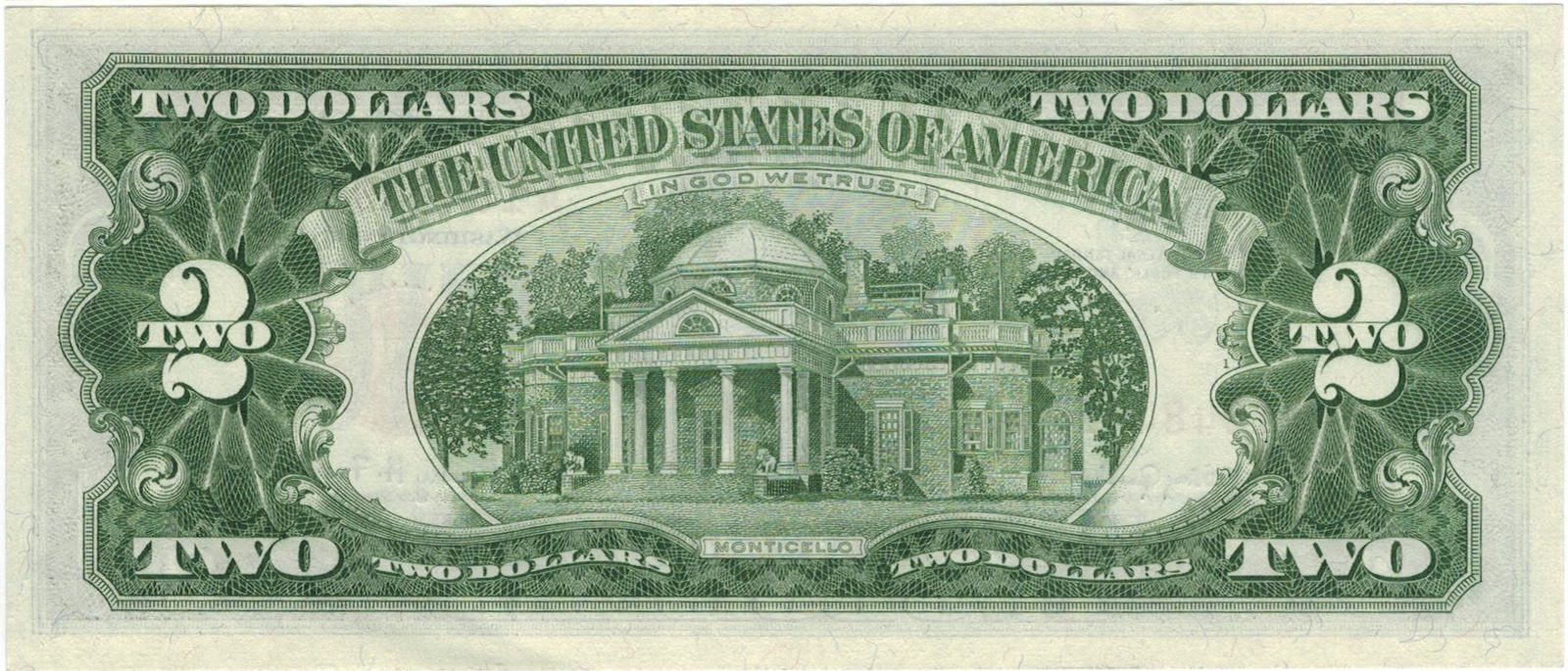
In 1928 U.S. currency shrank to the 6.14 by 2.61 inch size still in use. The $2 became a United States Note with a red Treasury seal and red serial numbers, a cropped version of the familiar Jefferson portrait, and a new back. As the Bureau of Engraving and Printing records, "Monticello, Thomas Jefferson's estate in Virginia, was first featured as the vignette on the back of the Series 1928 $2 United States Note."
The 1928 design ran through Series 1928G, with the Treasury counting 430,760,000 notes across those series. What each letter is worth is on the 1928 $2 Bill Value page.
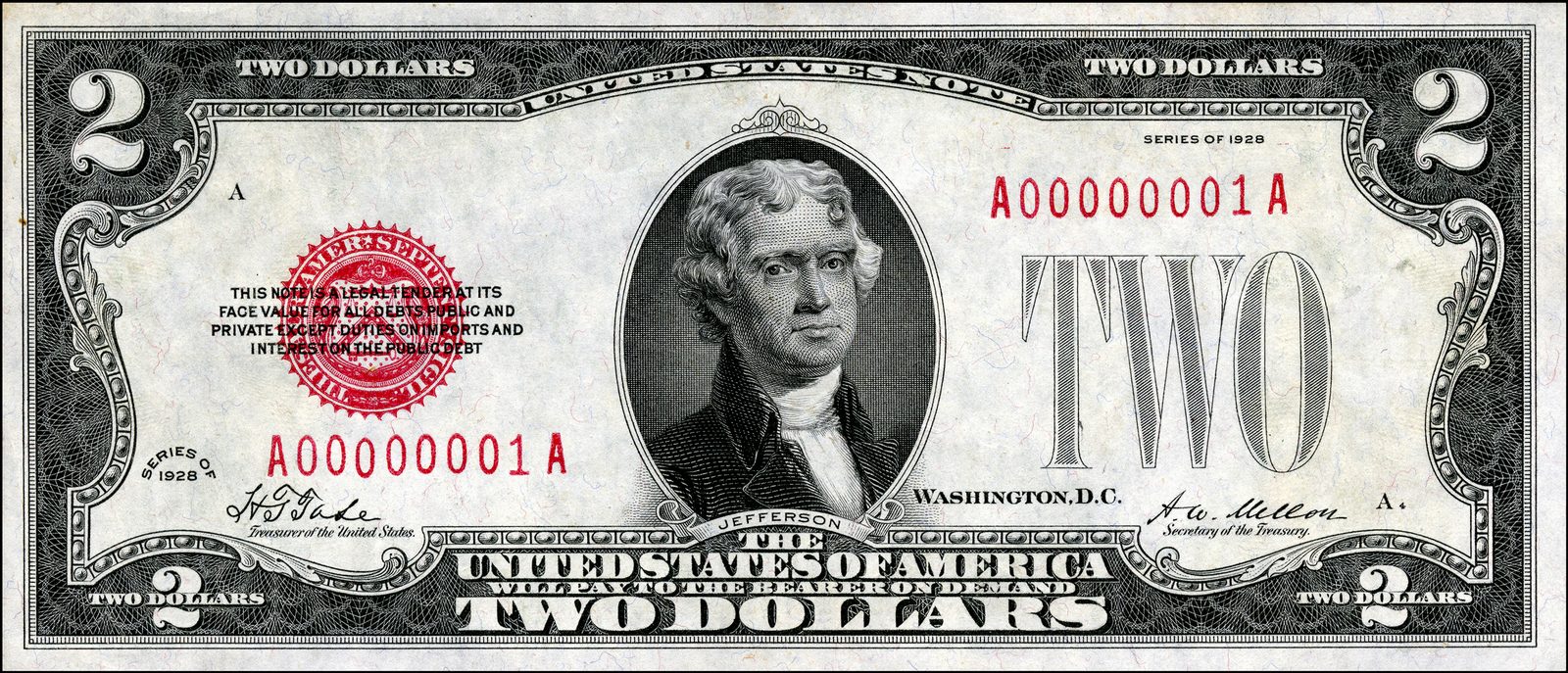
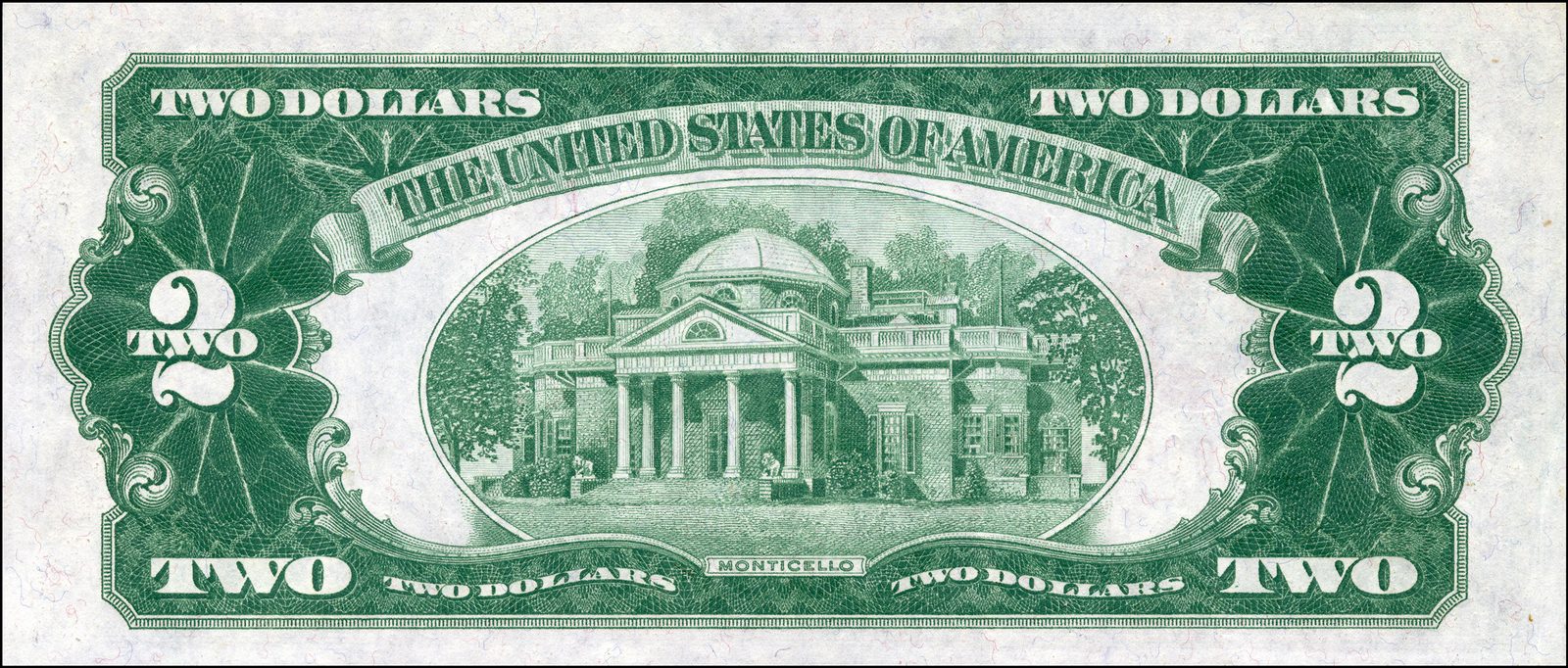
Sources: BEP, $2 Note · Richmond Fed 1976, Table I · dimensions per Wikipedia
1953 and 1963
Small Changes, Smaller Runs
Series 1953 made the Treasury seal smaller and moved it to the right over a gray "TWO," and put the legal tender obligation over a gray numeral 2 on the left; the back was unchanged. Series 1963 added "IN GOD WE TRUST" above Monticello and dropped "WILL PAY TO THE BEARER ON DEMAND" from the face.
The numbers tell the story of the decline. The 1953 series (1953 through 1953C) totaled 79,920,000 notes; the 1963 series (1963 and 1963A) only 18,560,000. Values by letter and grade are on the 1953 $2 Bill Value and 1963 $2 Bill Value pages.
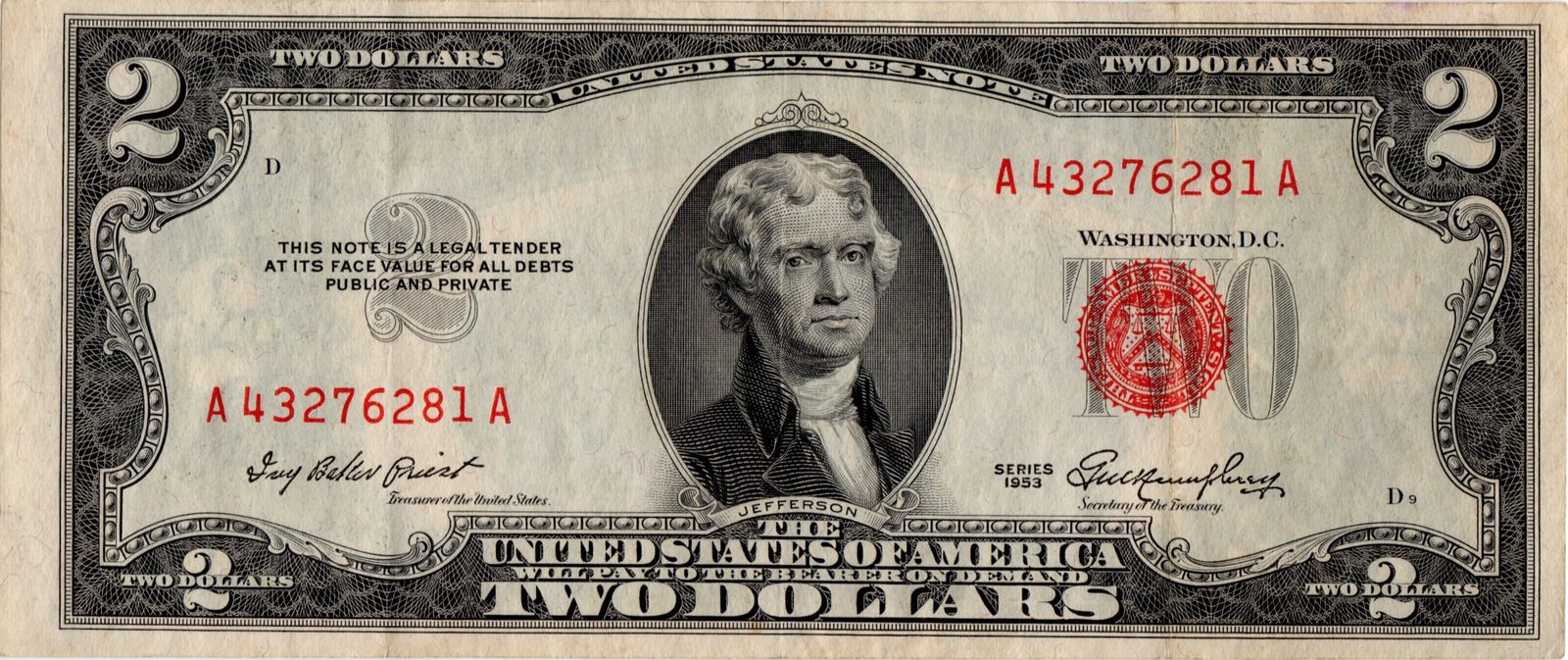
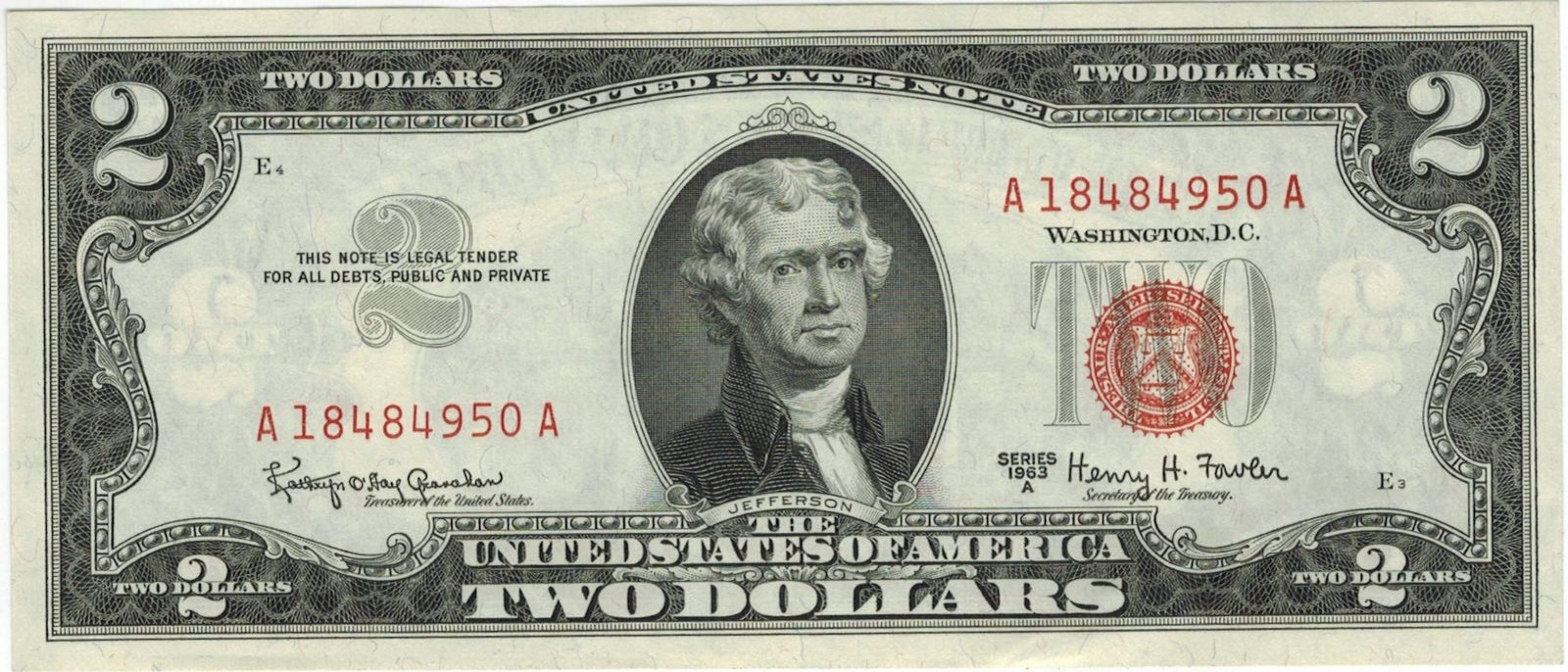
Sources: design changes per Wikipedia · totals from Richmond Fed 1976, Table I
Every Red Seal Series Letter
One row per series letter. Signatures are Treasurer and Secretary of the Treasury. Production for 1953 through 1963A is USPaperMoney.info's compilation of the Bureau's records; for 1928 through 1928G the Bureau's plate-summary counts come through two secondary compilations that disagree for three letters, and the star block was shared across the letters, so those cells say so. Values are on the year guides linked in the last column, and the value lookup routes each series there.
| Series | Signatures | Seal | Notable Variety | Star Notes | Production | Guide |
|---|---|---|---|---|---|---|
| 1928 | Tate, Mellon | Large, left | "No Back Plate #" engraving error | Yes; one block shared by all 1928 letters | 55,889,424 (secondary) | 1928 $2 Bill Value |
| 1928A | Woods, Mellon | Large, left | "No Back Plate #" engraving error; scarce star | Yes; shared block | 46,859,136 or 46,859,336 (secondary) | 1928 $2 Bill Value |
| 1928B | Woods, Mills | Large, left | Scarcest regular letter; star "with only 8 known" | Yes; shared block | 9,001,632 (secondary) | 1928 $2 Bill Value |
| 1928C | Julian, Morgenthau | Large, left | Mules (micro and macro plate numbers), "very scarce" | Yes; shared block | 86,584,008 (secondary) | 1928 $2 Bill Value |
| 1928D | Julian, Morgenthau | Large, left | Mules, common; unique inverted overprint | Yes; shared block | 146,381,364 (secondary) | 1928 $2 Bill Value |
| 1928E | Julian, Vinson | Large, left | Star "with very few known" | Yes; shared block | 5,261,016 or 6,480,000 (secondary) | 1928 $2 Bill Value |
| 1928F | Julian, Snyder | Large, left | Yes; shared block | 43,349,292 or 42,360,000 (secondary) | 1928 $2 Bill Value | |
| 1928G | Clark, Snyder | Large, left | The common letter | Yes; shared block ends *04152000A | "< 52,208,000" (secondary) | 1928 $2 Bill Value |
| 1953 | Priest, Humphrey | Small, right | Smaller seal over gray "TWO"; obligation over gray 2 | Yes; 2,160,000 | 45,360,000 | 1953 $2 Bill Value |
| 1953A | Priest, Anderson | Small, right | Yes; 720,000 | 18,000,000 | 1953 $2 Bill Value | |
| 1953B | Smith, Dillon | Small, right | Yes; 720,000 | 10,800,000 | 1953 $2 Bill Value | |
| 1953C | Granahan, Dillon | Small, right | Smallest 1953 run | Yes; 360,000 | 5,760,000 | 1953 $2 Bill Value |
| 1963 | Granahan, Dillon | Small, right | "IN GOD WE TRUST" added; "WILL PAY TO THE BEARER ON DEMAND" removed | Yes; 640,000 | 15,360,000 | 1963 $2 Bill Value |
| 1963A | Granahan, Fowler | Small, right | The last red seal $2; star rate "20.00%" | Yes; 640,000 | 3,200,000 | 1963 $2 Bill Value |
| Totals, Treasury | 430,760,000 (1928 series); 79,920,000 (1953); 18,560,000 (1963) |
Sources: USPaperMoney.info, $2 note summary and its series tables for 1928 to 1928G, 1953, 1953A, 1953B, 1953C, 1963, and 1963A (signatures, counts, star blocks) · 1928 per-letter counts per Numista and The Paper Money Project · varieties per Numismatic News, July 2, 2024, Coin World, and PMG · totals per Federal Reserve Bank of Richmond, 1976, Table I · design changes per Wikipedia
August 1966
Discontinued
The Federal Reserve Bank of Richmond's 1976 account is the clearest record of why the note went away. The 1963 series "was officially discontinued by the Treasury Department in August 1966. At that time the $2 note accounted for approximately one-third of one percent of total currency outstanding." The note barely wore out because it barely moved: "The average life of a $1 bill is 18 months, of a $5 bill is three years; when it was discontinued, the average life of the $2 bill was six years."
The same article explains why so few were printed in the first place. Federal statutes required about $320 million in United States Notes to be outstanding at all times, and "the 1963 issue of the $2 note was partly to meet the legal requirements." Then the trap closed: "the limited quantity printed made the bill an extreme novelty, thereby contributing to public superstitions about it."
"The last $2 series was discontinued in 1966 after low production and the concomitant unpopularity of the bill resulted in insufficient use."
Suzanne J. Stone, Federal Reserve Bank of Richmond, Economic Review, March/April 1976
Source: Federal Reserve Bank of Richmond, "The $2 Bill Returns" (PDF)
How the Notes Got Small
Treasury Secretary Andrew Mellon appointed a committee on August 20, 1925 and accepted its recommendation for small-size currency in May 1927; the new notes reached the Federal Reserve on July 10, 1929. The Bureau's reasoning was money and fraud: "In an effort to lower manufacturing costs, all Federal Reserve notes are made about 30 percent smaller. The reduced size enables BEP to convert from eight to 12 notes per sheet. In addition, standardized designs are instituted for each denomination across all classes of currency," which "makes it easier for the public to distinguish between genuine and counterfeit notes." The small $2 face was designed by Clair A. Huston and Alvin R. Meissner around Burt's 1869 Jefferson; the Monticello back was engraved by J. C. Benzing. Jefferson began building the house at twenty-six.
Sources: BEP, History of Currency · APMEX, "The History of Small Size U.S. Currency" · BEP $2 fact sheet (PDF)
Two Laws That Shaped the Last Red Seals
The motto. Public Law 84-140, approved July 11, 1955 on a bill from Representative Charles E. Bennett of Florida, ordered that new currency dies "shall bear ... the inscription 'In God We Trust', and thereafter this inscription shall appear on all United States currency and coins." It reached paper money on the Series 1957 $1 Silver Certificate and arrived on the $2 with Series 1963, above Monticello.
The quiet authorization. Public Law 88-36 of June 4, 1963 repealed the silver purchase laws and, in its third section, amended the Federal Reserve Act "by inserting '$1, $2,' immediately after 'notes of the denominations of.'" That clause is what made a $2 Federal Reserve Note legal. The $1 went into production that year; the $2 sat on the books for thirteen years until 1976.
Sources: Public Law 84-140 text · U.S. House of Representatives, History, Art and Archives · Public Law 88-36, 77 Stat. 54 (govinfo) · BEP, Currency Notes (PDF)
August 10, 1966, in the Papers
U.S. News and World Report carried the Treasury's announcement of August 10, 1966: the $2 was being dropped for "lack of public demand." At the time $139.3 million in twos was circulating, about one-third of one percent of all paper money, and the last printing had been in May 1965. Treasury officials "said that they wouldn't be surprised if the fade-out announcement stirred a demand for the bills as collector's items." The Bureau's fact sheet adds the detail that explains the tattered survivors: "$2 notes were often returned to the Treasury with corners torn off, making them mutilated currency and unfit for reissue." United States Notes of every denomination ended on January 21, 1971.
Sources: U.S. News and World Report, August 22, 1966 (reproduced at Click Americana) · BEP $2 fact sheet (PDF) · BEP FAQ