P 00000002 A
The Economics of the $2
On paper the two is the most efficient note the country prints. In practice it sits in drawers. Both halves of that are documented.
Four Point One Cents
The Federal Reserve publishes what it pays the Bureau of Engraving and Printing per note. For 2025: "$1 and $2: 4.1 cents per note," $5: 7.1 cents, $10: 6.8 cents, $20: 7.3 cents, $100: 11.3 cents. The $2 costs exactly what the $1 costs and carries twice the value, so every two that circulates instead of two ones halves the printing bill for that money. The whole 2025 currency budget was $1,040.0 million, of which $688.6 million went to fixed printing costs.
The Fed will not tell you how long a $2 lasts. Its lifespan table lists 7.2 years for a $1 and 24.0 years for a $100, and then: "Because the $2 note does not widely circulate, we do not publish its estimated lifespan." The last official estimate is the Richmond Fed's from 1966: six years, against 18 months for a $1.
4.1¢To print a $2 note in 2025, the same as a $1
- $1 and $2
- 4.1 cents
- $5
- 7.1 cents
- $10
- 6.8 cents
- $20
- 7.3 cents
- $100
- 11.3 cents
Federal Reserve, 2025 variable printing cost per note.
Sources: Federal Reserve FAQ, "How much does it cost to produce currency and coin?" · Federal Reserve FAQ, lifespan of paper money · Richmond Fed, 1976 (PDF)
The 1976 Pitch
The Treasury sold the 1976 reissue as arithmetic. The New York Times reported on April 11, 1976 that the note could replace about half the $1 bills in circulation and save $4 million to $7 million a year in printing. The Richmond Fed's fuller estimate was "about $27 million (in 1976 dollars) in printing, handling, storage, and shipping costs between 1976 and 1981," built on a printing cost of 1.525 cents per note and the fact that ones made up 55 to 60 percent of all pieces of currency. Secretary Simon said he believed the note "will be enthusiastically and widely accepted by the American people."
Sources: CoinWeek, citing the New York Times of April 11, 1976 · Richmond Fed, "The $2 Bill Returns" · Simon quote as reproduced at Attic Capital
Why the Public Did Not Play Along
Three reasons, each with a witness.
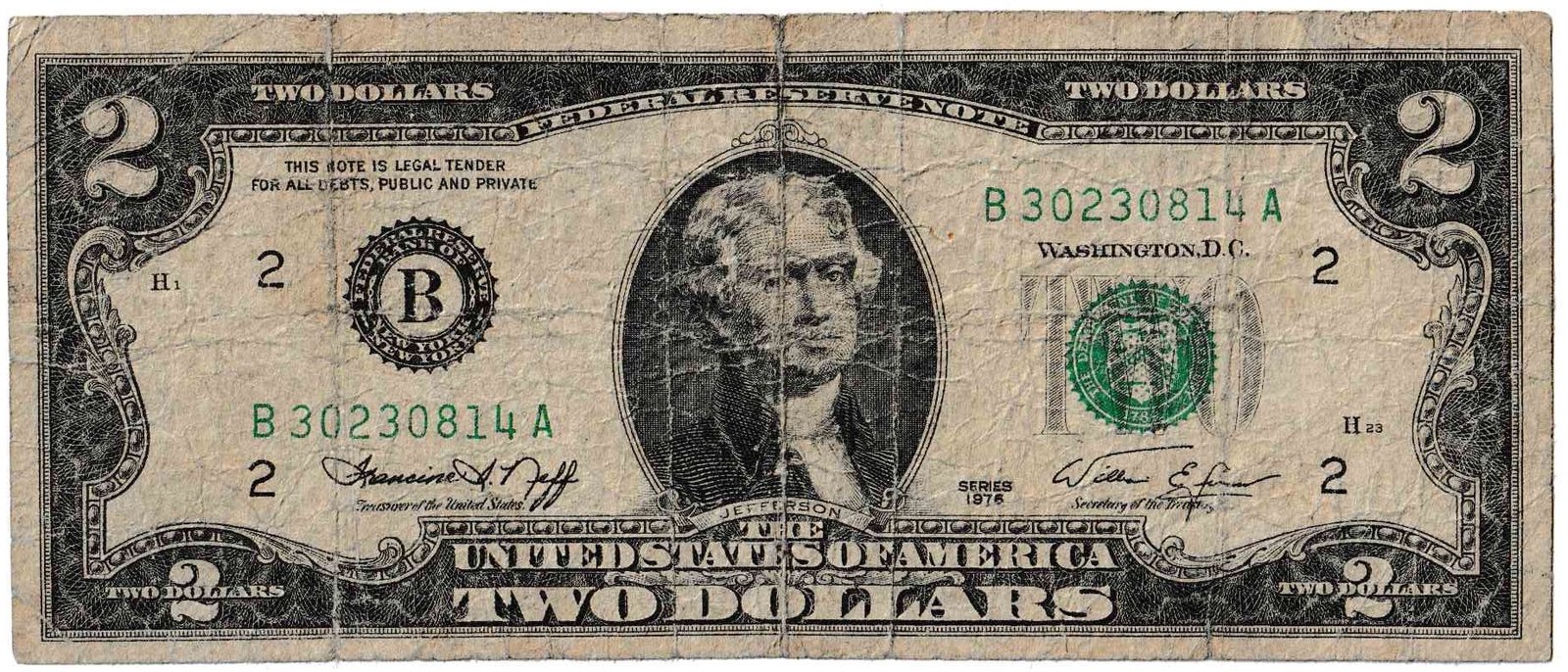
- Retailers never adopted it. The Bureau of Engraving and Printing's Lydia Washington: "The key for the successful circulation of the $2 note is for retailers to use them just like any other denomination in their daily operations." They did not, and a cashier who gets one usually swaps it out of the drawer.
- The cash register has no slot. "There's never even been a cash register slot for $2 bills," as one $2 advocate put it to Pacific Standard. Money magazine's account of 1976 blamed the same thing: cashiers "disliked them because cash trays lacked designated spaces."
- Everyone keeps them. John Bennardo, who made the documentary: "The reason they're rare is because everyone puts them in the drawer and doesn't use them." The Federal Reserve's process makes this self-reinforcing: print orders are driven by "destruction rates of unfit notes," and a note nobody handles never wears out, so the Fed rarely orders more.
The numbers show the drawers filling. The value of $2 notes in circulation rose every single year from $1.5 billion in 2005 to $3.6 billion in 2025, while the Fed says the note "does not widely circulate." Growth without circulation is a stockpile.
| 2005 | 2010 | 2015 | 2020 | 2022 | 2023 | 2024 | 2025 |
|---|---|---|---|---|---|---|---|
| $1.5 | $1.8 | $2.3 | $2.7 | $3.0 | $3.2 | $3.4 | $3.6 |
Sources: Pacific Standard, "The Mystery of $2 Bills," May 15, 2015 · Money · Federal Reserve, 2025 print order (how orders are set) · Federal Reserve, Value of Currency in Circulation · Federal Reserve lifespan FAQ
What the GAO and the Fed Have Said
The $2 shows up in Washington mostly as a footnote to the fight over the $1 coin. The Government Accountability Office spent two decades arguing that replacing the paper dollar with a coin would save money, and its 2011 report modeled the two directly: "If the $1 coin replaced the $1 note, the use of the $2 note could increase because people and businesses might limit how many coins they kept in their pockets and cash trays." It noted that "In Canada, demand for the $2 bill did increase when the $1 note was replaced with the $1 coin. However, Canada already had a readily circulating $2 note at the time, whereas the United States does not." In a scenario where a quarter of $1-note demand moved to twos, the projected 30-year benefit fell only slightly, to about $5 billion.
Then the math flipped. Because the Federal Reserve stopped destroying "misfaced" notes and the $1's life more than doubled, GAO found in 2019 that a coin switch would lose the government $611 million to $2.6 billion, "the first time GAO has found that replacing the $1 note with a $1 coin would result in a net loss." Fed staff had reached the same conclusion in 2013, adding that Canada's $2 note was replaced by only 1.25 coins per note, a sign that people simply moved to electronic payment. Nobody in these reports proposes touching the $2; it is the denomination everyone forgets to model.
Sources: GAO-11-281, March 2011 (PDF) · GAO-19-300, March 2019 (PDF) · Federal Reserve Board staff working paper, December 2013 (PDF)
What Congress Has Tried
No bill has ever proposed killing the $2. Two tried to make it interesting. Representative Jim Kolbe's Legal Tender Modernization Act of 2001 (H.R. 2528) would have required "a new design" for $2 notes "during each year of the 5-year period" starting in 2003, each "emblematic of the history of the United States," chosen with the Commission of Fine Arts, with the rule that "no portrait of a living person may be included." He tried again in 2006 with the COIN Act (H.R. 5818), which would have put five years of changing designs on the back of the $2 beginning in 2007 while phasing out the $1 note in favor of the coin. Neither passed. The bills that did target the $1 note, in 2011 and 2017, never mention the $2 at all.
Sources: H.R. 2528, 107th Congress (govinfo) · H.R. 5818, 109th Congress (govinfo) · H.R. 2977, 112th Congress · S. 759, 115th Congress
How Everyone Else Handles a Two
The United States is unusual in keeping both a $1 note and a $2 note with no circulating dollar coin. Most rich countries went the other way.
- Canada issued its last $2 note design in September 1986 and replaced it with the "toonie" coin on February 19, 1996 "in a drive to increase cost-savings"; the Bank of Canada Museum notes that "the life expectancy of a two-dollar note was about a year" against more than 10 for a coin. The Winnipeg mint struck 375 million toonies in 1996 alone. The old notes stopped being legal tender on January 1, 2021.
- Australia swapped its $2 note for a coin on June 20, 1988; the note "was so heavily used that it was only lasting six months or less."
- The United Kingdom replaced the £1 note with a coin in 1983 and, after a 1994 coinage review, put the £2 coin into general circulation in 1998.
- The euro has €1 and €2 coins and has never had a note below €5.
- Still printing a two: Bermuda (a polymer $2 in 2024), Belize, Barbados (polymer, December 2022), and Singapore. Fiji switched its $2 to a coin in 2013.
Why the difference? Those two-unit notes wore out in months because people spent them. The American two lasts for years because they do not, which is the whole story of this page in one sentence.
Sources: Bank of Canada Museum, "The Coming of the Toonie" · Royal Canadian Mint · Australian Geographic, quoting the Royal Australian Mint · The Royal Mint, history of the £2 coin · GAO-19-300 · European Central Bank, banknote denominations · Bermuda, Belize, Barbados, Fiji per the research dossier in Sources