L 00000001 *
How Much Is a 1976 $2 Bill Worth?
Almost always two dollars. This page is the exceptions: condition, the twelve district star runs, the serial numbers and errors that have actually sold, and the first-day postmarks, each figure with its source and its evidence type.
The Fast Answer
Every figure below is quoted from the source in its row. The evidence column uses the tiers on the Editorial Standards page: a realized sale is what somebody paid, with the venue and date; a dealer asking price is what a dealer lists; a secondary figure is a press summary, an aggregator, or an auction estimate. Where two sources disagree, both are shown.
| Note | Reported Figure | Evidence Type | Source |
|---|---|---|---|
| Circulated, ordinary serial | "Circulated examples typically trade at or near face value"; a dealer guide says such a note will "only be worth its face value of $2" | Secondary summary; dealer asking price | CoinWeek, Silver Recyclers |
| Uncirculated, ordinary serial | "Uncirculated notes often sell for $3 to $4" per CoinWeek; "around $9-15" per a dealer guide. The spread is the market: the lower figure is what a note brings, the higher is what a dealer asks | Secondary summary; dealer asking price | CoinWeek, Silver Recyclers |
| Star note, common district | "Star notes command higher premiums" (no figure); a dealer guide lists "around $8 in fine condition" and "around $17.50-22.50 for bills with an MS 63 grade" | Secondary summary; dealer asking price | CoinWeek, Silver Recyclers |
| Star note, Kansas City (J) or Minneapolis (I) | "around $80 in fine condition and around $150 in uncirculated condition with a grade of MS 63"; the guide names "The Federal Reserve Bank of Kansas City and the Federal Reserve Bank of Minneapolis" as "the rare varieties" | Dealer asking price | Silver Recyclers |
| Fancy serial number | $35,250 for the San Francisco star with serial number 00000001, PCGS 64 PPQ (Heritage, January 8, 2016); $21,150 for the plain serial 00000001 (same sale); $13,200 for a San Francisco serial number 2, PMG 64 EPQ (Heritage, July 2022); $4,000 for a serial number 00000002 (Heritage, November 2023) | Realized sales | Heritage, The Intelligent Collector, PMG, ANA |
| Genuine printing error | $19,200 for a Cleveland doubled third printing (Heritage, January 2022); $2,760 for a Richmond inverted overprint, PMG 66 EPQ (Heritage, January 2021); $36 each for a pair with an ink smear and a wrinkle (Lyn Knight, May 2022) | Realized sales | PMG, PMG, Lyn Knight |
| First-day postmarked, April 13, 1976 | Under $20 per a collector forum; "about twice face value" per Wikipedia; a crisp example estimated $50 to $100 in July 2025 went unsold | Secondary | Collectors Universe forum, Wikipedia, Invaluable |
Sources are linked in each row. The realized sales are repeated with dates and grades in the tables further down. No figure on this page is an appraisal of a particular note; each is what another note brought or what a dealer asked.
How to Identify a Series 1976 Note
Read the Series Year
"SERIES 1976" is printed to the right of Jefferson's portrait. The signatures are Neff (Treasurer) and Simon (Secretary of the Treasury), the only pair used on the series.
Check the Seals and Serials
A green Treasury seal at right and green serial numbers mark a Federal Reserve Note; a black Federal Reserve Bank seal at left names the district, and the same district letter (A through L) begins the serial number. A red seal means an older United States Note, covered on the Red Seal Era page.
Turn It Over
The back shows the signing of the Declaration of Independence, engraved after John Trumbull's painting. It replaced Monticello in 1976 and has not changed since, so the back alone does not date a note; the series year does.
No FW
Series 1976 was printed in Washington. The small "FW" beside the face plate number that marks Fort Worth production appears only from Series 1995 on. Catalogs list the series as Friedberg 1935 with the district letter as a suffix, Fr. 1935-A through Fr. 1935-L, and a star for replacement notes, such as Fr. 1935-J*.
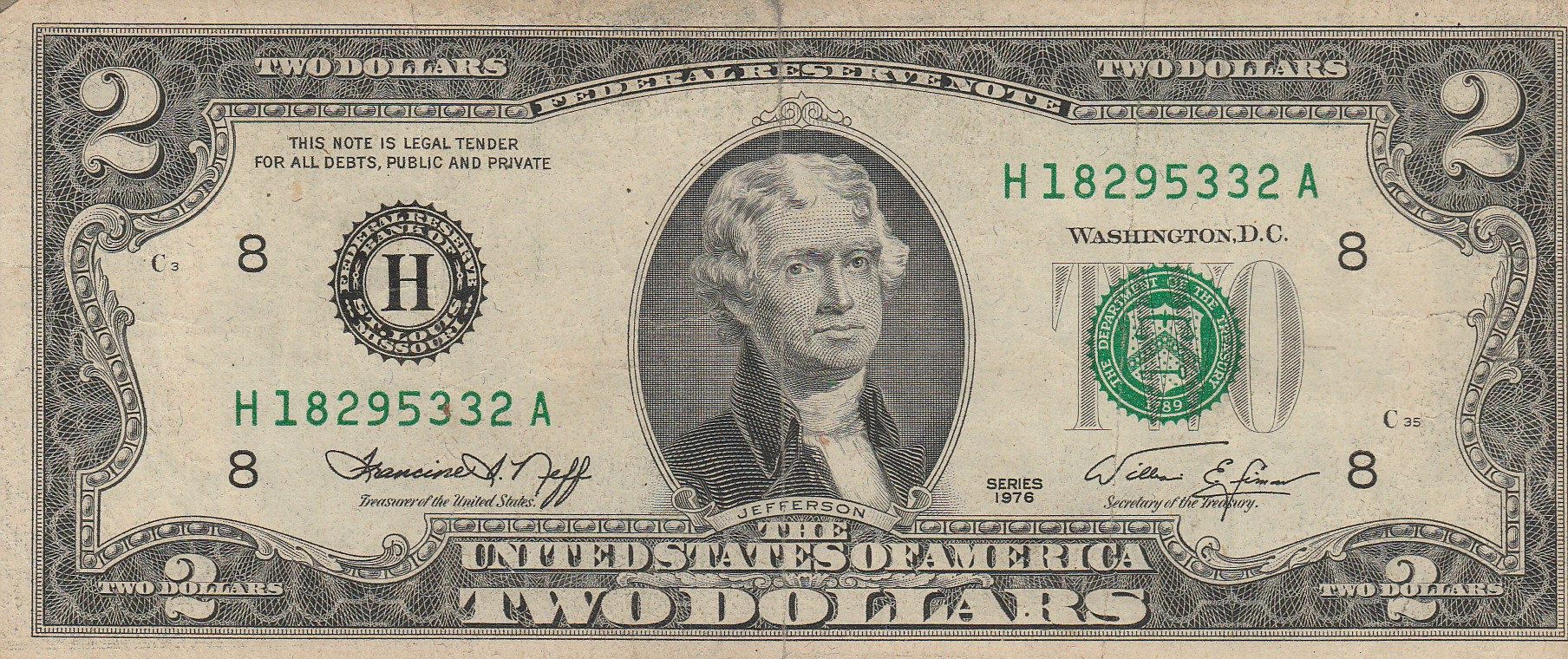
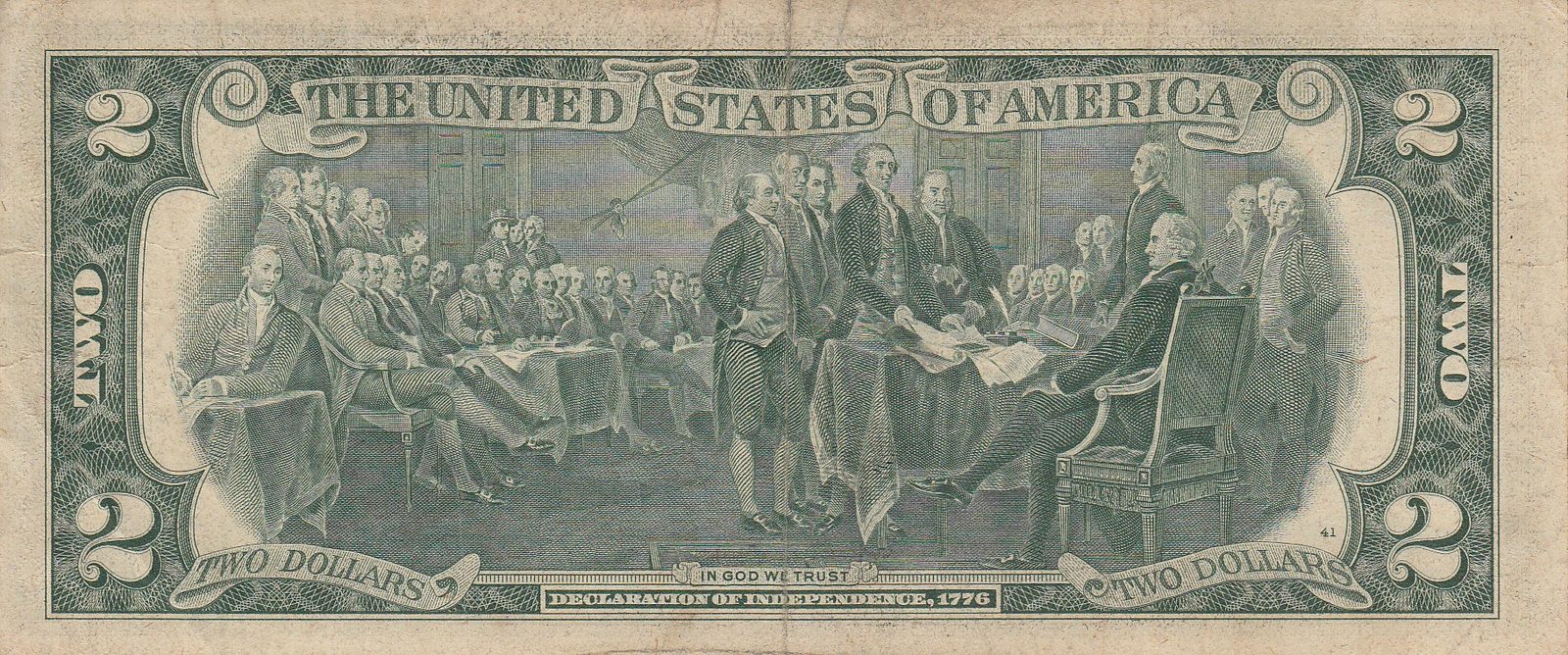
Sources: USPaperMoney.info, Series 1976 $2 (print dates, Neff-Simon signatures) · USPaperMoney.info, $2 notes summary (Fort Worth from Series 1995) · BEP, $2 Note · Friedberg numbers as used by CoinWeek
Why It Was Issued
The 1976 note was a cost-saving measure timed to the Bicentennial, not a commemorative. The Federal Reserve Bank of Richmond put the case in early 1976: "by replacing about half the 'ones' with an equivalent dollar volume of 'twos', thus decreasing the number of bills in circulation, the Federal Government will save about $27 million (in 1976 dollars) in printing, handling, storage, and shipping costs between 1976 and 1981." The Treasury added that "there will be no 'collector's' or other special issues of it." The announcement, the release on Jefferson's birthday, and what happened next are on the Modern $2 Bill History page.
Source: Federal Reserve Bank of Richmond, "The $2 Bill Returns," 1976 (PDF)
All Twelve Districts
Series 1976 was printed for every Federal Reserve district from December 1975 to September 1979: 575,360,000 regular notes and 15,360,000 star notes, the largest $2 series on record. The regular notes are common from every district. The star runs are where the counts differ, from 2,560,000 for New York down to 640,000 each for Richmond, Minneapolis, and Kansas City.
| District | Regular Notes | Star Notes | Note |
|---|---|---|---|
| A Boston | 29,440,000 | 1,280,000 | |
| B New York | 67,200,000 | 2,560,000 | The largest star run |
| C Philadelphia | 33,280,000 | 1,280,000 | |
| D Cleveland | 31,360,000 | 1,280,000 | The district of the doubled-print errors below |
| E Richmond | 56,960,000 | 640,000 | One of the three smallest star runs |
| F Atlanta | 60,800,000 | 1,280,000 | |
| G Chicago | 84,480,000 | 1,280,000 | The most regular notes |
| H St. Louis | 39,040,000 | 1,280,000 | |
| I Minneapolis | 23,680,000 | 640,000 | The fewest regular notes; a scarce star |
| J Kansas City | 24,960,000 | 640,000 | CoinWeek names Fr. 1935-J* the scarcest star of the series |
| K Dallas | 41,600,000 | 1,280,000 | |
| L San Francisco | 82,560,000 | 1,920,000 | The district of the serial number 1 notes below |
| Total | 575,360,000 | 15,360,000 |
A star run of 640,000 is small for the series but not small in absolute terms. The dealer guidance quoted on the Star Notes page puts a real premium on runs "under 640,000" and calls runs "of 16,000 or less" especially desirable; no 1976 star run comes near the second figure. That is why the dealer asking prices above top out around $150 for a Kansas City or Minneapolis star in MS 63.
Sources: USPaperMoney.info, Series 1976 $2 serial number table (all counts and print dates) · CoinWeek (Fr. 1935-J* as the scarcest star) · run-size guidance per GovMint
Condition and Grading
Millions of Series 1976 notes were put away uncirculated on release day, so an unfolded note is the normal case, not a rarity. What separates a $3 note from a $30 note is the grade a service assigns. In PMG's definitions, a 65 Gem Uncirculated "may have one or two minor distractions as a result of minor handling. The centering must be above average"; a 64 Choice Uncirculated has centering "off on one or two sides" but "no folds in the design"; a 58 is "often a note with a single fold that crosses the design"; a 40 Extremely Fine has "three or more folds." One center fold, in other words, takes a note out of the uncirculated grades entirely.
The population figures show how crowded the top is. PMG reported 18,830 grading events for Series 1976 $2 notes as of July 10, 2024, of which 6,040 were star notes. Of "the more than 16,000 Series 1976 $2 notes graded by PMG, fewer than 10" had reached PMG 69 as of July 2022, and PMG 68 is described as "extremely scarce." A raw note in a drawer is far more likely to grade 63 or 64 than 67, and the dealer asking prices in the fast answer are for MS 63.
Sources: PMG Grading Scale · CoinWeek (PMG population as of July 10, 2024) · PMG, "Registry Featured Set: 1976 Series $2 Federal Reserve Note," July 19, 2022
Documented Fancy-Serial Sales
Serial number 1 is the whole story of the 1976 note's top prices. Every sale below is dated and graded. The first block is realized sales reported by the auction house, a grading service, or a numismatic body; the second block is an aggregator's records, which carry the serial, grade, date, and price but do not name the house, and are listed as secondary evidence for that reason.
| Date | Note | Grade | Price | Evidence | Source |
|---|---|---|---|---|---|
| January 8, 2016 | San Francisco star, serial 00000001, "the only serial number 1 Bicentennial deuce star known to exist in private hands," Heritage FUN sale | PCGS Very Choice New 64 PPQ | $35,250 | Realized sale | Heritage, The Intelligent Collector |
| January 8, 2016 | San Francisco, plain serial 00000001, with its original BEP brick label, Heritage FUN sale | PCGS Gem New 65 PPQ | $21,150 | Realized sale | Heritage, The Intelligent Collector, CoinWeek |
| May 2009 | San Francisco star, serial number 1, Heritage Central States sale | PMG 58 Choice About Uncirculated | $29,900 | Realized sale | PMG, "Serial Number 1" |
| July 2022 | San Francisco, serial number 2, Heritage; the Skourtes Collection of fancy-serial $2 notes, sold July 24, 2022 | PMG 64 Choice Uncirculated EPQ | $13,200 | Realized sale | PMG, "Low Serial Numbers", Collectors Universe forum (sale date) |
| November 2023 | Serial number 00000002, district not stated, Heritage; the ANA's comment was that "almost every $2 bill is worth just $2" | "superb condition," grade not stated | $4,000 | Realized sale | American Numismatic Association |
| January 9, 2018 | L00000001 star (San Francisco), aggregator record | UNC-64 | $25,200 | Secondary (aggregator) | Serial Worth |
| July 24, 2022 | F11111111A (Atlanta solid serial), aggregator record | UNC-64 | $9,600 | Secondary (aggregator) | Serial Worth |
| January 8, 2016 | L00000002A (San Francisco, plain serial 2), aggregator record | UNC-63 | $9,400 | Secondary (aggregator) | Serial Worth |
| May 1, 2009 | L00000002 star (San Francisco), aggregator record | AU-58 | $9,775 | Secondary (aggregator) | Serial Worth |
| January 9, 2018 | K00000001 star (Dallas), aggregator record | VF-30 | $7,500 | Secondary (aggregator) | Serial Worth |
| April 24, 2020 | K00000001 star (Dallas), the same note, aggregator record | VF-30 | $6,600 | Secondary (aggregator) | Serial Worth |
| February 18, 2005 | F11111111A (Atlanta solid serial), aggregator record | GEM-65 | $6,325 | Secondary (aggregator) | Serial Worth |
What Could Not Be Sourced
Heritage's and Stack's Bowers' own lot archives could not be reached when this page was written, so the aggregator rows above are not confirmed against the house records and no lot numbers are given. No realized sale was found for a Series 1976 ladder, radar, repeater, or binary serial, and no sale at all was found for a plain low serial between 00000003 and 00009999. Claims that a 1976 ladder note sold for millions could not be traced to any auction record; the Errors and Auction Records page keeps the list of such numbers.
Sources are linked in each row. Serial Worth is a value aggregator; its rows are listed as secondary evidence because it does not name the auction house or lot. The 2016 and July 2022 dates in its rows match the Heritage sales documented in the first block.
Genuine Errors
An error is a mistake the Bureau's inspection missed. On the 1976 note the documented ones are few, and each has a price history. A star note is not an error; it is the replacement for one.
| Date | Error | Grade | Price | Evidence | Source |
|---|---|---|---|---|---|
| January 2022 | Cleveland doubled third printing, "with eight district '4's instead of four," Heritage | Not stated | $19,200 | Realized sale | PMG, Doubled Print Error |
| January 2017 | Cleveland doubled third printing, Heritage FUN sale | PMG 64 EPQ | $14,100 | Realized sale | PMG, Doubled Print Error |
| January 2021 | Richmond inverted overprint (seals and serials upside down), Heritage | PMG 66 Gem Uncirculated EPQ | $2,760 | Realized sale | PMG, Inverted Overprint |
| May 2022 | Richmond inverted overprint, Lyn Knight, Georgetown Collection | Gem 65 | $2,400 | Realized sale | Lyn Knight catalog, Coin World |
| May 2022 | A pair of notes with an ink smear and a paper wrinkle, Lyn Knight | Not stated | $36 each | Realized sale | Lyn Knight catalog |
| August 2017 | New York mismatched serial numbers, B59208497A at left and B59208597A at right, Stack's Bowers estimate | PMG 64 | $500 to $700 estimate | Secondary (estimate) | Coin World |
| 2022 | Atlanta printed fold, "an exceptionally rare fold over on a deuce," Lyn Knight estimate | Not stated | $1,500 to $3,000 estimate | Secondary (estimate) | Lyn Knight catalog |
| Undated | Mismatched serial number error, dealer guide | Very fine; uncirculated | "around $400"; "around $800" | Dealer asking price | Silver Recyclers |
A 1976 New York note with a St. Louis "H" prefix on one serial, PMG 66 EPQ, was offered by Heritage in August 2022; no price for it is in these sources. Buy any error graded: the EPQ and PPQ designations certify the paper was not "physically, chemically, or materially processed," which is what rules out a note whose overprint was removed after the fact. The full error catalog, with grade definitions, is on the Errors and Auction Records page.
Sources are linked in each row. Mismatched prefix per PMG, Mismatched Prefix Error; originality definition per the PMG Grading Scale.
First-Day Postmarks
On April 13, 1976 post offices cancelled a 13-cent stamp on the face of any new $2 note brought to the counter, and the Postal Service later estimated more than 10 million notes were stamped that day. A first-day note is the most common "rare" $2 bill in America. A collector forum puts them under $20; Wikipedia says "about twice face value"; a crisp example estimated $50 to $100 in July 2025 went unsold. A first-day note that is also a star, a low serial, or an error is priced on that attribute, not the postmark: an error note carrying the postmark was estimated $200 to $400 at Lyn Knight. How to recognize a genuine April 13 strike is on the 1976 First Day Postmarks page.
Sources: CoinWeek (the 10 million estimate) · Collectors Universe forum · Wikipedia · Invaluable, July 2025 lot · Lyn Knight
Questions About the 1976 $2 Bill
How Much Is a 1976 $2 Bill Worth?
Face value if it has been folded. Uncirculated, "$3 to $4" per CoinWeek or "around $9-15" per a dealer guide. The large sums belong to serial number 1 notes, which have sold for $21,150 to $35,250, and to genuine errors such as the doubled print that brought $19,200.
Is a 1976 $2 Star Note Worth Anything?
A modest premium. A dealer guide lists a common-district star at "around $8 in fine condition" and "around $17.50-22.50" in MS 63, and a Kansas City or Minneapolis star at "around $80" fine and "around $150" in MS 63. The only star notes that have brought thousands carried serial number 1 or 2.
What Makes a 1976 $2 Bill Rare?
Not the year: 590,720,000 were printed and PMG alone has graded more than 18,000. Rarity comes from the serial number (in 2016 Heritage called the San Francisco star serial 1 "the only serial number 1 Bicentennial deuce star known to exist in private hands"; an aggregator has since recorded a Dallas star serial 1 selling in 2018 and 2020), a genuine printing error, a Kansas City or Minneapolis star, or a grade of 68 or higher, which PMG calls "extremely scarce."
Is a 1976 $2 Bill With a Stamp Worth More?
A little. First-day postmarked notes trade for under $20 in the sources on this site, "about twice face value" in Wikipedia's summary, and more than 10 million were made in one day. A $50 asking price for a plain first-day note is not supported by any sale found.
Sources: as cited in the sections above, chiefly CoinWeek, Silver Recyclers, Heritage, The Intelligent Collector, PMG, and PMG, Registry Featured Set.