A 15360001 A
How Much Is a 1963 $2 Bill Worth?
The last red seal $2, in two series that look alike and are priced alike: a few dollars folded, under twenty crisp, and real money only for a star in a top grade or a perfect 70. Series 1963 and 1963A are separated below by signature, print run, and evidence, each figure with its source.
The Fast Answer
Every figure below is quoted from the source in its row. The evidence column uses the tiers on the Editorial Standards page: a realized sale is what somebody paid, with the venue and date; a dealer asking price is what a dealer lists; a secondary figure is a press summary, an aggregator's record, or an auction estimate. No house-reported realized sale for a 1963 or 1963A note could be found, and the page says so rather than borrowing a 1953 figure.
| Note | Reported Figure | Evidence Type | Source |
|---|---|---|---|
| Circulated, ordinary serial, 1963 or 1963A | "around $8 in very fine condition" for either series per a dealer guide; an aggregator's figures are $8.00 for VF-20 (84 records) and $8.50 for AU-55 (359 records) on Series 1963, and $9.39 for AU-55 (83 records) on 1963A | Dealer asking price; secondary (aggregator) | Silver Recyclers, Serial Worth, 1963, Serial Worth, 1963A |
| Uncirculated, ordinary serial | "around $16 for bills with an MS 63 grade" for either series per a dealer guide; the aggregator's figures are $20.50 for GEM-65 (174 records), $42.00 for GEM-67 (285 records), and $170.75 for GEM-68 (92 records) on Series 1963, and $24.50 for GEM-65 (80 records) and $39.00 for GEM-67 (101 records) on 1963A; Lyn Knight estimated a 1963 at PCGS 67 PPQ at $100 to $200 in November 2018 | Dealer asking price; secondary (aggregator); secondary (estimate) | Silver Recyclers, Serial Worth, 1963, Lyn Knight |
| Star note | Dealer guide: 1963 star "around $20 in very fine" and "around $47" in MS 63; 1963A star "around $24" and "around $70." Numismatic News: "stars can be purchased in Gem condition for $100 or less." The aggregator's top star records are $4,025 for a 1963 star at GEM-69 (January 6, 2012) and $632.50 for a 1963A star at GEM-68 (January 8, 2010) | Dealer asking price; secondary summary; secondary (aggregator) | Silver Recyclers, Numismatic News, Serial Worth |
| Grade 70 | $5,520 for a Series 1963 at GEM-70 (September 15, 2023) and $3,407.50 for a 1963A at GEM-70 (April 26, 2013), aggregator records | Secondary (aggregator) | Serial Worth, 1963, Serial Worth, 1963A |
| Low or fancy serial | Lyn Knight estimated a 1963 star with a low serial, VF, at $500 to $1,000 in May 2022, and star serial *00000026A, VF/XF, at $100 to $200 in November 2018; a 1963A star described as a "Near-repeater," AU, was estimated $100 to $200 in May 2022 | Secondary (estimate) | Lyn Knight, May 2022, Lyn Knight, November 2018 |
| Genuine printing error | Lyn Knight estimates, May 2022: a 1963 star obstructed printing, About New, $200 to $400; a 1963A obstructed printing, PCGS 58 PPQ, $350 to $700; a 1963A ink smear, Choice New, $150 to $300. Inverted overprints exist for 1963 per Coin World | Secondary (estimate); secondary summary | Lyn Knight, Coin World |
Sources are linked in each row. The aggregator's grade figures are the values it reports for that grade from the record count shown; its individual sales are repeated with dates and grades further down. No figure on this page is an appraisal of a particular note.
1963 Versus 1963A
Same Design, Two Signatures
Both series carry the small red seal at right over a gray "TWO," red serials, and Monticello on the back. Series 1963 is signed by Kathryn O'Hay Granahan as Treasurer and C. Douglas Dillon as Secretary; Series 1963A by Granahan and Henry H. Fowler. Catalogs number them Friedberg 1513 and 1514.
The Motto
"IN GOD WE TRUST" appears above Monticello for the first time on the $2. Public Law 84-140, approved July 11, 1955, ordered that new currency dies "shall bear ... the inscription 'In God We Trust', and thereafter this inscription shall appear on all United States currency and coins." Its absence marks a 1953 note.
The Obligation
The face no longer reads "WILL PAY TO THE BEARER ON DEMAND." Series 1963 removed that promise, leaving the note a legal tender obligation only. Together with the motto, this is the last design change made to the red seal $2.
Star and Serial Block
A replacement note has a red star in place of the prefix letter. Both series were numbered in one block, so a Series 1963A serial is always above A15360000A and a 1963A star is always above *00640000A.
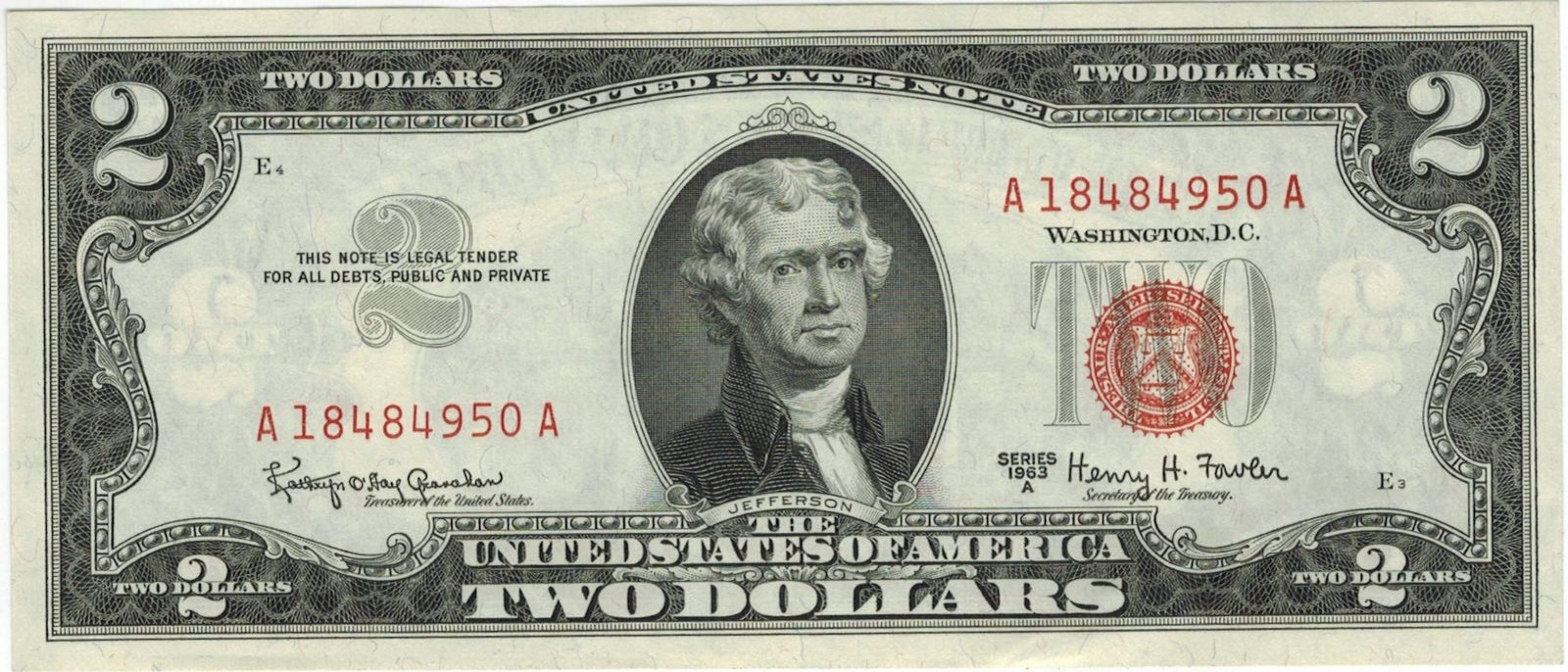
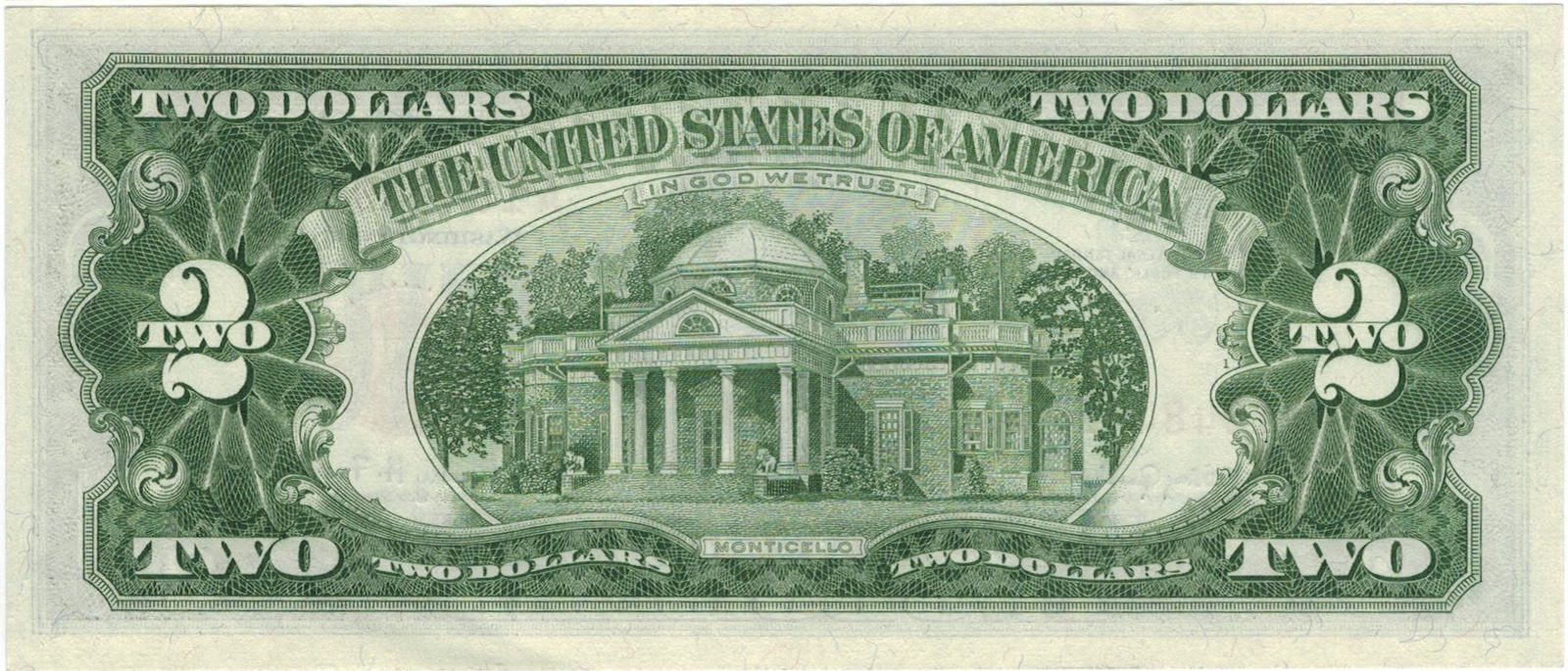
Sources: USPaperMoney.info, Series 1963 $2 and Series 1963A $2 (signatures, blocks) · Public Law 84-140 text · U.S. House of Representatives, History, Art and Archives · obligation change per Wikipedia
Print Runs
The Treasury's total for the 1963 series is 18,560,000 notes, quoted on the Red Seal Era page from the Federal Reserve Bank of Richmond. USPaperMoney.info's compilation of the Bureau's records splits it and adds the star runs, which total 1,280,000. The 1963A star run is the oddity of the whole red seal era: 640,000 stars against 3,200,000 regular notes, a star rate USPaperMoney.info gives as "20.00%," against "4.00%" for Series 1953A.
| Series | Signatures | Delivered to the Treasury | Regular Notes | Star Notes | Serial Block |
|---|---|---|---|---|---|
| 1963 | Granahan, Dillon | "between March and June 1964" | 15,360,000 | 640,000 | A00000001A to A15360000A; stars *00000001A to *00640000A |
| 1963A | Granahan, Fowler | "in July 1965" | 3,200,000 | 640,000 | A15360001A to A18560000A; stars *00640001A to *01280000A |
| Total | 18,560,000 | 1,280,000 |
Small runs did not make either series scarce. The notes were printed at the end of the denomination's life, when "the average life of the $2 bill was six years" because it barely circulated, and when the end was announced in 1966 Treasury officials "said that they wouldn't be surprised if the fade-out announcement stirred a demand for the bills as collector's items." That is why the aggregator holds 285 records of Series 1963 notes at GEM-67 and prices them at $42.00, and why the dealer guide asks the same "$16" for an MS 63 of either series despite 1963A having a fifth of the regular run.
Sources: USPaperMoney.info, Series 1963 · Series 1963A (delivery dates, counts, blocks, the 20.00% star rate) · Federal Reserve Bank of Richmond, 1976 (the 18,560,000 total, average life) · U.S. News and World Report, August 22, 1966 (reproduced at Click Americana) · Serial Worth, 1963 · Silver Recyclers
Documented Sales and Offerings
The first block is what an auction house or grading service itself published: offerings with estimates and one population fact, because the archives that hold the hammer prices could not be reached when this page was written. The second block is an aggregator's records, which carry the serial, grade, date, and price but do not name the house, and are listed as secondary evidence for that reason.
| Date | Note | Grade | Price | Evidence | Source |
|---|---|---|---|---|---|
| March 19, 2020 | Series 1963A star, Friedberg 1514*, D. Brent Pogue Collection, Stack's Bowers; PMG lists the note, not the price | PMG Superb Gem Uncirculated 68 EPQ | Not stated | Population and provenance | PMG, Pogue Collection list |
| November 13, 2018 | Series 1963, Friedberg 1513, Lyn Knight Fall in Kansas sale, lot 28481 | PCGS Superb Gem New 67 PPQ | $100 to $200 estimate | Secondary (estimate) | Lyn Knight catalog |
| November 13, 2018 | Series 1963 star, serial *00000026A, lot 28482 | VF/XF | $100 to $200 estimate | Secondary (estimate) | Lyn Knight catalog |
| November 13, 2018 | Series 1963, a full pack of 100 consecutive notes, lot 28480 | Choice to Gem CU | $1,000 to $1,500 estimate | Secondary (estimate) | Lyn Knight catalog |
| June 15, 2019 | Series 1963, "consecutive half-pack of 50 Red Seal Deuces," Lyn Knight IPMS sale, lot 51643 | Choice to Gem CU | $600 to $900 estimate | Secondary (estimate) | Lyn Knight catalog |
| May 4, 2022 | Series 1963 star, low serial, "Short upper margin tear affects nothing," Lyn Knight, lot 101552 | VF | $500 to $1,000 estimate | Secondary (estimate) | Lyn Knight catalog |
| September 15, 2023 | Series 1963, plain serial A00517243A, aggregator record | GEM-70 | $5,520 | Secondary (aggregator) | Serial Worth, 1963 |
| September 19, 2008 | Series 1963 star, serial 00601601, a trinary pattern, aggregator record | UNC-64 | $4,600 | Secondary (aggregator) | Serial Worth, 1963 |
| January 6, 2012 | Series 1963 star, serial 00128943, aggregator record | GEM-69 | $4,025 | Secondary (aggregator) | Serial Worth, 1963 |
| September 18, 2020 | Series 1963, plain serial A14915254A, aggregator record | GEM-70 | $2,640 | Secondary (aggregator) | Serial Worth, 1963 |
| August 9, 2022 | Series 1963 star, serial 00623461, aggregator record | GEM-69 | $2,640 | Secondary (aggregator) | Serial Worth, 1963 |
| April 26, 2013 | Series 1963A, plain serial A18222235A, aggregator record | GEM-70 | $3,407.50 | Secondary (aggregator) | Serial Worth, 1963A |
| September 18, 2020 | Series 1963A, plain serial A18222230A, aggregator record; the same note is recorded at $2,300 on January 5, 2007 | GEM-70 | $2,400 | Secondary (aggregator) | Serial Worth, 1963A |
| September 15, 2023 | Series 1963A, plain serial A18353478A, aggregator record | GEM-69 | $1,680 | Secondary (aggregator) | Serial Worth, 1963A |
| January 8, 2010 | Series 1963A star, serial 00922753, aggregator record | GEM-68 | $632.50 | Secondary (aggregator) | Serial Worth, 1963A |
What Could Not Be Sourced
Heritage's, Stack's Bowers', and GreatCollections' own lot archives answered HTTP 403 when this page was written, so no realized sale for any 1963 or 1963A note is reported here by the house that sold it; every price in the table above is an aggregator's record or a catalog estimate, and none is confirmed against a house archive or given a lot number. The price the Pogue Collection's 1963A star brought in March 2020 could not be found. No sale of a 1963 or 1963A inverted overprint was found.
Sources are linked in each row. Serial Worth is a value aggregator; its rows name no auction house or lot.
Condition and Grading
Because so many 1963 notes were saved crisp, a gem grade is the normal case and the price steps are small until the very top. The aggregator's Series 1963 figures rise from $8.50 at AU-55 to $20.50 at GEM-65, $42.00 at GEM-67, $170.75 at GEM-68, and $470.00 at GEM-69, with five GEM-70 records topping out at $5,520. In PMG's definitions a 65 Gem Uncirculated "may have one or two minor distractions as a result of minor handling. The centering must be above average," and a 58 is "often a note with a single fold that crosses the design." A 1963 note with one center fold is an $8 note; the same note unfolded and well centered can be a $40 note, and only a grader can say whether it is a $400 one.
Sources: Serial Worth, 1963 (grade figures and counts) · PMG Grading Scale · Silver Recyclers (the $8 very fine figure)
The Last Red Seal: August 1966
The Federal Reserve Bank of Richmond's 1976 account records that the 1963 series "was officially discontinued by the Treasury Department in August 1966. At that time the $2 note accounted for approximately one-third of one percent of total currency outstanding." U.S. News and World Report carried the Treasury's August 10, 1966 announcement that the $2 was being dropped for "lack of public demand," with the last printing in May 1965, which fits the July 1965 delivery of the last 1963A notes. Series 1963A is therefore the last $2 United States Note and the last red seal $2; the denomination returned in 1976 as a green seal Federal Reserve Note. The full story, from the size change of 1928 to the 1966 announcement and the two laws that shaped the last red seals, is on the Red Seal Era page.
Sources: Federal Reserve Bank of Richmond, "The $2 Bill Returns," 1976 (PDF) · U.S. News and World Report, August 22, 1966 (reproduced at Click Americana) · USPaperMoney.info, Series 1963A
Questions About the 1963 $2 Bill
How Much Is a 1963 $2 Bill Worth?
"around $8 in very fine condition" and "around $16" in MS 63 for either series, per a dealer guide; an aggregator's records put a Series 1963 at $8.50 in AU-55 and $20.50 in GEM-65. Only grades of 68 and above and the top star notes have brought hundreds to thousands.
Is a 1963A $2 Bill Worth More Than a 1963?
Not in the guides. The dealer figures are identical for the two series, and the aggregator's GEM-67 figures are $42.00 for 1963 and $39.00 for 1963A, although 1963A had 3,200,000 regular notes against 15,360,000. The 1963A star asks a little more, "around $70" against "around $47" in MS 63.
Is a 1963 Red Seal $2 Bill Still Legal Tender?
Yes. The Bureau of Engraving and Printing states that "All U.S. currency remains legal tender, regardless of when it was issued." A 1963 note can be spent for two dollars, which is roughly what a folded one is worth.
Why Did the $2 Bill Stop in 1966?
"lack of public demand," in the Treasury's words on August 10, 1966; the denomination was then about one-third of one percent of currency outstanding. The Richmond Fed's 1976 article adds that the small 1963 printing "made the bill an extreme novelty, thereby contributing to public superstitions about it."
Sources: as cited in the sections above, chiefly Silver Recyclers, Serial Worth, the BEP FAQ, and the Federal Reserve Bank of Richmond.