C 00000001 A
Collecting Two-Dollar Bills
Honest numbers first: most $2 bills are worth two dollars. Here is what makes the exceptions, and how to spot them.
How Much Is a $2 Bill Worth?
CoinWeek's guide to the Series 1976 note, the one most people find in a drawer, gives the market plainly: circulated examples bring face value, uncirculated notes $3 to $4, and star notes a premium. That is a Series 1976 figure. Later green-seal series have no comparable published figure in this site's sources; the dealer guides quoted on the Star Notes page cover their star notes, and the value table lists each series on its own row.
Value comes from five places, roughly in order of how often they matter:
- Age and type. Large-size notes before 1928 and, to a lesser degree, red-seal notes from 1928 to 1963 carry real premiums because far fewer survive in nice shape.
- Condition. Folds, soft corners, and handling marks are what the grade measures, and the grade moves the price: recorded sales put a Very Fine 20 Series 1953 $2 at $6.50 and an Uncirculated 63 at $21.51. Uncirculated means never folded, with sharp corners and original crispness.
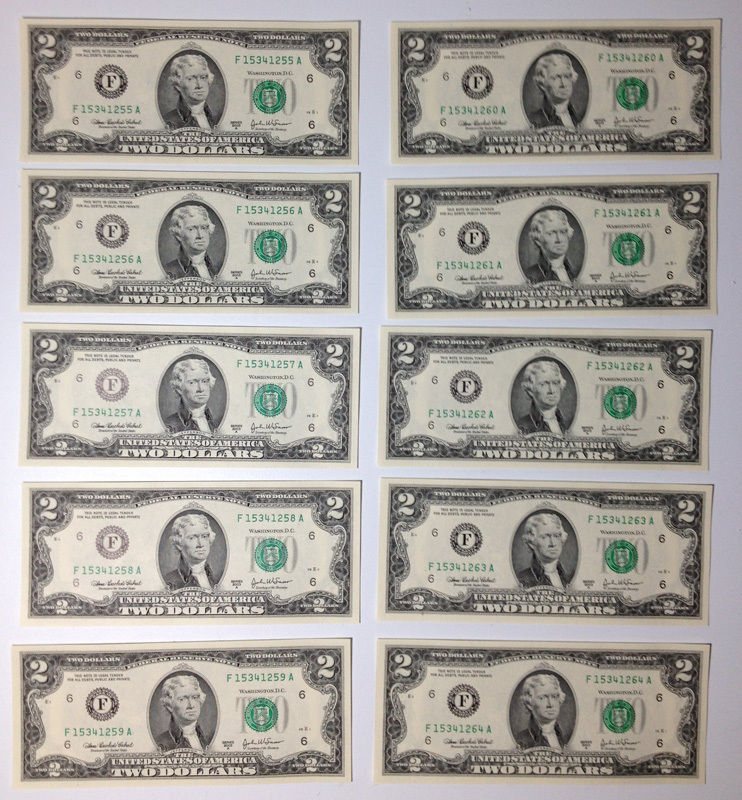
- Serial number. Stars, very low numbers, and patterns. This is where modern notes become valuable. See valuable serial-number patterns.
- District scarcity. Some series were printed for one district or a few, and star notes for fewer still.
- Errors. Doubled or inverted seals and serials, mismatched numbers, printed folds. Rare on a $2, and the good ones bring four and five figures. Auction records.
Sources: CoinWeek, "The Bicentennial $2 Bill: First of a Kind" · Serial Worth, Series 1953 sales
Which $2 Bills Are Rare?
Three things make a note rare in the market, and the print tables show only the first: how many were printed, how many survive, and how many collectors want one. Survival is what the grading services' population reports count (PMG had recorded 6,040 star notes among 18,830 Series 1976 $2 grading events as of July 2024, per the Star Notes page), and demand shows only in sold prices, which the value table collects. A small printing with no demand stays cheap. With that said, the print tables tell you where the small issues are. Series 1995 was printed only for Atlanta (F), Series 2003 only for Minneapolis (I). Series 2009 skipped five districts. And star notes are always the thin end: Series 2003A had 320,000 stars against 230,400,000 regular notes, all for Atlanta; Series 2009 had 640,000 stars, only for New York (B) and Dallas (K).
Within Series 1976, the star counts by district ranged from 2,560,000 for New York down to 640,000 each for Richmond (E), Minneapolis (I), and Kansas City (J). A 1976 star from one of those three is the one to look at twice.
| District | Regular Notes | Star Notes |
|---|---|---|
| A Boston | 29,440,000 | 1,280,000 |
| B New York | 67,200,000 | 2,560,000 |
| C Philadelphia | 33,280,000 | 1,280,000 |
| D Cleveland | 31,360,000 | 1,280,000 |
| E Richmond | 56,960,000 | 640,000 |
| F Atlanta | 60,800,000 | 1,280,000 |
| G Chicago | 84,480,000 | 1,280,000 |
| H St. Louis | 39,040,000 | 1,280,000 |
| I Minneapolis | 23,680,000 | 640,000 |
| J Kansas City | 24,960,000 | 640,000 |
| K Dallas | 41,600,000 | 1,280,000 |
| L San Francisco | 82,560,000 | 1,920,000 |
| Total | 575,360,000 | 15,360,000 |
Sources: USPaperMoney.info, Series 1976 $2 · Series 2003A · Series 2009 · full series table on Series and Production
The Big Sales
The headline numbers people see in "your $2 bill could be worth thousands" articles are real. For ordinary modern green-seal notes without special provenance, they are all serial numbers or errors, never plain notes. Older types are a different market, and so is provenance: the most ever paid for a $2 bill was for a Series 1953 note flown to the Moon.
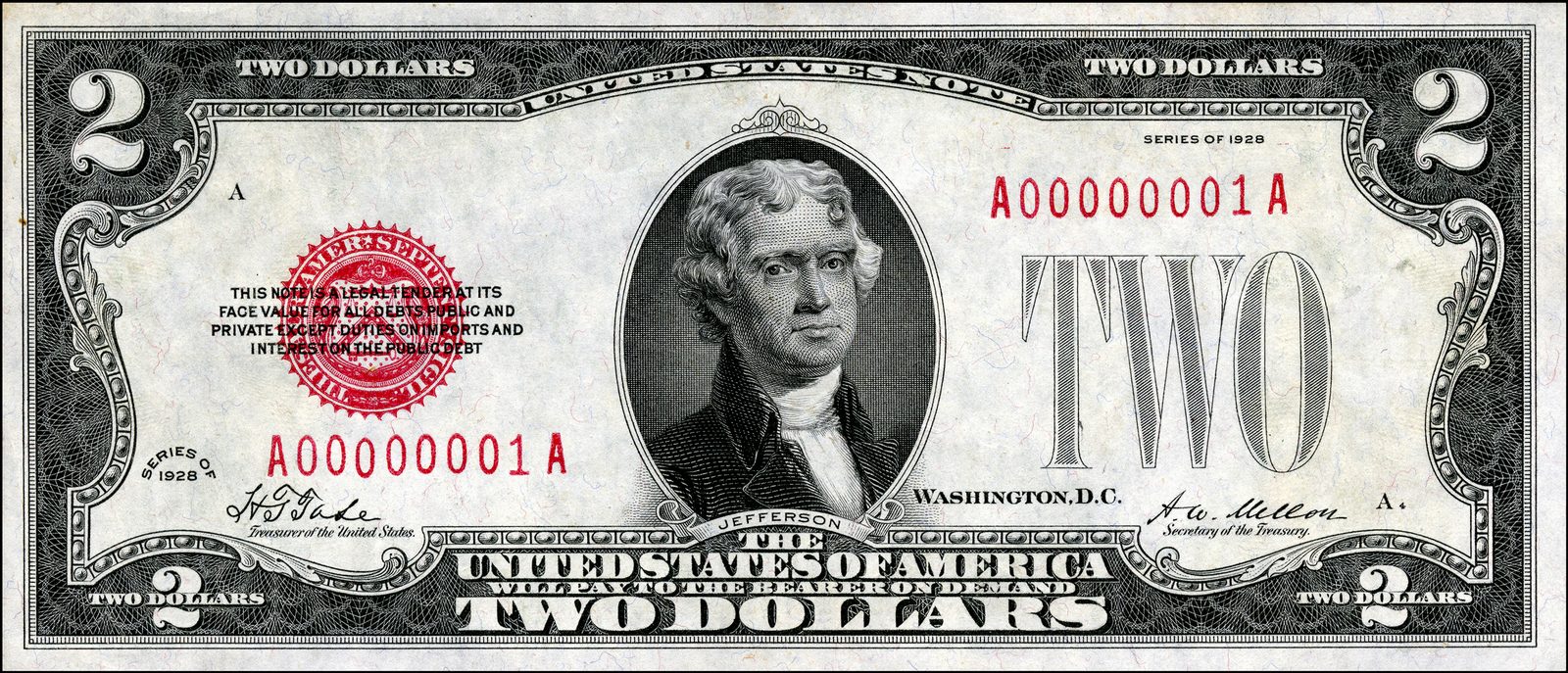
- The record for a modern $2: a Series 1976 San Francisco star note with serial number 00000001, PCGS 64 PPQ, sold for $35,250 at Heritage Auctions in January 2016. The plain serial number 1 from the same district brought $21,150 in the same sale. That $35,250 gets repeated online as an "error note"; it was the serial number.
- A Series 1976 note with serial number 00000002 sold at Heritage in November 2023 for $4,000.
- Heritage sold a Series 2003 $2 for $2,400 in July 2022; the reason given was a low serial number.
- The highest documented $2 error sale found for this site is a Series 1976 Cleveland note with a doubled third printing, $19,200 at Heritage in January 2022.
Grading matters at that level. Notes in Heritage's premium results are almost always holdered by PMG or PCGS Currency, with the grade and any "EPQ" or "PPQ" original-paper designation on the label. The full record book, with the grade ladder, is here.
Sources: Heritage, The Intelligent Collector · CoinWeek · American Numismatic Association · NBC Chicago · Numismatic News
Buying Without Getting Burned
Online listings for $2 notes attract more than their share of fraud, because the notes are cheap to fake up as "rare" and buyers rarely know the print tables. What protects a buyer:
- Buy the bank, not the listing, for plain notes. An ordinary uncirculated 2013 or 2017A is available at face value from any bank that will order for you. Paying $8 online for a $2 note only makes sense if you cannot get to a bank. How to get $2 bills from your bank.
- For anything with a premium, insist on photos of the actual note, both sides, with the serial number legible. Stock photos on a "star note" listing are a red flag.
- Check the serial against the print tables. A claimed star note should fall inside a real star range for its series and district. The tables at USPaperMoney.info are free.
- Treat "colorized," "gold," and "enhanced" notes as novelties. No agency authorizes them, the treatment has no official collector status, and no sold price for one is in this site's sources.
- For notes over about $50, buy graded (PMG or PCGS Currency holders) or from a dealer who will put the grade in writing.
- Pay in a way you can dispute. Friends-and-family transfers and gift cards are how the scam ends.
Serial ranges for every series: USPaperMoney.info. Grading services: PMG, PCGS Banknote.
C 00000006 A
The Collecting Guides
Value
How Much Is a $2 Bill Worth?
Reported values by year and type, star notes, and what the rare ones brought at auction.
Identify
Star Notes
Why the Bureau prints replacement notes with a star, how to spot one, and every modern $2 star run with its size.
Identify
Serial Numbers
Stars, low numbers, ladders, radars, solids, and birthdays.
Value
Errors and Auction Records
The $35,250 serial number 1 star note, the $19,200 doubled-print error, and the grade ladder.
Identify
1976 First Day Postmarks
Ten million of them. What they are and what they bring.
Buy
Uncut Sheets
Buying twos by the sheet from the government, and what Woz does with them.
Value by Year
Value
1976 $2 Bill Value
Condition, the twelve district star runs, documented serial-number and error sales, and first-day postmarks.
Value
1953 $2 Bill Value
Red seal values by letter and grade: 1953A, 1953B, and 1953C signatures, star runs, and documented sales.
Value
1928 $2 Bill Value
1928 through 1928G by letter: the scarce 1928B, star notes, mules, documented sales, and errors.
Value
1963 $2 Bill Value
1963 against 1963A, the motto change, star runs, the 1966 discontinuation, and values by grade.
Value
2003 $2 Bill Value
2003 against 2003A, their star runs and collector sets, and the $2,400 low-serial sale in context.
Value
2013 $2 Bill Value
Every district's print run, the three star runs and the San Francisco caveat, and headlines against documented sales.
Value
2017A $2 Bill Value
Why the series is 2017A, the 2019 runs by district, and the disputed Philadelphia star range.