B 00000000 A
Before 1862
The United States printed its first $2 in 1862. Americans had been spending two-dollar notes for 87 years by then, issued by a Congress, a colony, a republic, thousands of banks, and a rebellion.
1775 to 1779
The Continental Two
The Continental Congress began issuing paper money on May 10, 1775 to pay for the Revolution, and a $2 note was in the mix from the start. The note promised the bearer "TWO SPANISH MILLED DOLLARS, or the Value thereof in GOLD or SILVER," because the Spanish dollar was the coin people actually had. Two-dollar Continentals were printed for the emissions of November 29, 1775; February 17, 1776; May 9, 1776; July 22, 1776; November 2, 1776; February 26, 1777; May 20, 1777; and January 14, 1779, all by the Philadelphia printers Hall and Sellers, the firm Benjamin Franklin had founded.
Each denomination carried its own emblem and Latin motto. The $2 shows a hand with a flail over sheaves of wheat on a threshing floor, with the words TRIBULATIO DITAT, explained in a 1775 letter as "Affliction enriches," or, applied to the picture, "Threshing improves it." The backs carry Franklin's anti-counterfeiting trick: prints taken from real leaves, whose vein patterns no engraver could copy, on paper flecked with mica and blue threads.
Congress put out roughly $241.5 million of Continental currency in all. By 1779 it had "depreciated to pennies on the dollar," in the New York Fed's words; on March 18, 1780 Congress itself devalued it to one-fortieth of face; by mid-1781 it stopped circulating. That is where "not worth a Continental" comes from, and the $2 was part of it.
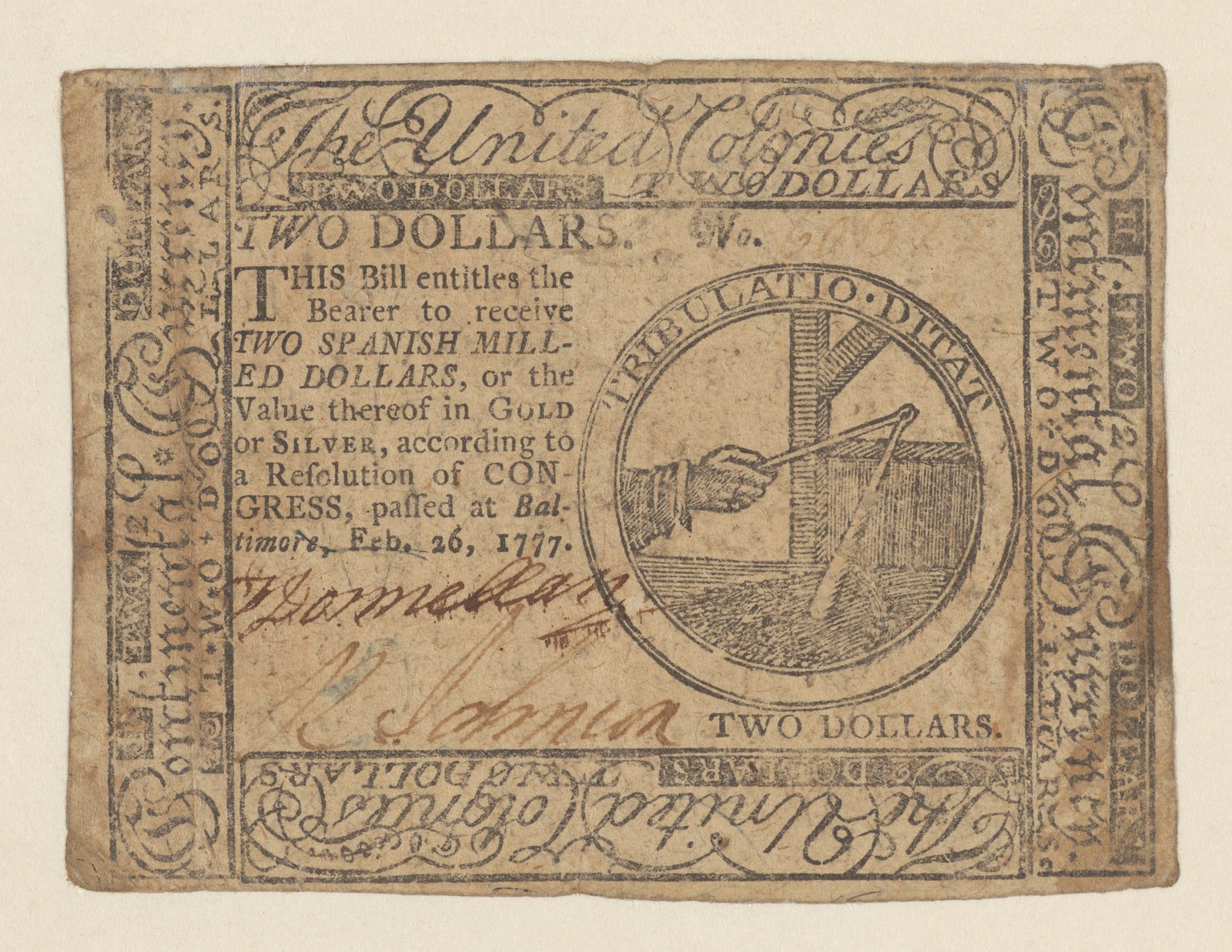
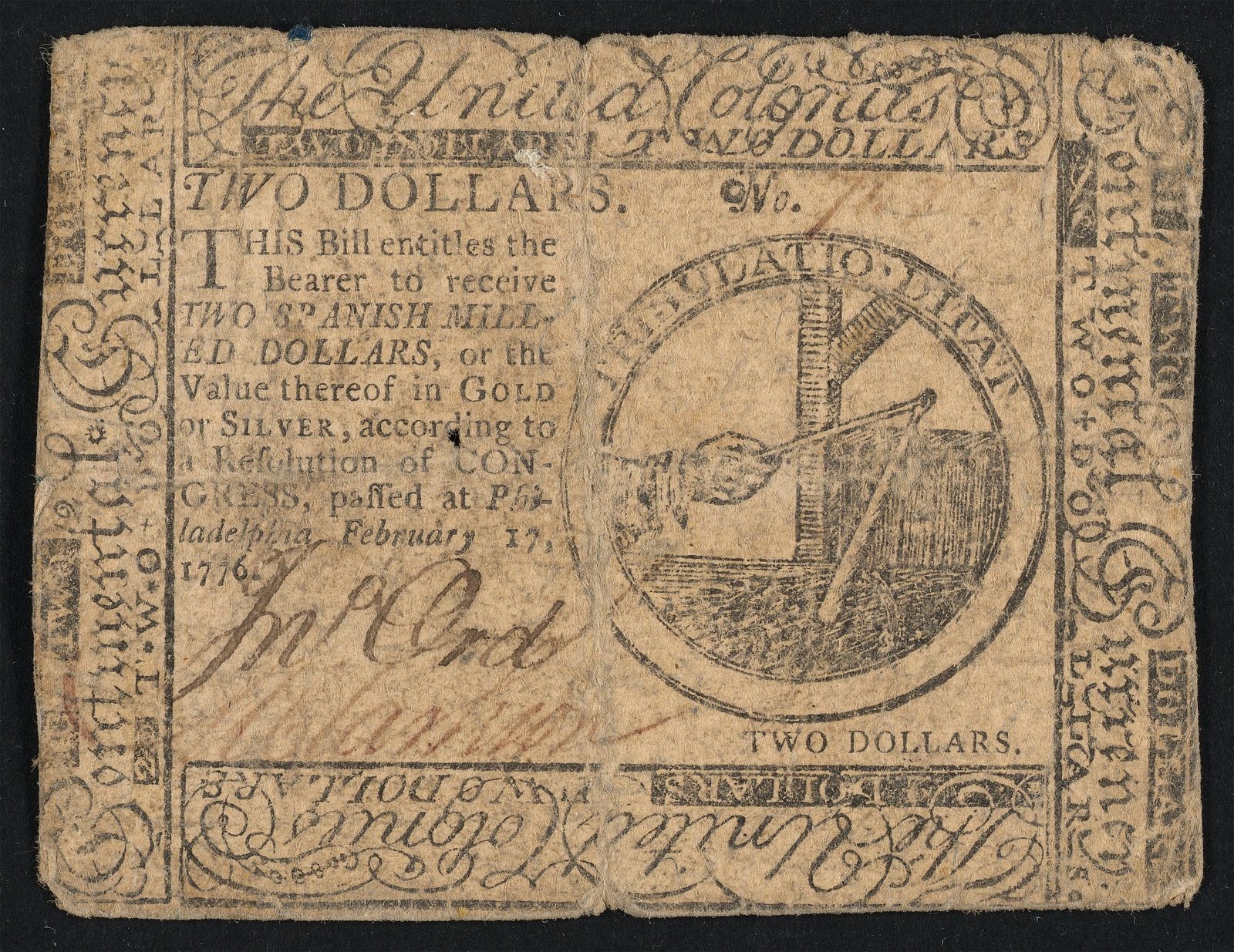
Sources: University of Chicago Library, American currency finding aid · Baker Library, Harvard Business School, 1776 $2 (face text and printer) · Wikimedia Commons, Continental $2 emissions · Metropolitan Museum of Art, February 26, 1777 $2 · Harper's, March 1863, reprinting the 1775 explanation of the devices (via Brewminate) · The Conversation, on the Notre Dame study of Franklin's paper money · New Jersey State Library, "Not Worth a Continental" · Federal Reserve Bank of New York, Liberty Street Economics

1774
A Colony's Two Dollars
Most colonial paper money before the Revolution was denominated in pounds, shillings, and pence. Maryland was the exception, issuing dollar-denominated notes as early as 1770, and a Maryland $2 dated 1774 sits in the National Museum of American History. The Continental $2 of 1775 was therefore not the first two-dollar note on the continent, only the first from a national government.
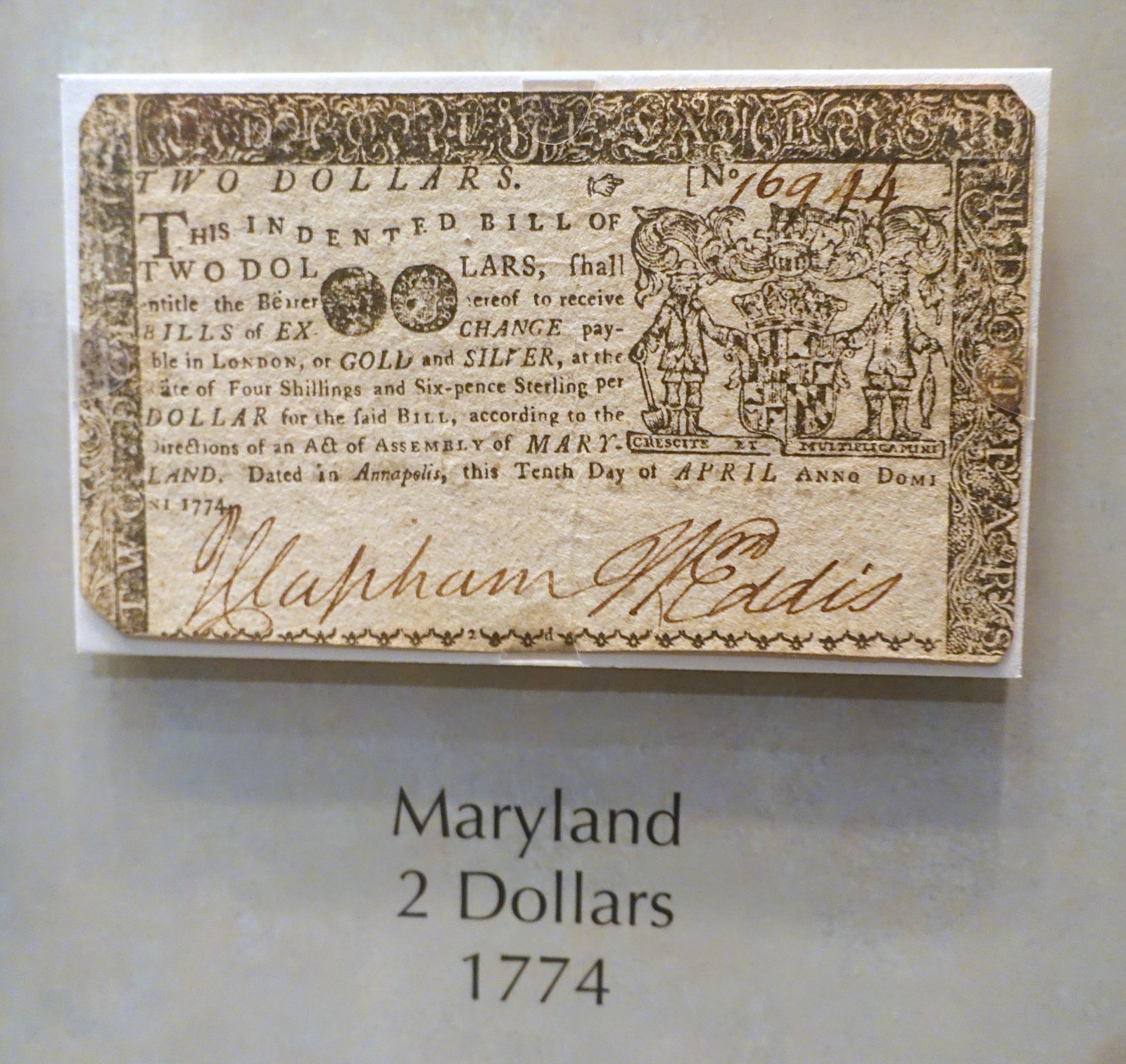
Sources: University of Chicago Library finding aid (colonial notes in shillings and pence) · National Museum of American History exhibit, photograph via Wikimedia Commons (CC0) · Maryland 1770 dollar notes at Baker Library


1800s to 1866
Seven Thousand Banks, Each With Its Own Two
For the first half of the nineteenth century, paper money in the United States was issued by banks, not the government. The Office of the Comptroller of the Currency describes "thousands of individual banks" issuing "paper notes issued in multiple denominations"; the Society of Paper Money Collectors' database of these obsolete notes lists 7,012 issuers and 24,949 designs. A $2 from the Merchants and Planters Bank of Florida in the 1840s or the Bank of DeSoto, Nebraska in 1857 was good money near the bank and a discounted curiosity a few hundred miles away. Collectors call them "broken bank notes" because so many of the banks broke.
The National Currency Act of February 25, 1863 created national banks and the Comptroller's office; the National Bank Act of June 1864 rebuilt it. Then Congress killed the state notes outright. The Act of March 3, 1865 provided that every bank "shall pay a tax of ten per centum on the amount of notes of any state bank or state banking association, paid out by them after the first day of July, eighteen hundred and sixty-six." State bank notes in circulation fell from $143 million in 1865 to $4 million by 1867. From then on, a two-dollar bill meant a federal note or a National Bank Note on a federal design, the Lazy Deuce.
Sources: Office of the Comptroller of the Currency, history 1863 to 1865 · Society of Paper Money Collectors, obsolete note database · Smithsonian, Bank of Florida $2 · Smithsonian, Bank of DeSoto $2 · Act of March 3, 1865, 13 Stat. 469, section 6 (govinfo) · Federal Reserve History, National Banking Acts · American Numismatic Society, "A Rare 1866 Obsolete Bank Note"
1837 to 1842
The Republic of Texas Two
An independent Texas needed money and had no silver or gold to coin, so it printed. The act of June 12, 1837 authorized $500,000 in interest-bearing promissory notes that "bore 10 percent interest, and were payable twelve months from date," marked with "a small five-pointed star in the center of the upper part of the face," which gave them the name Star Money. Denominations ran $1, $2, $3, $5, $10, $20, $50, $100, and $500. President Lamar's act of January 19, 1839 replaced them with non-interest "redbacks," including change notes of $1 to $3, and the Texas State Library records the result: "initially worth about 37 cents to a U.S. dollar," and by 1842 "virtually worthless." A Republic of Texas $2 change note is a real, scarce collectible; one dealer sold an 1841 example graded Good for $945.
Sources: Handbook of Texas, "Money of the Republic of Texas," Texas State Historical Association · Texas State Library and Archives, Republic currency · The Antiquarium, 1841 $2 change note (dealer sale)
1862 to 1864
The Confederate Two
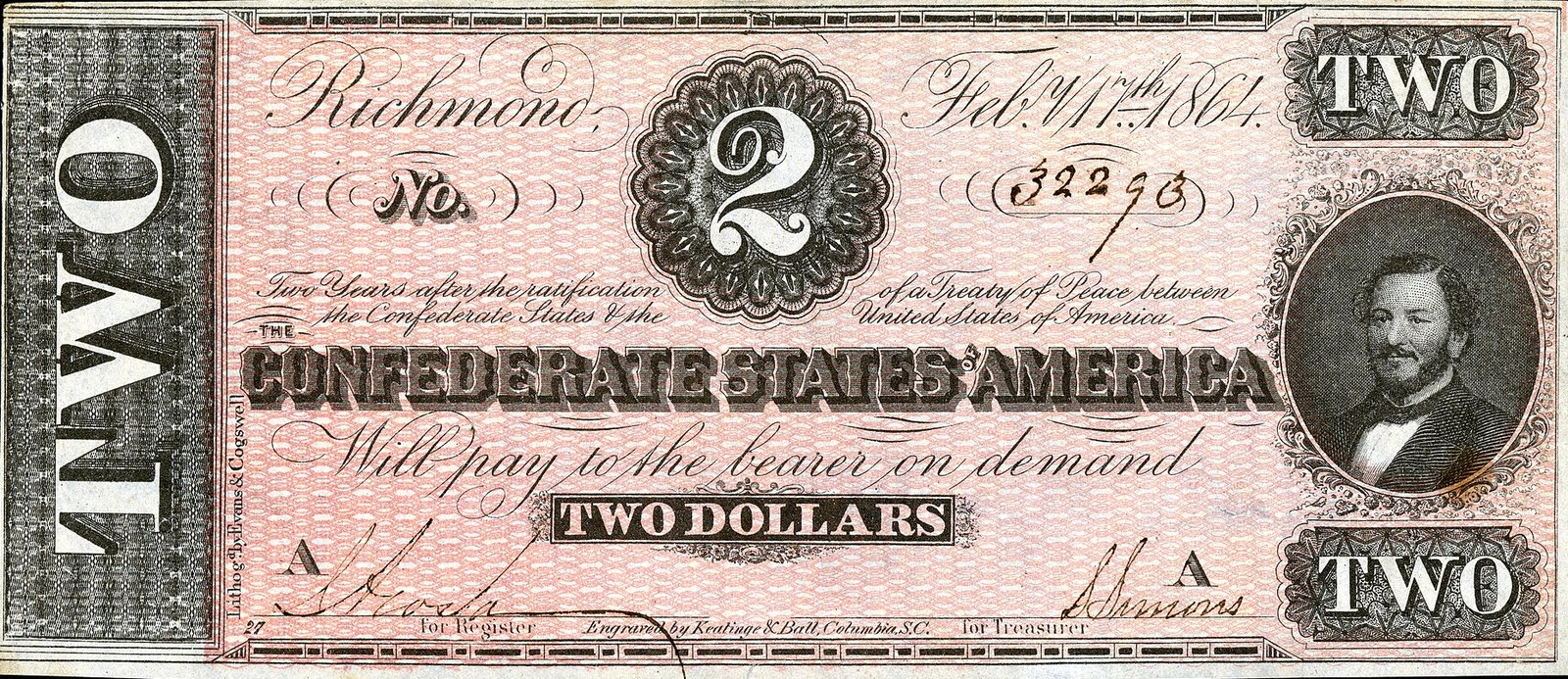
The Confederacy issued 72 types of currency between 1861 and 1864, and its $2 notes all carry the same face: Judah P. Benjamin, the Louisiana senator who served the Confederacy as Attorney General, Secretary of War, and Secretary of State. The first $2 types (T-38, T-42, T-43) were printed by B. Duncan of Columbia, South Carolina in 1862, one of them dated "1861" in error; the later ones (T-54 in 1862, T-61 in 1863, T-70 in 1864) came from Keatinge and Ball, also of Columbia, which printed Confederate money to the end of the war. The standard reference puts the 1862 T-42 at 1,520,000 notes and the 1864 T-70 at about 944,000.
The Virginia Department of Historic Resources gives the arc in three sentences: "The first notes were worth only 95 cents compared to the dollar in gold, and that value quickly fell. By 1863, the notes were worth 33 cents to the dollar. Two years later, they were worth less than 2 cents to the dollar." A Confederate $2 today is an affordable piece of history; a catalog value for the 1864 note in Very Good is about $85.
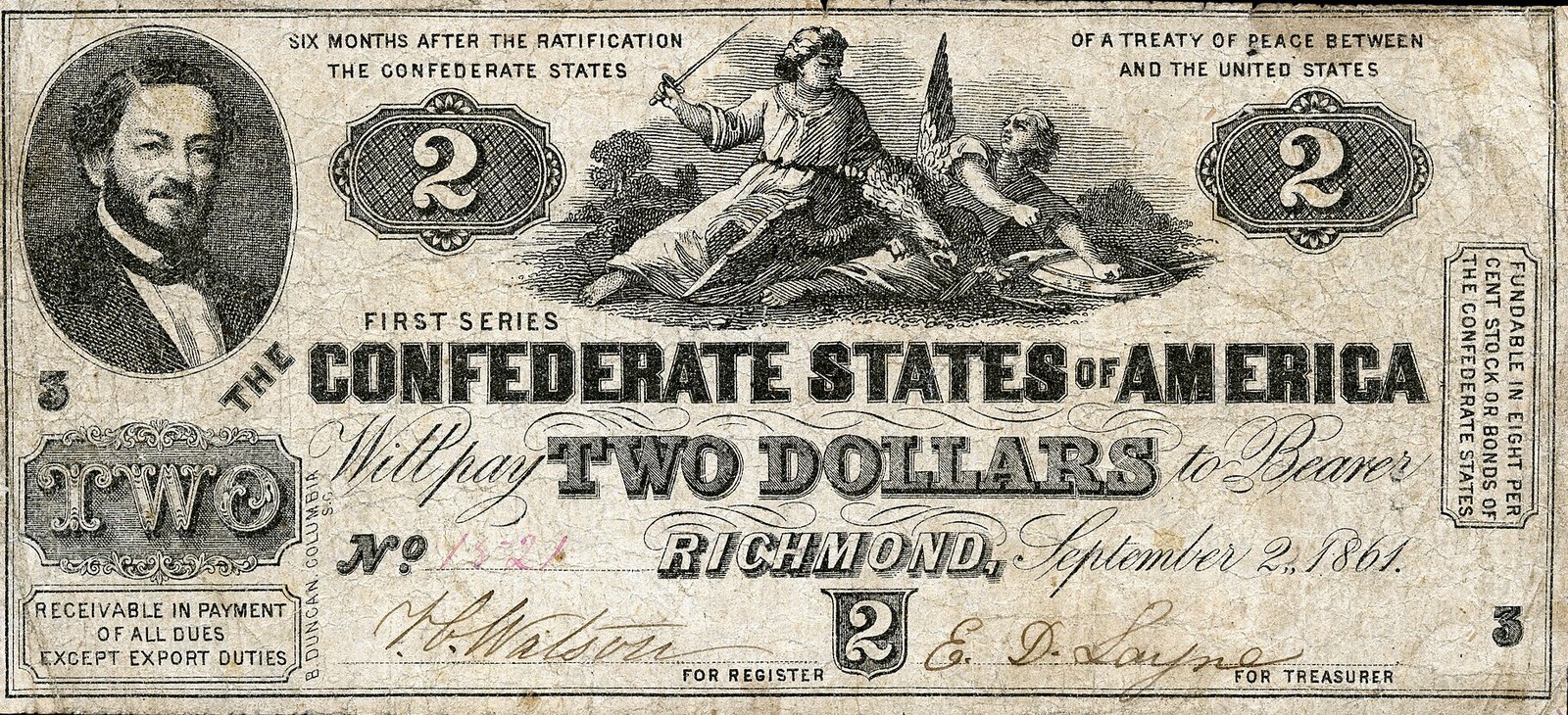
Sources: Virginia Department of Historic Resources, "Paying for Rebellion" · Smithsonian NNC scan of T-38 (via Wikimedia Commons) · Smithsonian NNC scan of T-70 · Numista, 1864 $2 catalog entry · type quantities per Fricke as summarized on Wikipedia
.jpg)

1861 to 1862
Why the First Federal Two Was 1862 and Not 1861
The Union's first paper money, the Demand Notes of 1861, came only in $5, $10, and $20. The first Legal Tender Act of February 25, 1862 authorized $150 million of United States Notes "of such denominations as he may deem expedient, not less than five dollars each." The small notes had to wait for the second act, of July 11, 1862, which authorized another $150 million and added the clause that made the $1 and $2 possible: "no note shall be issued for the fractional part of a dollar, and not more than thirty-five millions shall be of lower denominations than five dollars." That is the act the 1862 $2 cites in its top border, and its second section, letting the Secretary have notes "engraved, printed, and executed" at the Treasury in Washington, is the legal root of the Bureau of Engraving and Printing.
Greenbacks were controversial from the day they were born. Civil War spending had caused a coin shortage, the notes were declared "lawful money and a legal tender in payment of all debts, public and private," and they promptly traded at a discount to gold. In 1870 the Supreme Court, in Hepburn v. Griswold, ruled that forcing creditors to accept them for earlier debts was unconstitutional; a year later, in Knox v. Lee, it reversed itself. The $2 in your wallet is legal tender because of that second decision.
Sources: American Numismatic Association Money Museum (Demand Note denominations) · Act of February 25, 1862, 12 Stat. 345 (govinfo) · Act of July 11, 1862, 12 Stat. 532 (govinfo) · U.S. Capitol Visitor Center, H.R. 240, Legal Tender Act · Tax Project Institute on the greenback controversy · Legal Tender Cases per Wikipedia