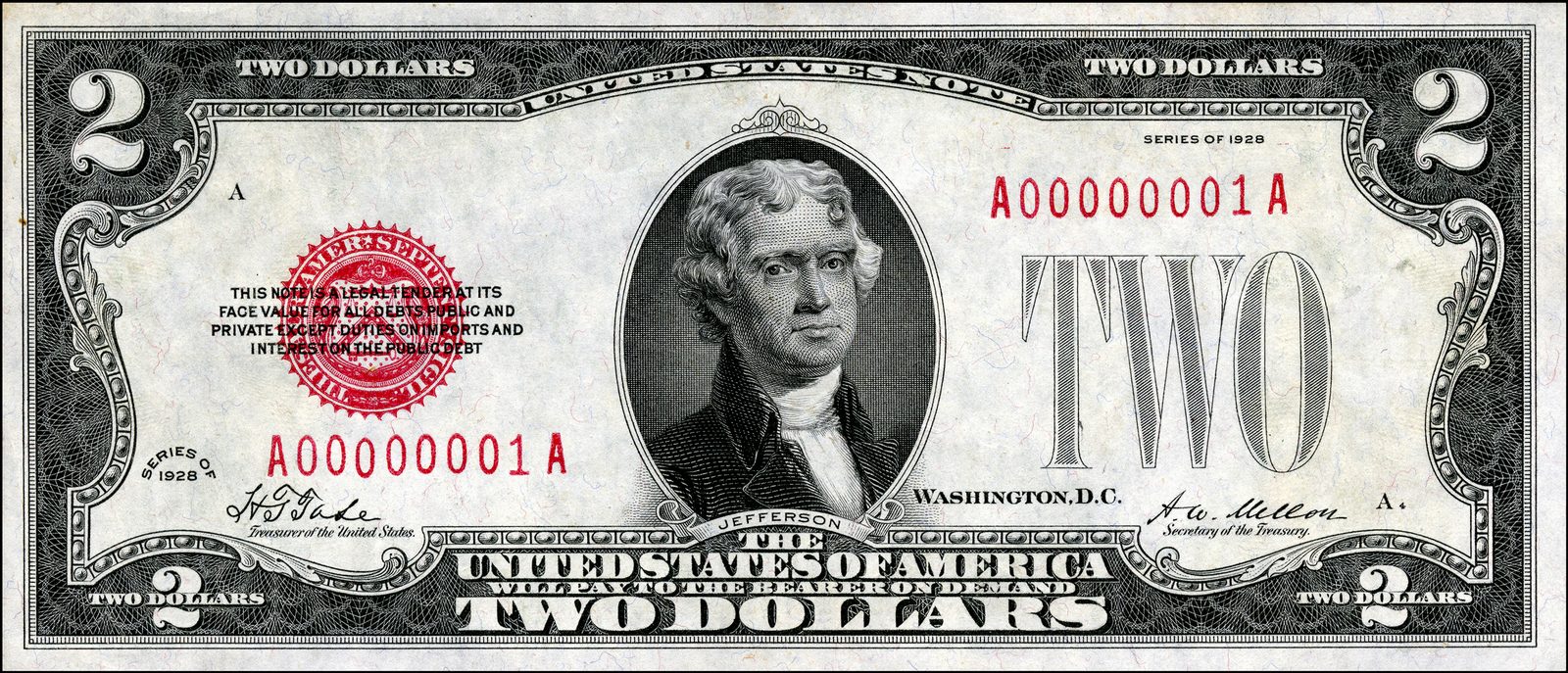
A 00000001 A
How Much Is a 1928 $2 Bill Worth?
The first small-size $2 came in eight letters, 1928 through 1928G, and the letter is most of the answer. Common letters bring tens of dollars; a 1928B brings hundreds; a 1928B star is one of the rarest small-size notes there is. Every figure here carries its source and its evidence type.
The Fast Answer
Every figure below is quoted from the source in its row. The evidence column uses the tiers on the Editorial Standards page: a realized sale is what somebody paid, with the venue and date; a dealer asking price is what a dealer lists; a secondary figure is a press summary, an aggregator's record, or an auction estimate. Unlike the 1953 and 1963 series, the eight 1928 letters carry different prices, so the dealer figures are given letter by letter.
| Note | Reported Figure | Evidence Type | Source |
|---|---|---|---|
| Circulated, ordinary serial, by letter | Dealer guide, very fine: 1928 "$38"; 1928A "$55"; 1928B "$160"; 1928C "$30"; 1928D "$20"; 1928E "$27"; 1928F "$24"; 1928G "$24". An aggregator's VF-20 figures are $19.50 for 1928C (25 records) and $123.00 for 1928B (26 records) | Dealer asking price; secondary (aggregator) | Silver Recyclers, Serial Worth, 1928C, Serial Worth, 1928B |
| Uncirculated, ordinary serial, by letter | Dealer guide, MS 63: 1928 "$155"; 1928A "$260"; 1928B "$725"; 1928C "$135"; 1928D "$100"; 1928E "$115"; 1928F "$70"; 1928G "$80". An aggregator's UNC-63 figures are $126.50 for 1928 (41 records), $88.00 for 1928C (31 records), $51.00 for 1928G, and $528.00 for 1928B (9 records) | Dealer asking price; secondary (aggregator) | Silver Recyclers, Serial Worth, 1928, Serial Worth, 1928G |
| Star note, common letters (1928, C, D, F, G) | Dealer guide, very fine and MS 63: 1928 "$285" and "$1,000"; 1928C "$290" and "$2,600"; 1928D "$95" and "$420"; 1928F "$110" and "$390"; 1928G "$75" and "$365" | Dealer asking price | Silver Recyclers |
| Star note, scarce letters (1928A, B, E) | Dealer guide: 1928A "$1,300" very fine and "$24,000" MS 63; 1928B "$24,000" very fine and "Very Rare" uncirculated; 1928E "$2,900" and "$15,000". Numismatic News: "the 1928B star, with only 8 known, and the 1928 E, also with very few known." A 1928A star, PMG 65 EPQ, was estimated "at least $85,000" by Heritage for January 2025; an aggregator records a 1928B star, VF-25, at $46,000 (January 11, 2008) | Dealer asking price; secondary summary; secondary (estimate); secondary (aggregator) | Silver Recyclers, Numismatic News, PMG, Serial Worth, 1928B |
| Mule (mismatched plate-number sizes), 1928C and 1928D | An aggregator records a 1928C mule, C02144707A, at $4,920 in UNC-63 (January 13, 2023) and $4,370 in AU-55 (February 18, 2005); Numismatic News says "1928 D Mules can be found in dealer stock" while "The 1928 C Mules are very scarce" | Secondary (aggregator); secondary summary | Serial Worth, 1928C, Numismatic News |
| Genuine printing error | $375 and $225 for two Series 1928D gutter folds, PCGS VF 30, at GreatCollections; the 1928D inverted overprint is "unique" per Coin World; Lyn Knight estimated a 1928A gutter fold, VF, at $150 to $300 and a 1928F star gutter fold, VF, at $500 to $1,000 in May 2022 | Realized sales; secondary summary; secondary (estimate) | GreatCollections, Coin World, Lyn Knight |
Sources are linked in each row. The aggregator's grade figures are the values it reports for that grade from the record count shown; its individual sales are repeated with dates and grades further down. No figure on this page is an appraisal of a particular note.
How to Identify a Series 1928 Note
The First Small-Size $2
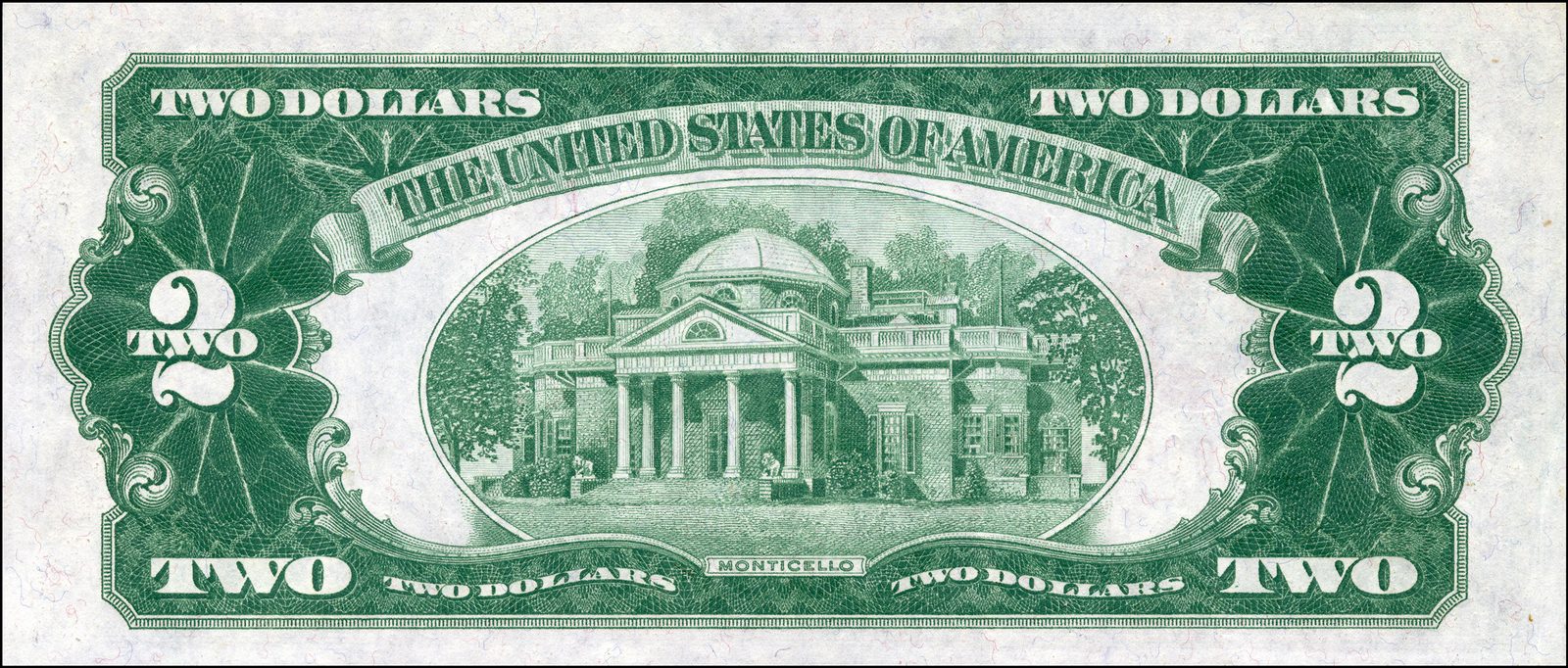
In 1928 U.S. currency shrank to the 6.14 by 2.61 inch size still in use, and the $2 became a United States Note with a red seal and red serials. The Bureau records that "Monticello, Thomas Jefferson's estate in Virginia, was first featured as the vignette on the back of the Series 1928 $2 United States Note." The story of the size change is on the Red Seal Era page.
Large Seal at Left
The 1928 design has a large red Treasury seal on the left of the face and the legal tender obligation on the right. Series 1953 moved a smaller seal to the right over a gray "TWO," so a large left-hand seal on a small note is a 1928 series note of some letter.
Read the Letter and the Signatures
The series letter after "1928" and the two signatures identify the note: Tate and Mellon (1928), Woods and Mellon (1928A), Woods and Mills (1928B), Julian and Morgenthau (1928C and 1928D), Julian and Vinson (1928E), Julian and Snyder (1928F), Clark and Snyder (1928G). Catalogs number them Friedberg 1501 through 1508.
Star, Block, and Plate Numbers
A replacement note has a red star in place of the prefix letter. The serial block (A-A, B-A, C-A, D-A, E-A) says roughly where in the run a note fell. On 1928C and 1928D notes, compare the tiny plate numbers on face and back: a mule is "a note with a micro-sized plate number on one side and a macro-sized plate number on the other," micro being 0.6 mm and macro 1.0 mm.
Sources: BEP, $2 Note · USPaperMoney.info, Series 1928 to 1928G $2 (signatures, blocks) · PMG, "Small Size Varieties," September 28, 2010 (mule definition) · dimensions per Wikipedia
The Eight Letters: Signatures and Print Runs
The Treasury's total for the 1928 series is 430,760,000 notes, quoted on the Red Seal Era page from the Federal Reserve Bank of Richmond; USPaperMoney.info's serial table ends at E30760000A, the same figure, and the notes were "delivered to the Treasury between April 1929 and May 1953." Splitting it by letter is harder than for 1953, because, as USPaperMoney.info explains, "Prior to Series 1953, when notes of different series were in production simultaneously, they would often be mixed together before the serial numbers were overprinted. Therefore, it is not always possible to separate the serial numbers used on one series from those used on the next." The per-letter figures below are the Bureau's plate-summary counts as compiled by two secondary references, which disagree for three letters; both figures are shown where they differ.
| Series | Signatures | Notes Printed (Secondary Compilations) | Serial Block Ends | Notable Variety |
|---|---|---|---|---|
| 1928 | Tate, Mellon | 55,889,424 | A18000000A, then mixed with 1928A | "No Back Plate #" engraving error |
| 1928A | Woods, Mellon | 46,859,136 or 46,859,336 | Mixed with 1928 and 1928B | "No Back Plate #" engraving error; the star is the scarce one |
| 1928B | Woods, Mills | 9,001,632 | B09008000A | Scarcest regular letter; star "with only 8 known" |
| 1928C | Julian, Morgenthau | 86,584,008 | B83988000A | Mules "very scarce" |
| 1928D | Julian, Morgenthau | 146,381,364 | D29712000A | Mules common; unique inverted overprint |
| 1928E | Julian, Vinson | 5,261,016 or 6,480,000 | D36192000A | Star "with very few known" |
| 1928F | Julian, Snyder | 43,349,292 or 42,360,000 | D78552000A | |
| 1928G | Clark, Snyder | "< 52,208,000" | E30760000A | The common letter; "The most common is the 1928G" |
| Total, Treasury | 430,760,000 | Stars: one block for all letters, *00000001A to *04152000A |
The star runs cannot be split by letter for the same reason: USPaperMoney.info reports that "It is unclear whether there is any mixing of series in the star notes during the 1928/1928A transition, or at all during the 1928B/1928C transition." What is clear from the market is which stars are scarce. The dealer guide asks "$24,000" for a 1928B star in very fine and calls an uncirculated one "Very Rare"; PMG had certified five 1928B stars as of August 2015, "Fewer than a dozen representatives of this variant are known to exist," and the finest before that year was a Very Fine 30.
Sources: USPaperMoney.info, Series 1928 to 1928G $2 (delivery dates, serial blocks, mixing) · Federal Reserve Bank of Richmond, 1976, Table I (the 430,760,000 total) · per-letter counts per Numista and The Paper Money Project, which cites the Bureau's "plate summary cards" · varieties per The Paper Money Project and Numismatic News, July 2, 2024 · 1928G per Old Currency Values · PMG, August 19, 2015
Condition and Grading
A 1928 note has had up to nine decades to get folded, so the grade drives the price more than for any later $2. In PMG's definitions a 65 Gem Uncirculated "may have one or two minor distractions as a result of minor handling. The centering must be above average"; a 58 is "often a note with a single fold that crosses the design"; a 40 Extremely Fine has "three or more folds." The aggregator's figures for a plain Series 1928 note run $126.50 at UNC-63, $204.00 at GEM-65, and $646.25 at GEM-67, and for the common 1928G from $7.99 in Good 4 up to $74.00 at GEM-65 and $998.75 at GEM-68.
The top of the population is where the money is. Lyn Knight described a 1928F at PMG 67 EPQ as "Top Pop at PMG" in June 2019 and estimated it at $800 to $1,600; the D. Brent Pogue Collection held a Series 1928 star, Friedberg 1501*, at PMG 67 EPQ; the aggregator records a 1928G at GEM-69 selling for $4,700 in January 2014. The EPQ and PPQ designations matter more here than on a modern note, because a 1928 note that has been pressed or washed to look uncirculated is the commonest disappointment in the series.
Sources: PMG Grading Scale · Serial Worth, 1928 and 1928G (grade figures) · Lyn Knight, June 2019 catalog · PMG, D. Brent Pogue Collection list
Documented Sales and Offerings
The first block is what an auction house or grading service itself published: two realized sales and a set of offerings with estimates, because the archives that hold the hammer prices could not be reached when this page was written. The second block is an aggregator's records, which carry the serial, grade, date, and price but do not name the house, and are listed as secondary evidence for that reason. One aggregator row matches a house-reported offering: the 1928B star at VF-25 that Heritage listed for its April 26 to May 2, 2017 sale appears in the aggregator as a $17,625 sale on April 28, 2017.
| Date | Note | Grade | Price | Evidence | Source |
|---|---|---|---|---|---|
| Not stated | Series 1928D gutter fold, GreatCollections | PCGS VF 30 | $375 | Realized sale | GreatCollections archive |
| Not stated | Series 1928D gutter fold, GreatCollections | PCGS VF 30 | $225 | Realized sale | GreatCollections archive |
| January 14 to 17, 2025 | Series 1928A star, Friedberg 1502*, Heritage FUN Currency Signature Auction, lot 23004; PMG's preview called it "a 1928A $2 Legal Tender Note graded PMG 65 Gem Uncirculated EPQ" | PMG 65 Gem Uncirculated EPQ | "at least $85,000" estimate | Secondary (estimate) | PMG, December 17, 2024 |
| April 26 to May 2, 2017 | Series 1928B star, Friedberg 1503*, Heritage Central States Signature Auction, listed among the featured lots | PMG Very Fine 25 | Not stated | House-reported offering | Numismatic News, April 11, 2017 |
| September 19, 2021 | Series 1928C, Heritage Ferryville Collection Currency Showcase Auction, lot 96009 | PMG 40 Extremely Fine EPQ | "$600 and up" estimate | Secondary (estimate) | PMG, August 27, 2021 |
| June 15, 2019 | Series 1928B, Friedberg 1503, "Gems of this issue remain exceptionally rare," Lyn Knight IPMS sale, lot 51639 | PMG Gem UNC 65 EPQ | $1,500 to $2,500 estimate | Secondary (estimate) | Lyn Knight catalog |
| November 13, 2018 | Series 1928G star, Friedberg 1508*, Lyn Knight Fall in Kansas sale, lot 28476 | PCGS Very Choice New 64 PPQ | $350 to $700 estimate | Secondary (estimate) | Lyn Knight catalog |
| March 18, 2016 | Series 1928, Friedberg 1501, "First issue Legal Tender Deuce," Lyn Knight CPMX sale, lot 701 | PMG Gem UNC 66 EPQ | $400 to $800 estimate | Secondary (estimate) | Lyn Knight catalog |
| March 18, 2016 | Series 1928C star, Friedberg 1504*, "Scarce 1928-C star note," lot 704 | VF+ | $250 to $350 estimate | Secondary (estimate) | Lyn Knight catalog |
| January 11, 2008 | Series 1928B star, serial 00944325, listed with an overprint error, aggregator record; the same note is recorded at $32,900 on April 26, 2013 and $25,850 on January 9, 2015 | VF-25 | $46,000 | Secondary (aggregator) | Serial Worth, 1928B |
| April 28, 2017 | Series 1928B star, serial 00948776, aggregator record | VF-25 | $17,625 | Secondary (aggregator) | Serial Worth, 1928B |
| January 13, 2023 | Series 1928B star, serial 00955901, aggregator record | FN-15 | $9,900 | Secondary (aggregator) | Serial Worth, 1928B |
| January 13, 2023 | Series 1928B, plain serial A92663951A, aggregator record | GEM-67 | $7,800 | Secondary (aggregator) | Serial Worth, 1928B |
| January 6, 2017 | Series 1928 star, serial 00006909, aggregator record; the same note is recorded at $7,637.50 on August 11, 2016 and $4,800 on September 15, 2023 | GEM-66 | $12,925 | Secondary (aggregator) | Serial Worth, 1928 |
| April 29, 2016 | Series 1928 star, serial 00410332, aggregator record | GEM-66 | $8,812.50 | Secondary (aggregator) | Serial Worth, 1928 |
| April 28, 2017 | Series 1928C star, serial 01633427, aggregator record | UNC-64 | $9,400 | Secondary (aggregator) | Serial Worth, 1928C |
| January 13, 2023 | Series 1928C mule, serial C02144707A, aggregator record | UNC-63 | $4,920 | Secondary (aggregator) | Serial Worth, 1928C |
| April 26, 2013 | Series 1928C, plain serial B83988489A, aggregator record | GEM-69 | $4,993.75 | Secondary (aggregator) | Serial Worth, 1928C |
| January 10, 2014 | Series 1928G, plain serial E04169361A, aggregator record | GEM-69 | $4,700 | Secondary (aggregator) | Serial Worth, 1928G |
| April 26, 2013 | Series 1928G star, serial 04044059, aggregator record | GEM-68 | $4,112.50 | Secondary (aggregator) | Serial Worth, 1928G |
| July 24, 2022 | Series 1928G, repeater serial D90909090A, aggregator record | GEM-65 | $2,760 | Secondary (aggregator) | Serial Worth, 1928G |
What Could Not Be Sourced
Heritage's and Stack's Bowers' own lot archives answered HTTP 403 when this page was written, so the only house-reported realized sales here are the two GreatCollections gutter folds, and the aggregator rows above are not confirmed against house records or given lot numbers. No realized price was found for the 1928A star estimated at "at least $85,000" in January 2025, for the 1928B star at PMG 65 EPQ that PMG certified in 2015, or for the Pogue Collection's 1928 star at PMG 67 EPQ. Claims on value sites that a 1928B star "sold for over $88,000" could not be traced to any auction record and are not repeated as fact.
Sources are linked in each row. Serial Worth is a value aggregator; its rows name no auction house or lot. The 1928B star offering per Numismatic News; population per PMG.
Genuine Errors and Varieties
The 1928 series has more documented errors than any later red seal simply because it ran for twenty-four years. The ones on record here, each with its price history where one exists:
| Error or Variety | What It Is | Evidence on Record | Source |
|---|---|---|---|
| Gutter fold | A crease in the sheet before printing, leaving a blank stripe through the design | 1928D, PCGS VF 30: $375 and $225 realized at GreatCollections. Lyn Knight estimates, May 2022: 1928A, VF, $150 to $300; 1928F star, VF, $500 to $1,000; 1928G, VF, $350 to $700 | GreatCollections, Lyn Knight |
| Inverted overprint | The seal and serials printed upside down | The 1928D is "unique" per Coin World, in the Doris A. Bart Collection shown in June 2018; no price on record | Coin World |
| Cutting error | The sheet cut off register, showing part of the neighboring note | 1928G, Gem New, estimated $150 to $300, Lyn Knight, May 2022 | Lyn Knight |
| Ink smear | Excess ink wiped across the design | 1928G, Very Choice About New, "a large ink smear that starts extremely thick and fades in the margin as the wiper cleaned the plate," estimated $250 to $500, Lyn Knight, May 2022 | Lyn Knight |
| Mule | A variety, not an error: micro plate number on one side, macro on the other, from the 1934 to 1953 changeover of plates | 1928C mule C02144707A: $4,920 UNC-63 (January 2023), $4,370 AU-55 (February 2005), aggregator; 1928D mules "can be found in dealer stock at small and large shows" | PMG, Serial Worth, Numismatic News |
A star note is not an error; it is the replacement for one. Buy any error graded: PMG's EPQ and PCGS's PPQ designations certify that the paper was not "physically, chemically, or materially processed," which rules out a note whose overprint was removed or moved after the fact. The full error catalog with grade definitions is on the Errors and Auction Records page.
Sources are linked in each row. Originality definition per the PMG Grading Scale; mule dates per PMG, "Small Size Varieties".
1928 Against 1953 and 1963
The 1928 design ran until May 1953 and was replaced by Series 1953, which shrank the seal, moved it right over a gray "TWO," and set the obligation over a gray 2 on the left; Series 1963 added "IN GOD WE TRUST" above Monticello and dropped "WILL PAY TO THE BEARER ON DEMAND." The later series are more available and cheaper: a dealer guide asks "$11" for any very fine 1953 against "$20" to "$160" for a 1928 depending on the letter. The identification matrix for every letter from 1928 to 1963A is on the Red Seal Era page; the later series have their own guides, 1953 $2 Bill Value and 1963 $2 Bill Value.
Sources: design changes per Wikipedia · delivery dates per USPaperMoney.info · dealer prices per Silver Recyclers, 1928 and Silver Recyclers, 1953
Questions About the 1928 $2 Bill
How Much Is a 1928 $2 Bill Worth?
It depends on the letter. A dealer guide asks "$20" for a very fine 1928D and "$24" for a 1928F or 1928G, up to "$160" for a 1928B; in MS 63 the range is "$70" (1928F) to "$725" (1928B). An aggregator's records put an ordinary Series 1928 at $126.50 in UNC-63 and $204.00 in GEM-65.
Which 1928 $2 Bill Is the Rarest?
Among regular notes, 1928B, with 9,001,632 printed per the secondary compilations against 146,381,364 for 1928D. Among stars, 1928B: Numismatic News counts "only 8 known," PMG had certified five as of 2015, and the dealer guide asks "$24,000" for one in very fine. The 1928E star is next, "with very few known," and the 1928A star was estimated "at least $85,000" by Heritage in 2025.
Is a 1928 $2 Star Note Worth Anything?
Every 1928 star carries a premium. Dealer asking prices for the common letters run "$75" (1928G) to "$290" (1928C) in very fine and "$365" to "$2,600" in MS 63; the scarce letters, 1928A, 1928B, and 1928E, are priced in the thousands to tens of thousands. The aggregator's gem 1928 and 1928G stars have brought $4,112.50 to $12,925.
What Is a 1928 $2 Mule?
A note whose face and back plate numbers are different sizes, 0.6 mm on one side and 1.0 mm on the other, from the changeover of plates between 1934 and 1953. It is a variety, not an error. 1928D mules are common in dealer stock; 1928C mules are "very scarce," and one has sold for $4,920 in the aggregator's records.
Sources: as cited in the sections above, chiefly Silver Recyclers, Serial Worth, Numismatic News, PMG, and Numista.