U 00000001 A
Uncut Sheets
The only way to buy money straight from the printer, and the only $2 product the government marks up.
What the Bureau Sells
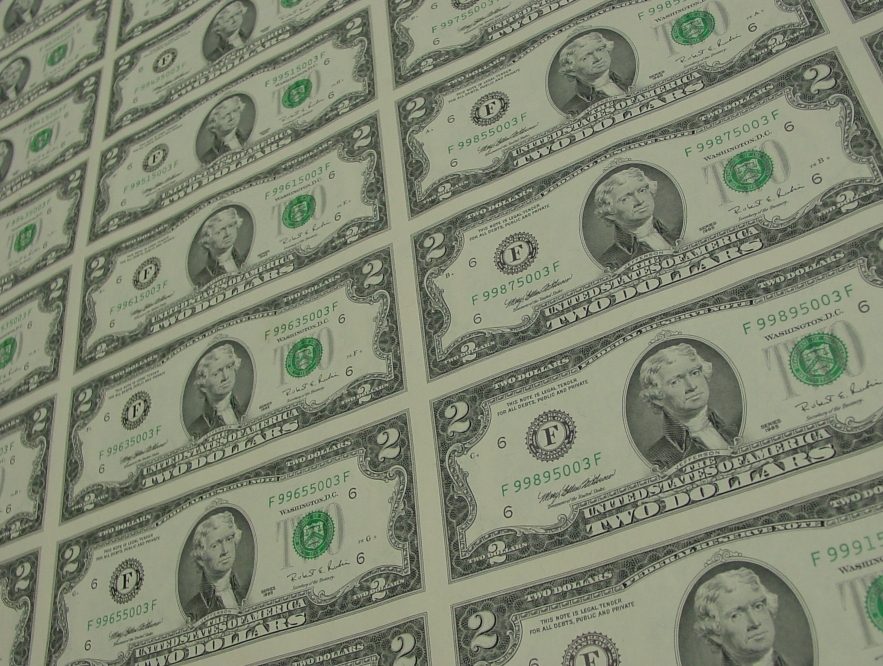
The Bureau of Engraving and Printing sells uncut sheets of currency through its public store. For the $2 the sizes are a full 32-note sheet, which is the size the notes are actually printed on, plus 16-note, 8-note, and 4-note sheets cut from it. They are real, spendable notes; nothing stops you from cutting one out and buying coffee, except the price you paid.
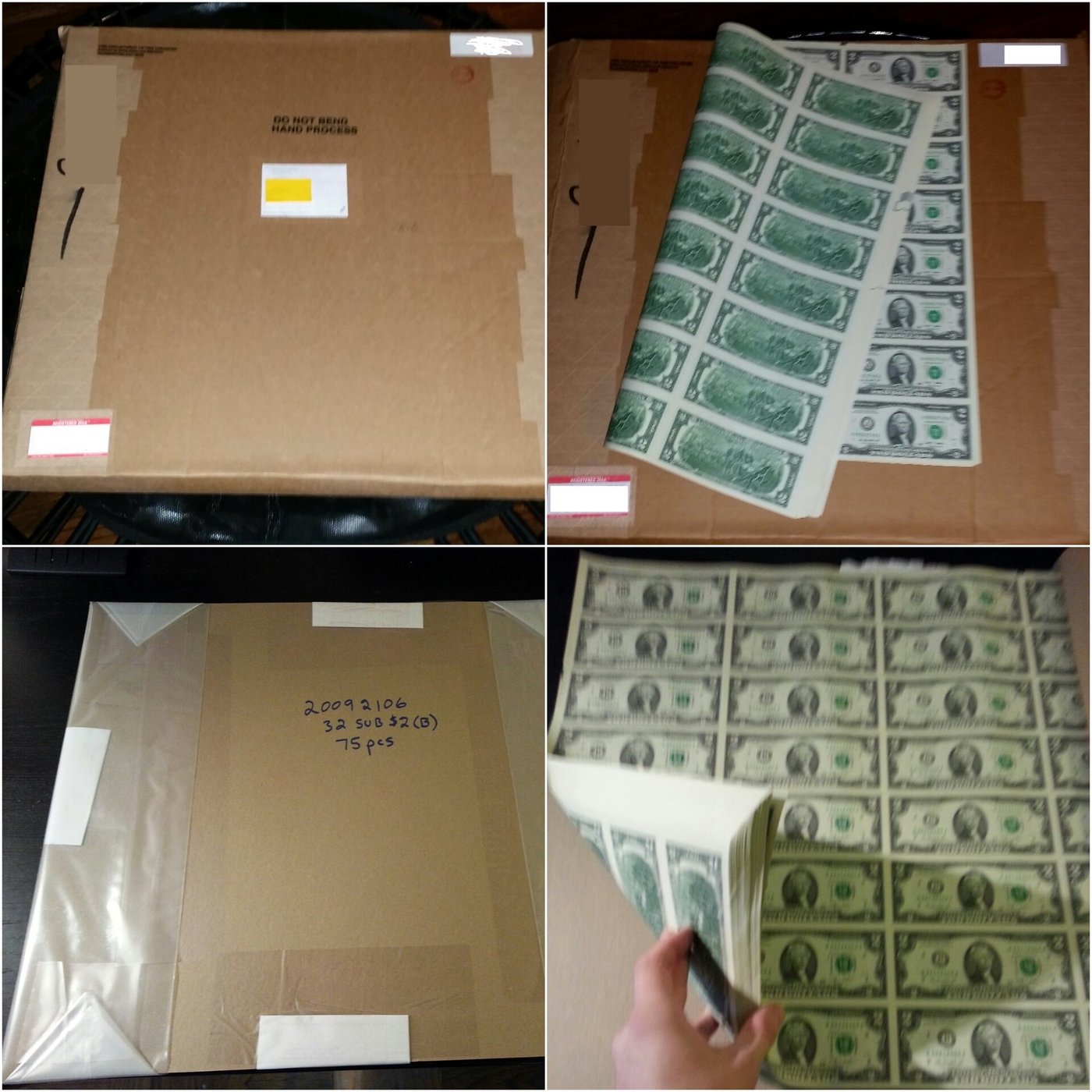
When the Bureau released Series 2009 $2 sheets in October 2012, the prices were $22.50 for 4 notes, $36.00 for 8, $61.00 for 16, and $102.00 for 32. That 32-note sheet carries $64 in face value, so the premium covers the special handling and the fact that you are buying a collectible from a government agency that does not otherwise sell to the public. Current prices are on the store site.
Sources: CoinNews, "Series 2009 $2 Uncut Currency Sheets Released by BEP," October 19, 2012 · BEP uncut currency store · sheet sizes per Wikipedia
Why Sheet Notes Look Different
Notes sold on sheets get serial numbers from the same series as circulating notes but from their own blocks, which is why sheet-cut notes often carry suffix letters and serial ranges that never appear in bank straps. The Series 1995 millennium sheets are the well-known example: in late 1999 the Bureau printed 9,999 star notes for each of the twelve Federal Reserve Banks for sheet sales, even though Series 1995 circulating notes had only ever been issued for Atlanta. Series 2003 sheets were printed for six districts while only Minneapolis notes were released to circulation.
The practical upshot for collectors: a Series 1995 $2 from any district other than Atlanta, or a Series 2003 from anywhere but Minneapolis, came from a sheet. It is genuine, and it is not a mystery.
Source: Wikipedia, "United States two-dollar bill," Uncut currency sheets. Circulating districts per USPaperMoney.info.
The Sheet Program Started With the $2
Uncut currency sales began with the note on this site. Coin World's history of the program: "It began slowly with the Bicentennial $2 notes of 1976 which were sold in sheets of 32, 16, and 4." Continuous public sales date from 1981, and 32-subject sheets are still sold in every denomination except the $1, which moved to 50-note sheets in 2014 and to 50-subject collector sheets in 2016.
Every modern $2 series through 2013 has had a sheet release: Series 1976, 1995, 2003, 2003A, 2009, and 2013. The Series 2009 sheets (New York district, Geithner and Rios signatures) went on sale October 18, 2012; the Series 2013 sheets (Dallas district, Lew and Rios) on February 22, 2016; both at $22.50, $36, $61, and $102 for 4, 8, 16, and 32 notes, prices set in August 2011. When the Bureau restarted collector sales through the U.S. Mint store on October 1, 2023, it called uncut sheets "BEP's core public sales product," and the $2 sheet it restocked was still Series 2013. No Series 2017A or 2021 $2 sheet has been documented.
Sources: Coin World, "BEP to begin sales of 50-subject uncut sheets" · USPaperMoney.info, Uncut Currency Sheets and Other Collector Products · CoinNews, 2011 price increase · CoinNews, Series 2009 $2 sheets · CoinNews, Series 2013 $2 sheets · Coin World, BEP resumes collector sales, 2023
The Bureau's $2 Gimmicks, and They Are Good Ones
Beyond plain sheets, the Bureau sells $2 notes with serial numbers chosen for a story. The ones on record:
- 1995 Millennium Notes
- Sold in 2000: Series 1995 star notes with serials starting 2000, "9,999 notes per District" for all twelve districts, in a presentation folder. These are the only Series 1995 $2 notes from any district but Atlanta.
- 2003 Star Note Sets
- Announced in late 2007: Series 2003 star notes with serials under 16,000, 10,000 per district, $9.95 a note or $119.40 for all twelve. The Bureau warned that "no effort will be made to provide matching serial numbers."
- Lucky Money 8.8.8 Set
- December 4, 2008: a Series 2006 $1, a Series 2003A $2, and a Series 2003 $5 with matching serials beginning 8888, $48.88 a set, 8,888 sets, 25 per household.
- $2 Single Note Collections
- 2011 and 2012 issues with serials beginning 2011 and 2012 at $7.95 a note; the 2012 Kansas City note came from a run the Bureau said would be sold "only during calendar year 2012."
- $2 "8888" Sheet
- Issued November 18, 2015: an 8-note Series 2009 sheet with every serial beginning 8888, $58.88, limit 16,888 sheets.
- Texas $2 Step
- July 2016: two matching Series 2009 Dallas notes with serials beginning 2016, $39.95, 6,500 sets, marking 25 years of printing at the Fort Worth plant.
- $2 Lucky Panda
- July 10, 2018: a $2 with a serial beginning 888 in a red folder with gold foil, $12.88, no more than 106,888 units, and a first-week household limit of 500 that the Bureau dropped after seven days. The Bureau's copy: "The $2 Lucky Panda symbolizes character traits as peace, harmony and friendship."
- Youth Coin and Currency Set
- October 31, 2019, with the U.S. Mint: five proof quarters and an uncirculated Series 2009 $2, $29.95, 25,000 sets.
The Happy Birthday notes and the Year-of-the-animal Lucky Money notes are $1 products; the two has never had a holiday issue of its own.
Sources: Currency Quest, 1995 Millennium notes · USPaperMoney.info, collector serial ranges · Numismatic News, 2003 star note packages · CoinNews, Lucky Money 8.8.8 Set · CoinNews, 2011 $2 Single Note Collection · CoinNews, 2012 $2 single notes · CoinNews, $2 8888 sheet · Numismatic News, Texas $2 Step · CoinNews, $2 Lucky Panda · CoinNews, 2019 Youth Set
The Wozniak Method
Apple co-founder Steve Wozniak buys $2 sheets from the Bureau in the 4, 16, and 32-note sizes, and by his own account they "cost nearly $3 each when purchased on sheets." He has a printer glue the sheets of four into gummed pads like stationery and perforate between the notes, so he can tear off a two the way you tear off a check. The point is comedy. It once earned him a Miranda warning from the Secret Service in Las Vegas after he tipped a waitress with two perforated notes. The full story is on the pop culture page.
Source: The E-Sylum, "Steve Wozniak's Perforated Pads of $2 Bills," Vol. 18 No. 36, September 6, 2015