L 00000001 A
The Large-Size Era, 1862 to 1918
Bigger paper, more kinds of money, and the best engraving the country ever put on a two.
Five Kinds of Two Dollars
Before 1928 a $2 note could be one of several different promises. A Legal Tender Note (also called a United States Note) was the government's own paper. A National Bank Note was issued by a chartered local bank, secured by bonds deposited with the Treasury. A Silver Certificate was a receipt for silver dollars on deposit. A Treasury Note of 1890 and 1891 was issued to buy silver bullion. A Federal Reserve Bank Note of 1918 was an obligation of one Reserve Bank. Each type had its own design and seal color, which is why the timeline on this site uses seal color as its code.
All of them were large: roughly 7.4 by 3.1 inches, against today's 6.14 by 2.61. For the twos that came before any of these, see Before 1862.
Type descriptions summarized from Wikipedia, "United States two-dollar bill"; dimensions from the same article. Production totals below are from the Treasury's "Historical Narrative on the $2 Bill" as reprinted in the Richmond Fed's 1976 Economic Review (PDF), Table I.
1862
Hamilton, the First Two
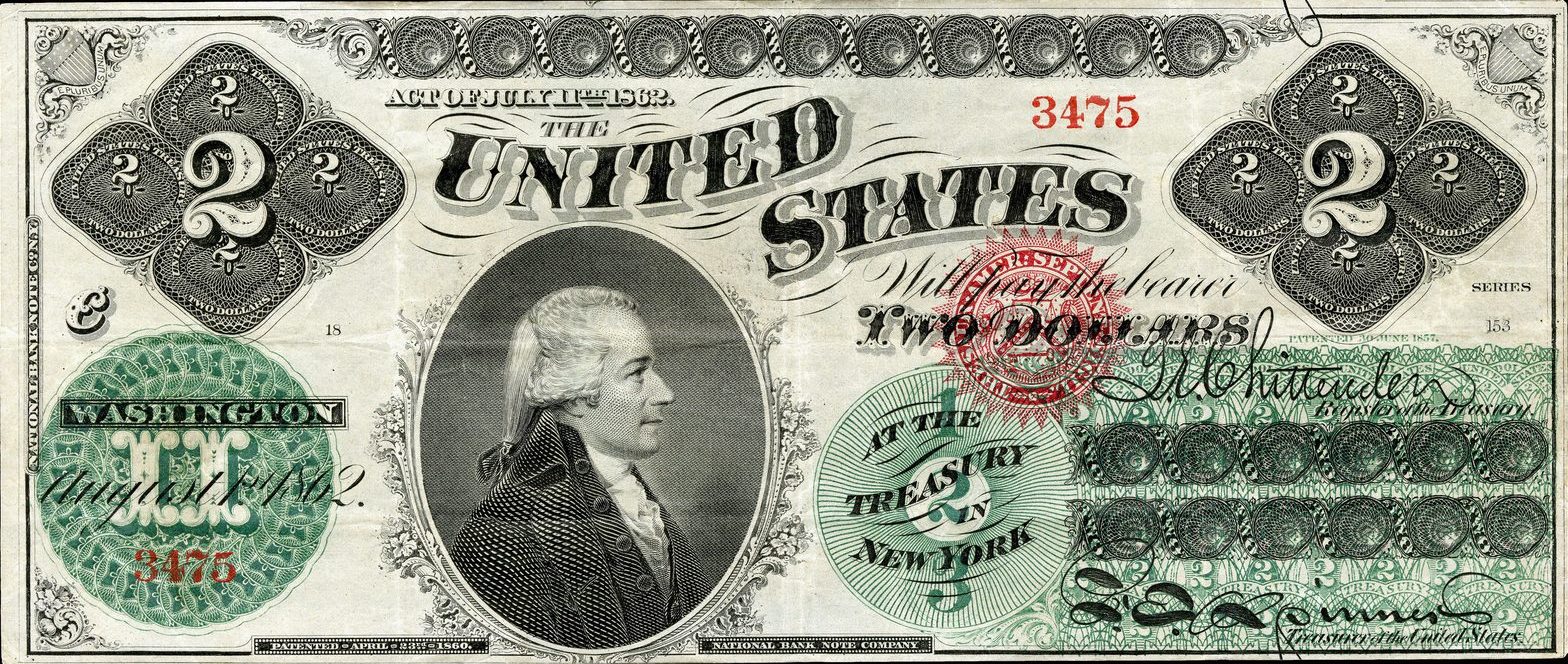
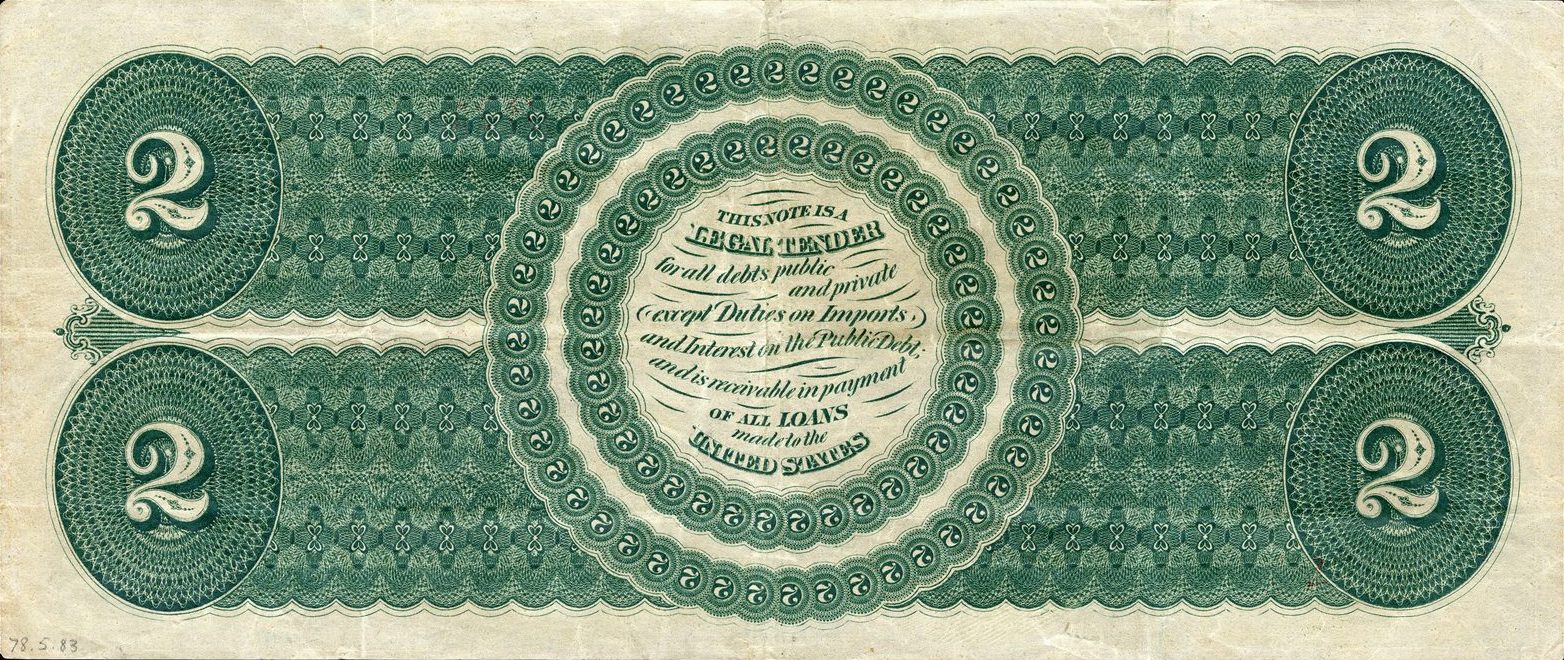
"The first $2 notes (called United States Notes or 'Legal Tenders') were issued by the federal government in 1862 and featured a portrait of the first Secretary of the Treasury, Alexander Hamilton (1789-1795)," says the Bureau of Engraving and Printing. The note itself cites the Act of July 11, 1862 in its top border and was printed by the National Bank Note Company under contract to the Treasury; the government's own printing bureau did not exist yet. The back is the plain green "legal tender" text panel that gave greenbacks their name.
The Treasury's historical narrative lists no production total for the 1862 issue.
Sources: BEP, $2 Note · Smithsonian NNC scan via Wikimedia Commons (printer credit)

1869 to 1917
Jefferson and the Capitol
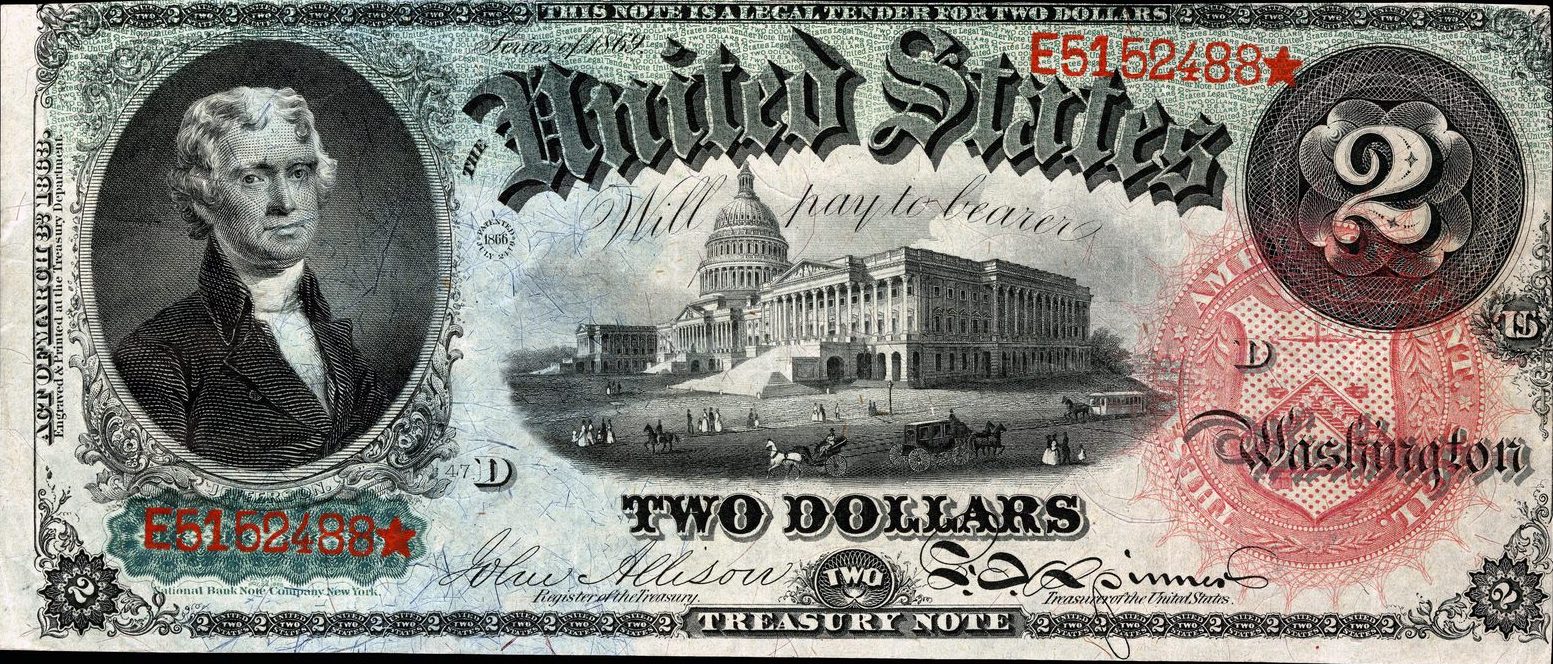
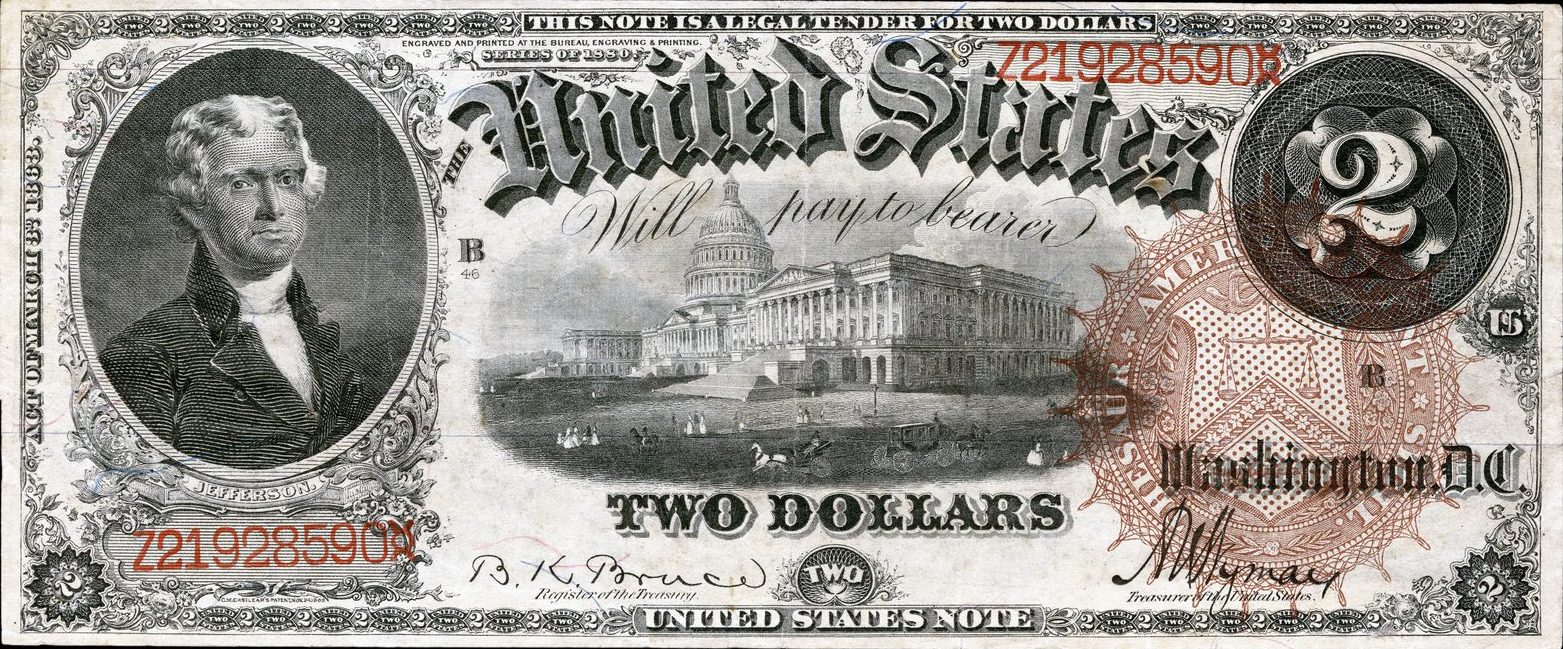
Series 1869 put Thomas Jefferson at left and a view of the U.S. Capitol at center, and the portrait has stayed on the denomination ever since. The Treasury's tally gives 14,408,000 notes for the 1869 series. The design was reworked in 1874, 1875, 1878, 1880, and again in 1917, mostly in the color of the seals, serial numbers, and the ornament around "Washington, D.C." The Series 1917 note was the big one: 317,416,000 printed, which made it the most common large-size $2 by a wide margin.
Sources: BEP, $2 Note · Richmond Fed 1976, Table I (totals: 1869 14,408,000; 1874 11,632,000; 1875 11,518,000; 1878 4,676,000; 1880 28,212,000; 1917 317,416,000) · design changes per Wikipedia
1875
The Lazy Deuce
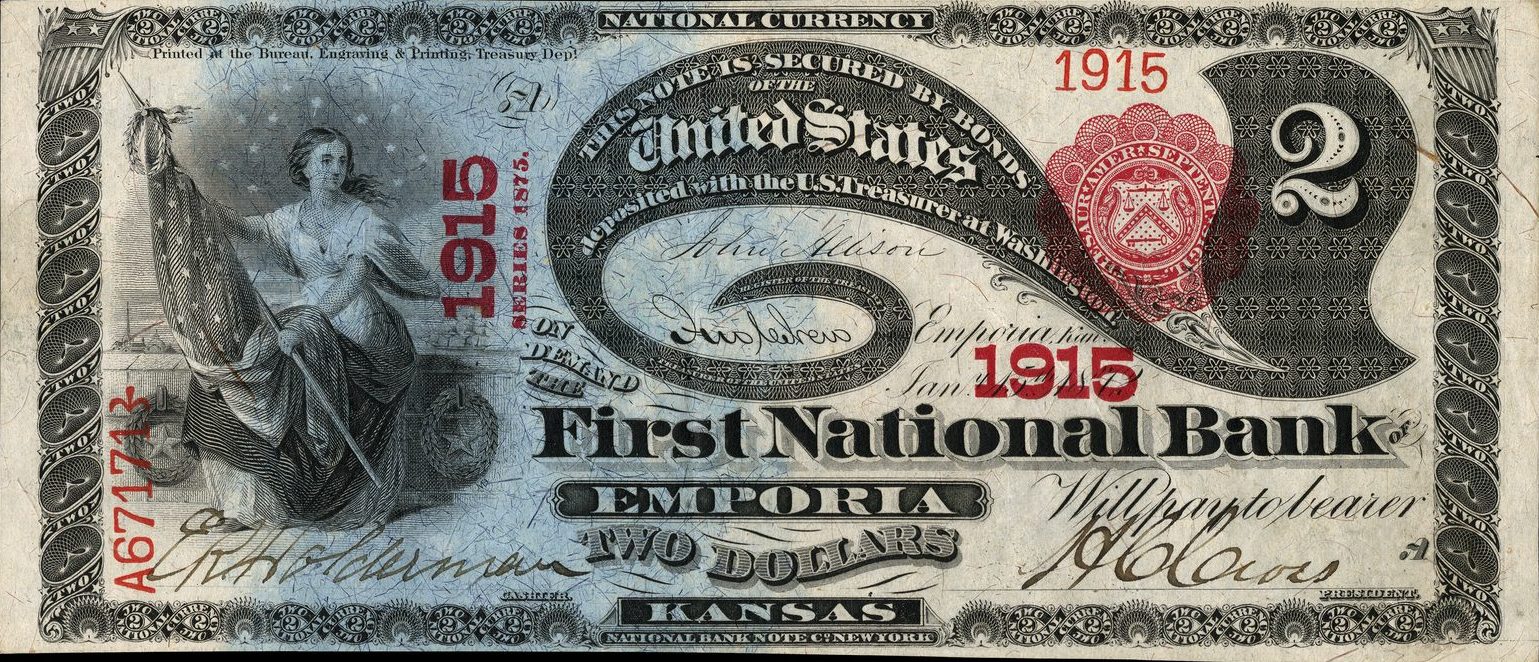
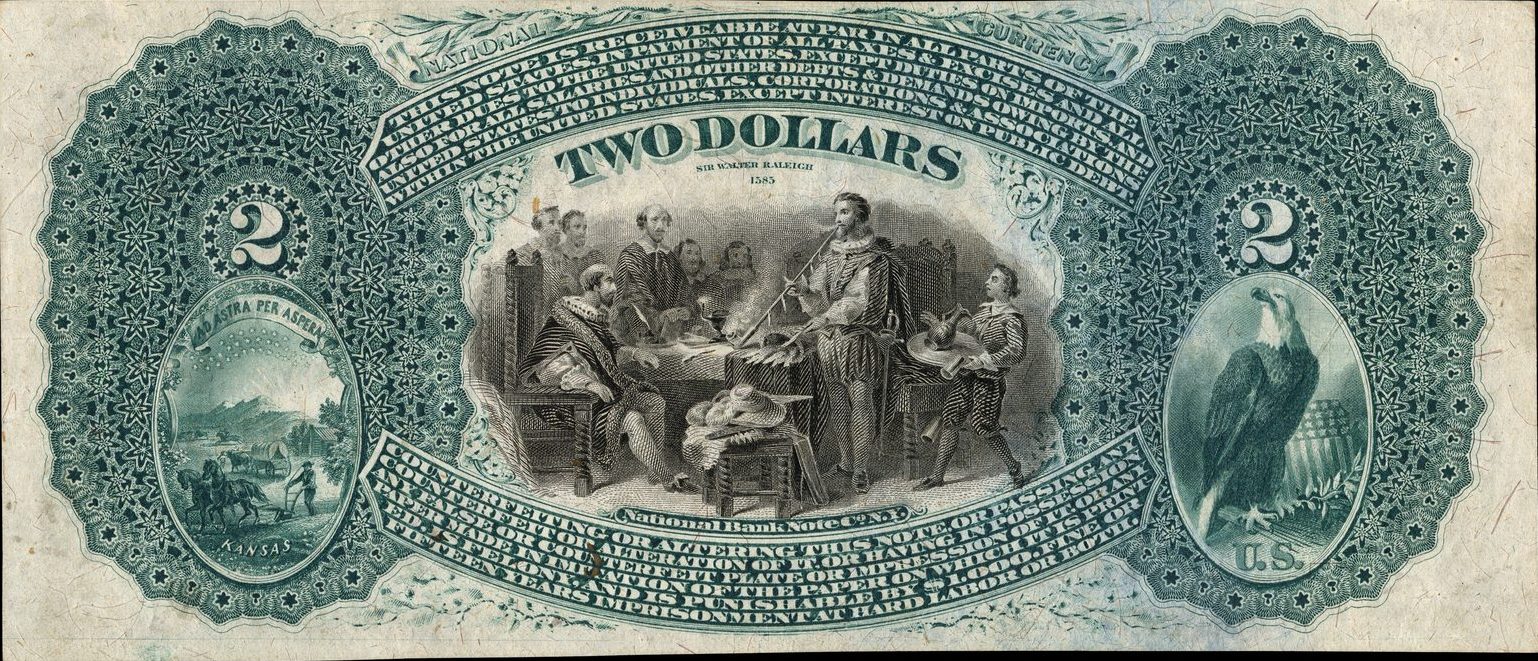
National Bank Notes were issued by local banks on a shared design. The $2 shows a woman unfurling a flag and, at right, a giant numeral 2 lying on its side, which earned it the nickname "Lazy Deuce." The back shows Sir Walter Raleigh in England, presenting tobacco and corn from the New World, with an eagle and shield alongside. The Treasury counted 1,381,205 Series 1875 $2 National Bank Notes.
Sources: Wikipedia (design) · Richmond Fed 1976, Table I (total)
1886 to 1899
Silver Certificates: Hancock, Windom, and Washington
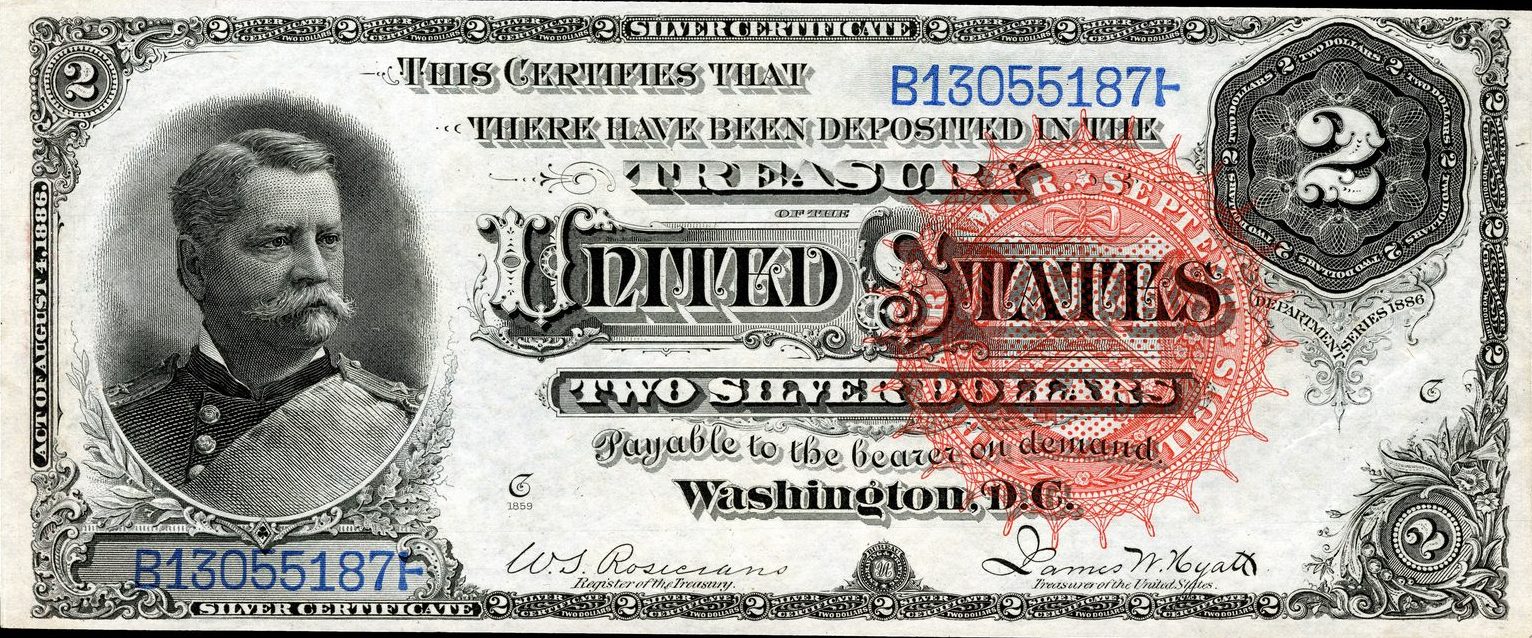
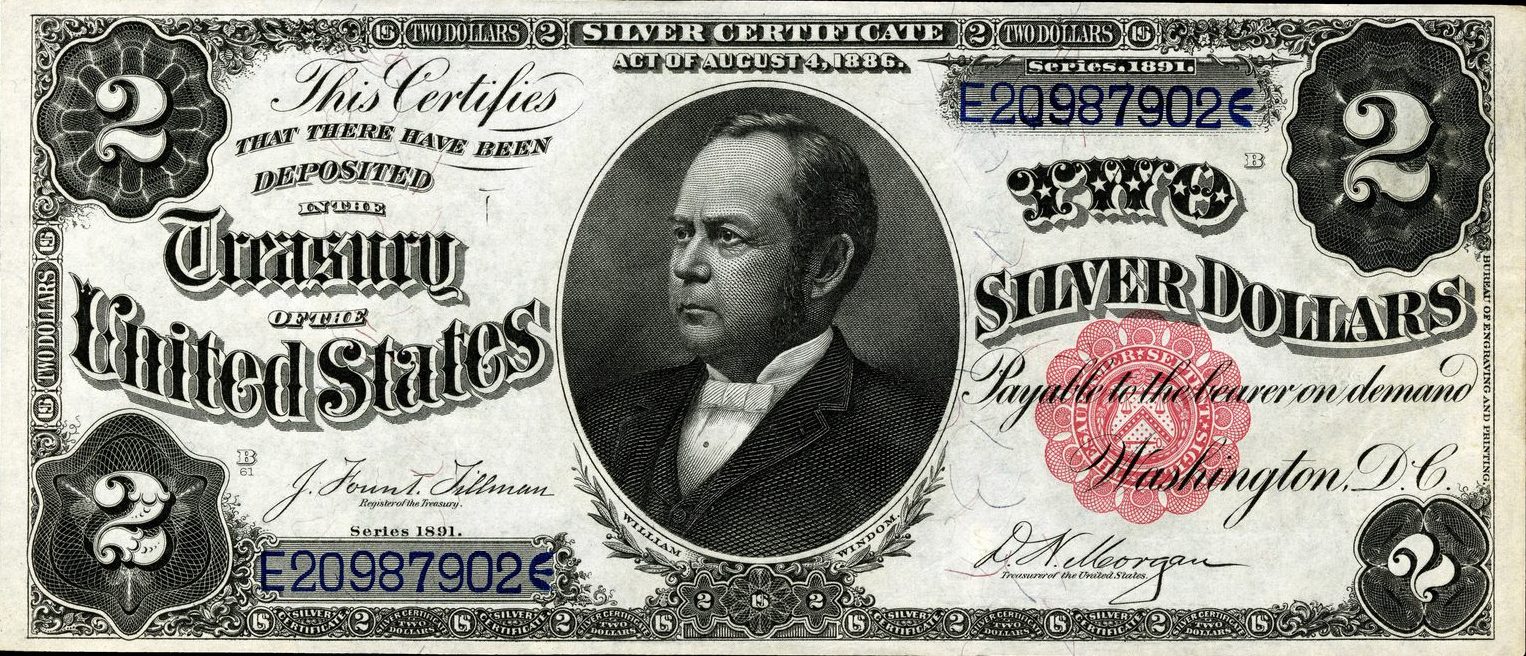
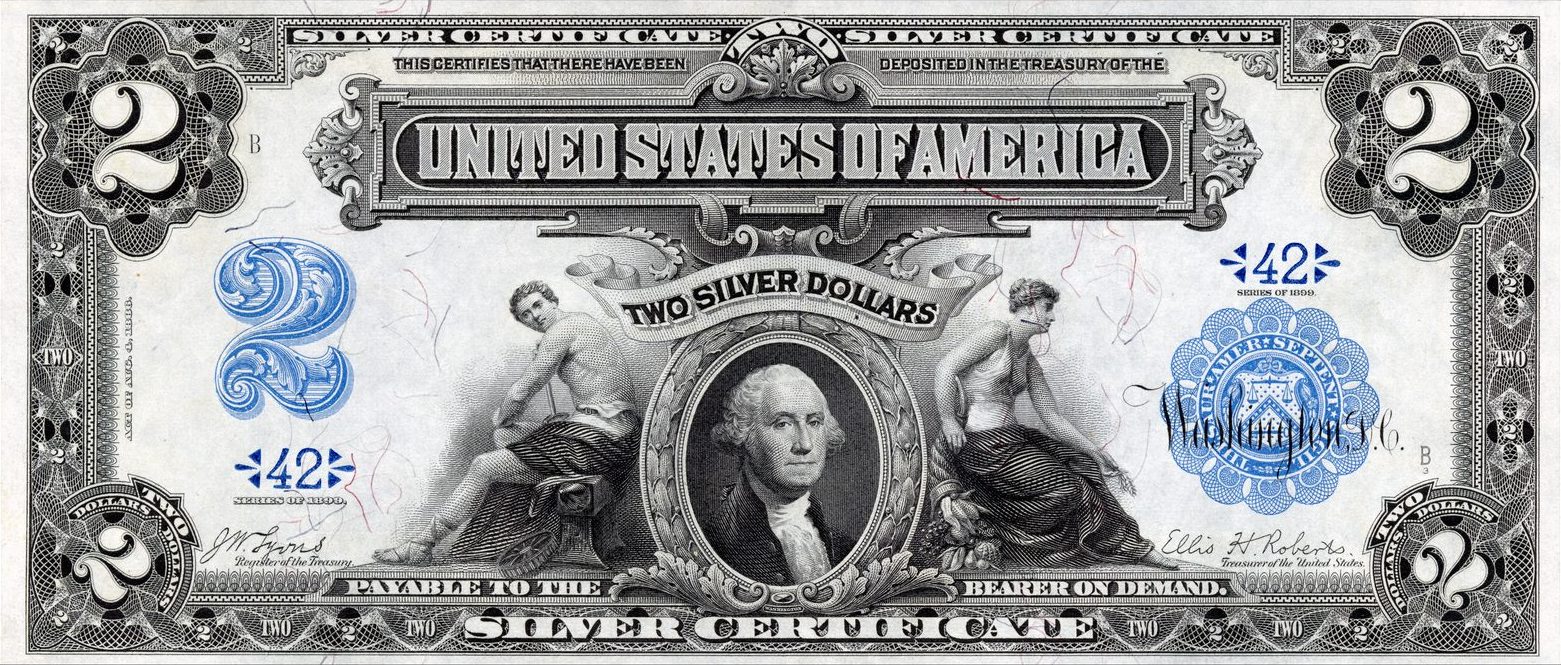
The $2 Silver Certificate started in 1886 with General Winfield Scott Hancock (21,000,000 printed) and switched in 1891 to Treasury Secretary William Windom (20,988,000). Series 1899 put a small portrait of George Washington between allegorical figures of agriculture and mechanics, and that design ran and ran: 538,734,000 notes, the largest total of any large-size $2.
Sources: Richmond Fed 1976, Table I · Wikipedia (design)
1896
The Educational Series
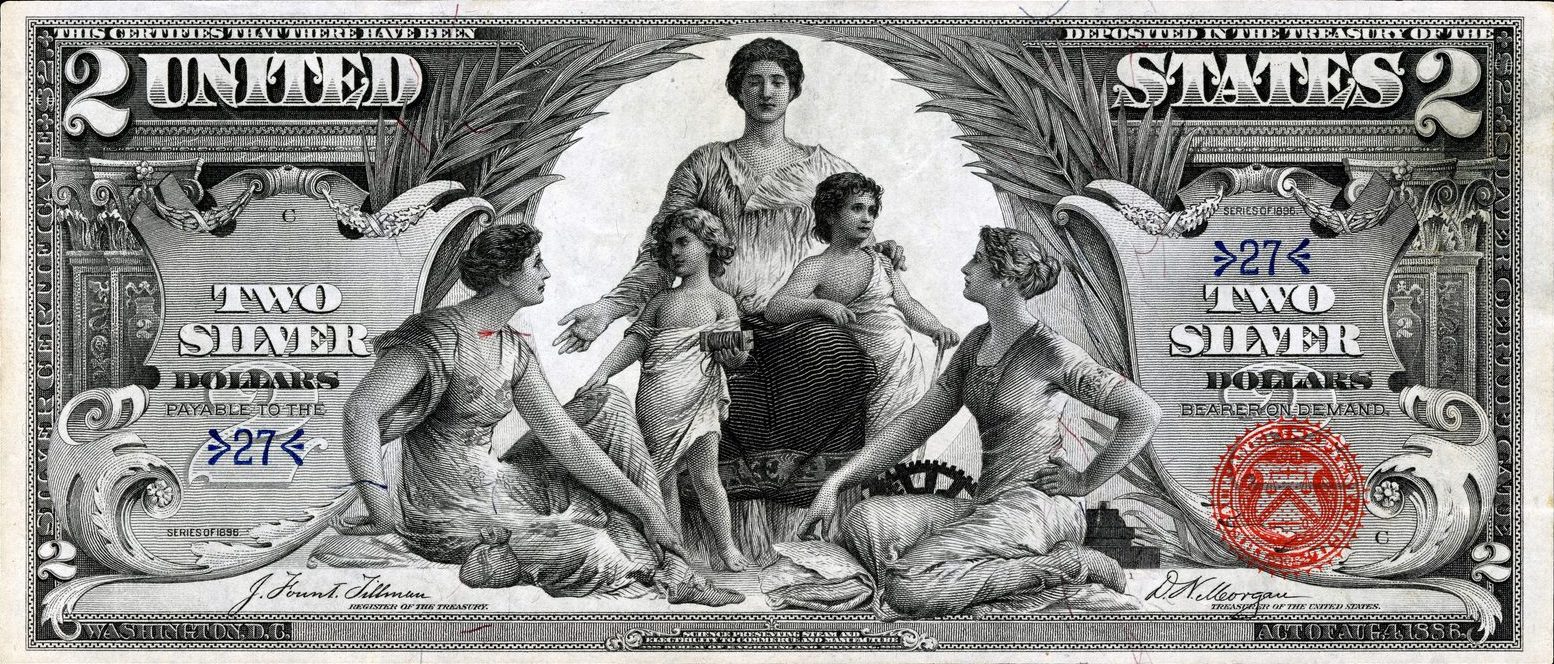
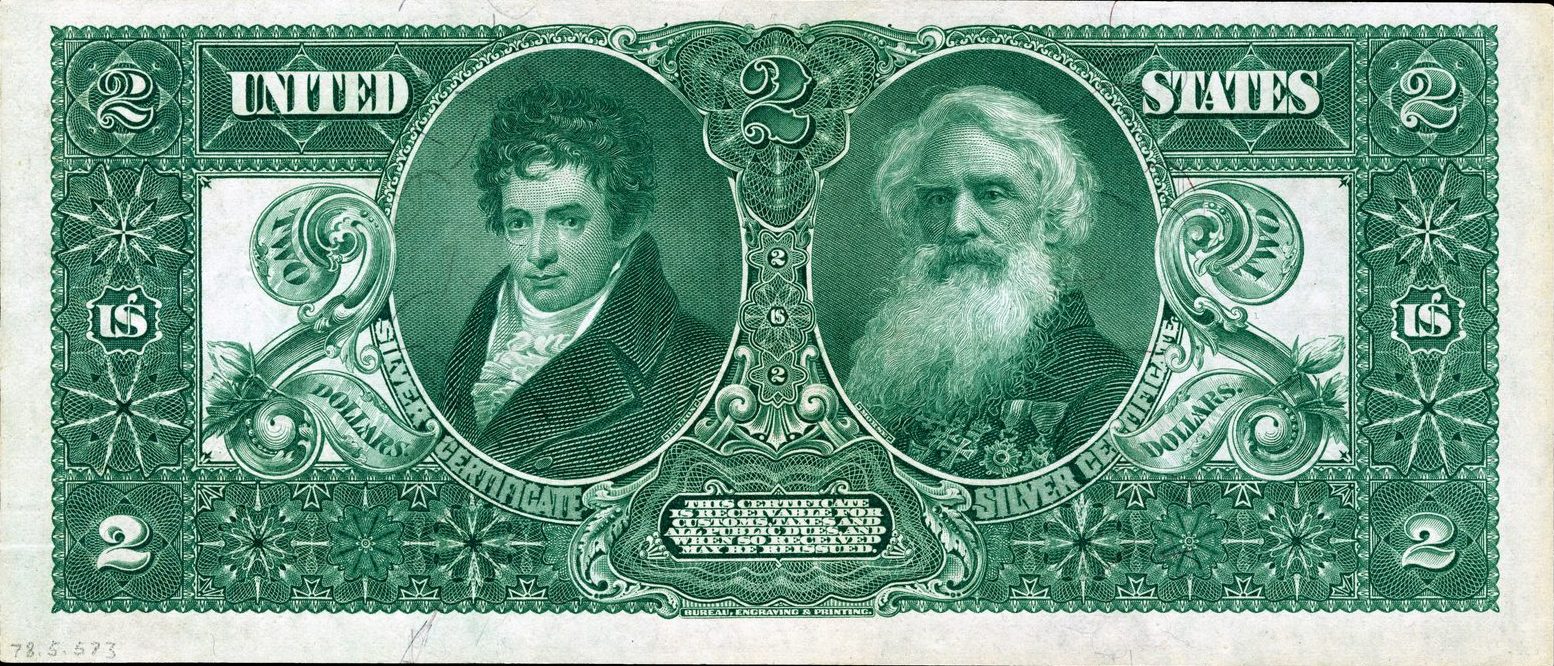
Collectors call the 1896 Silver Certificates the Educational Series, and the $2 is its centerpiece. The face is an allegory: Science presenting Steam and Electricity to Commerce and Manufacture. The back carries portraits of Robert Fulton and Samuel F. B. Morse in an ornate frame. Only 20,652,000 were printed, and the design was replaced by 1899. It is regularly named among the most beautiful notes the United States has issued.
Sources: Wikipedia (design) · Richmond Fed 1976, Table I (total)
1918
The Battleship Note
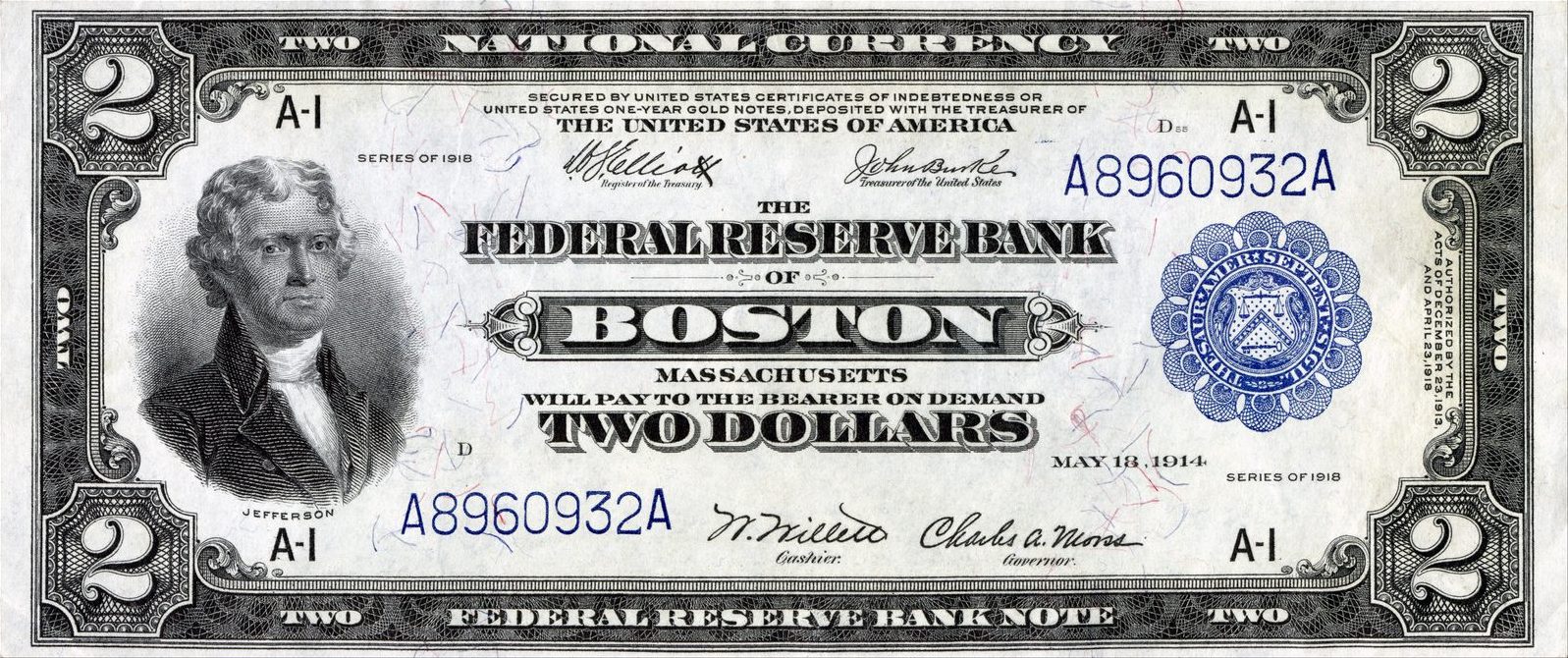
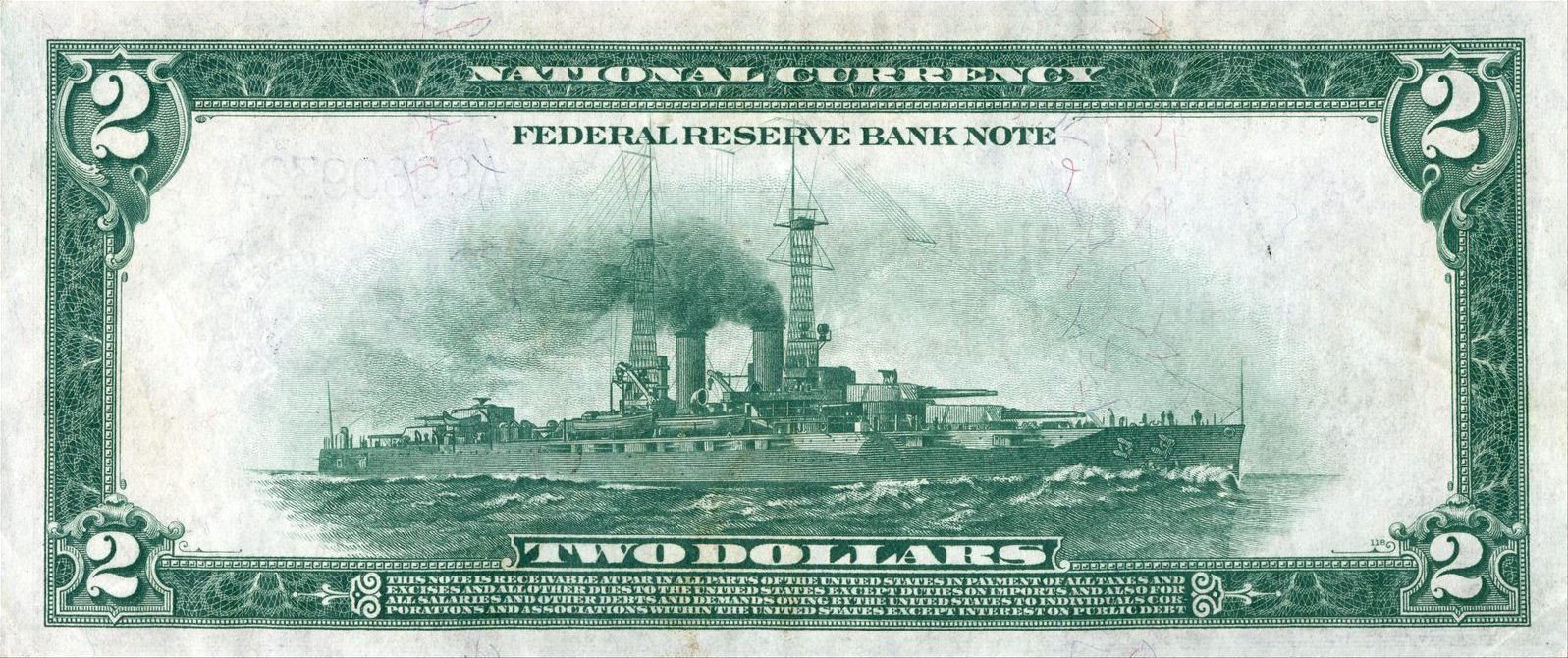
The last large-size $2 was a Federal Reserve Bank Note, an obligation of the individual Reserve Bank named on it. The face has a borderless Jefferson at left and the bank's name in the center; the back shows a World War I era battleship, which is the only reason anyone remembers the design. The Treasury counted 68,116,000 of them.
Sources: Wikipedia (design, nature of the obligation) · Richmond Fed 1976, Table I (total)
Who Engraved Them
The Bureau of Engraving and Printing's historical fact sheet on the $2 names the hands behind each design. It is the closest thing to a credits roll the note has.
- 1862 Hamilton
- Portrait engraved by Joseph P. Ourdan; designer unknown. The note was printed by the National Bank Note Company; the Treasury only trimmed, separated, and sealed the sheets. The Bureau did not engrave and print United States Note faces itself until Series 1869, and did not print all U.S. currency until 1877.
- 1869 to 1963 Jefferson
- Portrait engraved by Charles K. Burt after Gilbert Stuart's painting, and used on every $2 United States Note from 1869 through 1963A, plus the 1918 Federal Reserve Bank Note. The Capitol vignette on the 1869 to 1917 notes was engraved by Louis Delnoce and William Chorlton. Collectors call the 1869 issue the "Rainbow" note for its red, blue, and green face on paper made under an 1866 patent.
- 1875 Lazy Deuce
- Both the flag vignette and the Raleigh back engraved by Louis Delnoce. The Bureau explains why so few $2 nationals exist: "In the 1860s, there were limits on how many $1 and $2 notes the banks could issue because, at the time, it was believed that the widespread use of small-denomination notes caused inflation."
- 1886 Hancock
- Engraved by Charles Schlecht. The Silver Certificate act passed on August 4, 1886, and Hancock, the 1880 Democratic nominee for president, had died on February 9 of that year, which made the portrait, in one grading service's words, "a logical choice."
- 1891 Windom
- Engraved by W. G. Phillips. William Windom served twice as Secretary of the Treasury and died in January 1891 while giving a speech at Delmonico's in New York.
- 1890 and 1891 McPherson
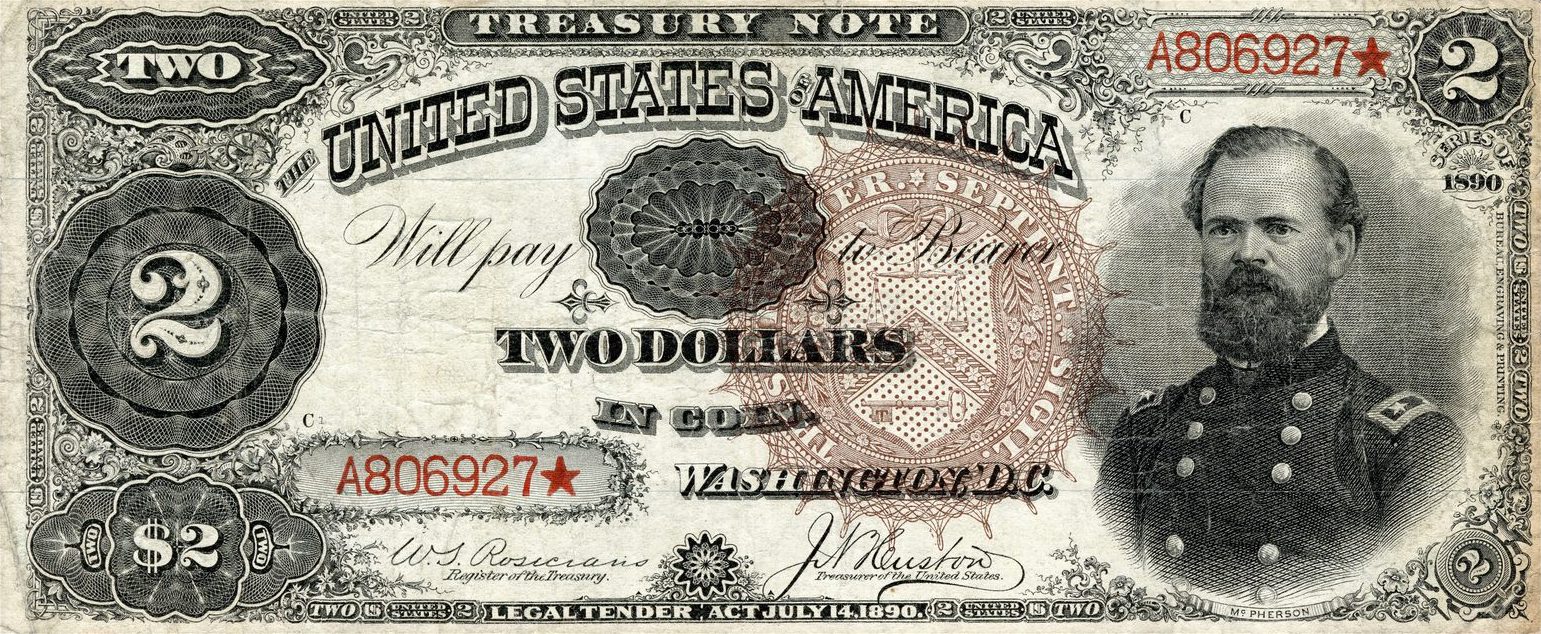
- Designed by George W. Casilear, engraved by Charles Burt from an 1862 photograph by Barr and Young. The Bureau knows Casilear designed them because he told a Senate committee, "I was very busy at the time getting up some Treasury notes." James B. McPherson was the second-highest-ranking Union officer killed in the war. The notes were authorized on July 14, 1890 under the Sherman Silver Purchase law and were retired under the Currency Act of March 14, 1900.
- 1896 Educational
- Face vignette designed by the muralist Edwin H. Blashfield and engraved by G.F.C. Smillie, with Thomas F. Morris designing the frame and the back. The Bureau credits the Fulton and Morse portraits to Burt and Schlecht; hobby references credit Lorenzo Hatch. Blashfield had meant the pyramid-shaped design for a $50 that was never made.
- 1899 Washington
- Portrait and the "Mechanics and Agriculture" figures engraved by Smillie. The only $2 ever to carry George Washington.
- 1918 Battleship
- Designed by Clair Aubrey Huston, ship engraved by C. M. Chalmers, almost certainly from a photograph of the dreadnought USS New York, though the note never names her.
Sources: Bureau of Engraving and Printing, "Historical Highlights: $2 Note" fact sheet (PDF) · BEP, History of Currency · CoinWeek on the 1869 Rainbow note · PCGS on the 1886 Hancock note · BEP, Treasury Coin Notes fact sheet (PDF) · PCGS on the 1896 Educational $2 · PCGS on the 1918 Battleship note · Windom per Wikipedia
Why the Educational Note Lasted Three Years
The 1896 series began when the Bureau's chief, Claude M. Johnson, commissioned three painters in 1893 at $800 per accepted design, and production started on April 18, 1896. It ended almost as fast. Bank tellers complained that the denominations were "too indistinct for rapid use at the banks" (The Washington Times, May 1, 1897), the heavy black ink smudged and made notes look "suspicious with a little use," and the Bureau had left off the fine lathework that made counterfeiting hard, to stay faithful to the paintings. One correspondent wrote the Treasury on January 25, 1898, "May I respectfully plead that the indelicate figures now in use, especially on the $5 bills, may be avoided." The new Treasury Secretary, Lyman Gage, called silver certificates "dangerous" and ruled that future notes would not be designed by painters. The Bureau's own verdict today: the Educational Series is "considered some of the most beautiful notes ever produced."
Sources: PMG, Educational Series Notes (part 1) · PMG (part 2) · Coin World, "Series 1896 Silver Certificates were beautiful failures" · Smithsonian Magazine · BEP $2 fact sheet
Why 1918 Was a Federal Reserve Bank Note
The Pittman Act of April 23, 1918 sent American silver to Britain, melting as many as 350 million silver dollars, which pulled the Silver Certificates backed by them out of circulation. To fill the gap, the Reserve Banks issued Federal Reserve Bank Notes, obligations of the individual bank rather than of the United States, and the $2 was among them, printed from 1918 into 1921 for all twelve districts. Wartime inflation raised demand for twos at the same time. Two decades later the note got another odd boost: in early 1942 the Treasury barred carrying U.S. currency across the Mexican border, excepting only $2 notes and silver dollars, and "demand for $2 notes skyrocketed along the border."
Sources: BEP $2 fact sheet · BEP, Silver Certificates fact sheet (PDF) · BEP, Currency Notes (PDF) · PCGS