R 00000001 A
Real or Fake
The $2 is "infrequently counterfeited," in the government's words. Most "fake" twos are real notes that confused someone.
How to Tell If a $2 Bill Is Real
The U.S. Currency Education Program's features sheet for the $2 note issued 1976 to present lists exactly these:
- Raised printing. "Move your finger along the note's surface to feel the raised printing, which gives genuine Federal Reserve notes their distinctive texture." Jefferson's coat and the border lettering should feel slightly ridged.
- Red and blue fibers in the paper. "Federal Reserve note paper is one-fourth linen and three-fourths cotton, and contains red and blue security fibers." They are embedded in the paper, scattered at random, not printed on it.
- A black Federal Reserve Bank seal at left with the district's name and letter.
- A green Treasury seal at right.
- Matching serial numbers, "a combination of eleven numbers and letters," printed twice in green. The first letter must match the bank seal's letter.
- Jefferson on the front, the Declaration signing on the back.
Source: U.S. Currency Education Program, "$2 Note Issued 1976 to Present" (PDF)
What It Does Not Have
No Watermark, No Thread
The official $2 features sheet lists no watermark and no security thread. Hold a $2 up to the light and you will see nothing hidden, and that is correct. Those features belong to redesigned higher denominations. A cashier who rejects a $2 because "there's no strip" is checking for something the note was never made with.
The reason the government gives is simple: "The United States government redesigns Federal Reserve notes primarily for security reasons: to stay ahead of counterfeiting threats and keep counterfeiting levels low. Because the $2 note is infrequently counterfeited, the government has no plans to redesign this note."
A Red Seal Is Not a Fake
Every $2 United States Note from Series 1928 through Series 1963A has a red Treasury seal and red serial numbers, with Monticello on the back. These are genuine, and they are still money. The Bureau of Engraving and Printing states it flatly: "All U.S. currency remains legal tender, regardless of when it was issued."
Large-size notes from before 1928 are genuine too, with red, blue, or brown seals depending on the type. Nobody expects you to spend an 1896 Educational note, but it would be legal.
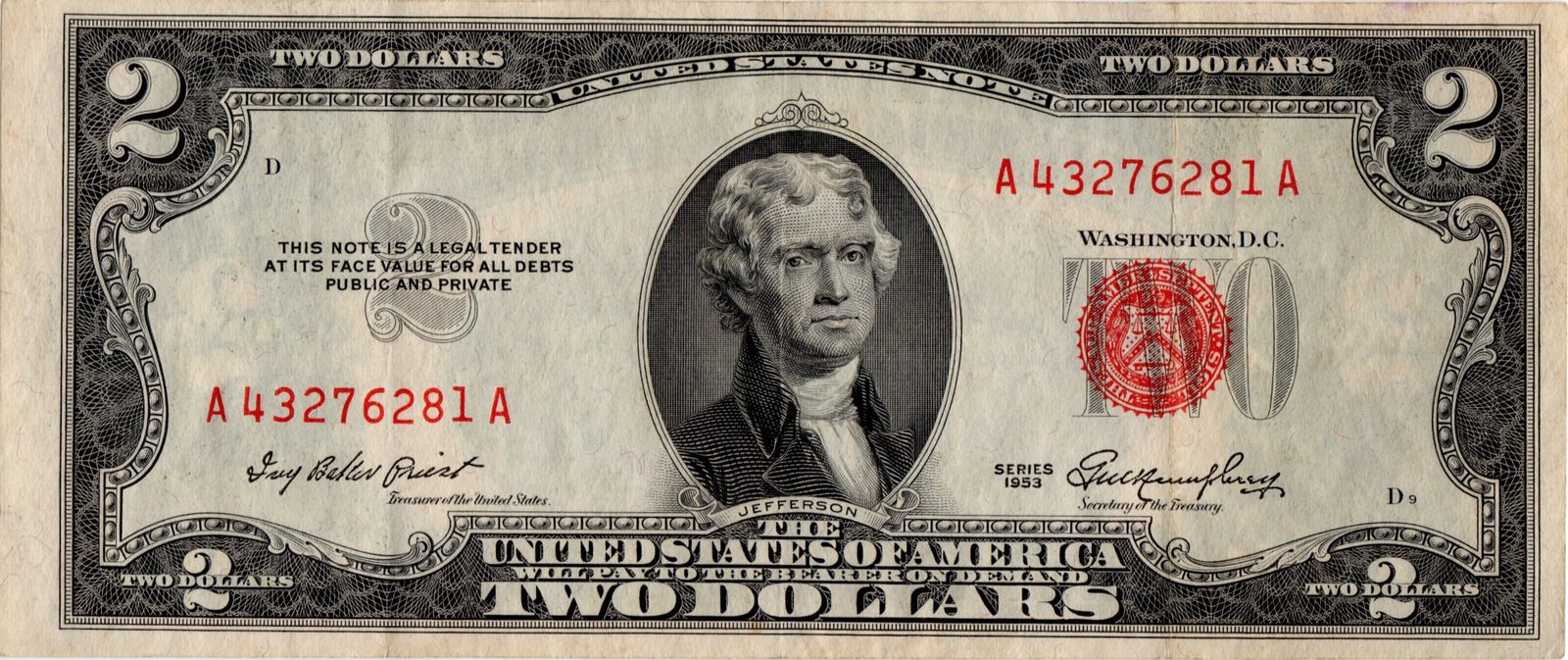
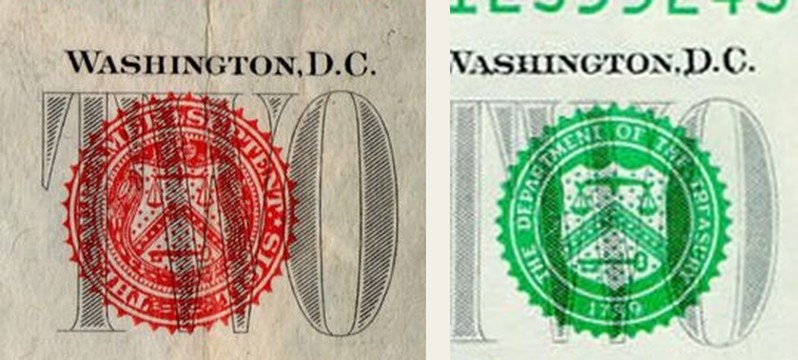
Source: BEP, $2 Note. Seal colors by series: Timeline.
The Counterfeit Pen Problem
Counterfeit-detection pens test paper chemistry, not the note. They have a record of flagging genuine $2 bills, and the results can be absurd. In May 2016 an eighth grader at Christa McAuliffe Middle School in the Fort Bend Independent School District outside Houston tried to buy lunch with a $2 bill her grandmother had given her. A cafeteria worker's pen raised a flag, school police got involved, and the bill was taken to a bank, verified as genuine, and returned. She did not get her chicken nuggets.
If a pen says your $2 is fake, ask for a second check by feel and by the fibers, or ask them to call a bank. The pen is the least reliable tool in the room.
Source: Forbes, "Police Involved After Student Tries To Buy Lunch With $2 Bill," May 4, 2016
Enhanced, Colorized, and Gold Twos
Buyer Beware
Bills sold as "colorized," "gold-plated," "24K," or "enhanced" $2 notes are ordinary notes with a private overlay applied after they left the Bureau. No government agency authorizes them, and the treatment has no official collector status. The note underneath is still a $2 note; whether the overlay adds or subtracts anything at resale is not something this site has a sold price to show.
See Wikipedia's note on unauthorized "enhanced" $2 bills and the Collecting Guide.