S 00000001 *
Star Notes
A star where the last letter should be means the note is a replacement. Here is why that matters, and which $2 stars are actually scarce.
What Is a Star Note?
The Bureau of Engraving and Printing explains it in one paragraph: "When an imperfect sheet is detected during the manufacturing process after the serial number has been overprinted, it must be replaced with a new sheet. A 'star' sheet is used to replace the imperfect sheet. Reusing an exact serial number to replace an imperfect note is costly and time consuming. A 'star' note has its own special serial number followed by a star in place of a suffix letter."
In practice the Bureau "first prints a small quantity of notes with star serial numbers, and then uses these to replace any damaged or misprinted notes discovered during the main print run." The star's serial number "is not related to the serial number of the defective note it replaces; indeed, a defective note may even be replaced by a star note from a different series." When a sheet fails inspection, the entire sheet is pulled and a replacement sheet from the separate star sequence takes its place.
Two things follow. A star note is not an error; it is the fix for one. And because stars are printed in small runs before the main run, the number printed is known, which is exactly what collectors price.
Sources: Bureau of Engraving and Printing, Serial Numbers · USPaperMoney.info, Details of Serial Numbering
How to Identify a $2 Star Note
Look at the End of the Serial Number
A modern $2 serial reads like F15341255A: a district letter, eight digits, a suffix letter. On a star note the suffix letter is replaced by a solid star, printed in the same green ink: F00123456*. The star appears in both serial numbers.
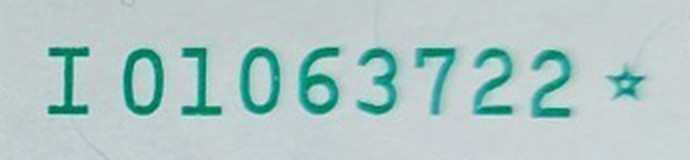
The upper serial on the note above, at twice its printed size. Check Both Serials Match
Both serials should carry the star. A star on one side only is a mismatched-print error, which is a different and rarer thing.
Older Notes Put the Star First
On large-size notes before 1909 the star preceded the serial number; from 1909 on it follows. Red-seal $2 United States Notes from 1928 through 1963 use a red star at the end of a red serial.
Look Up the Run
Every star run's serial range and size is published from BEP production reports. If a "star note" for sale does not fall inside a real range for its series and district, walk away. The run lookup below gives the size and status of every run this site documents.
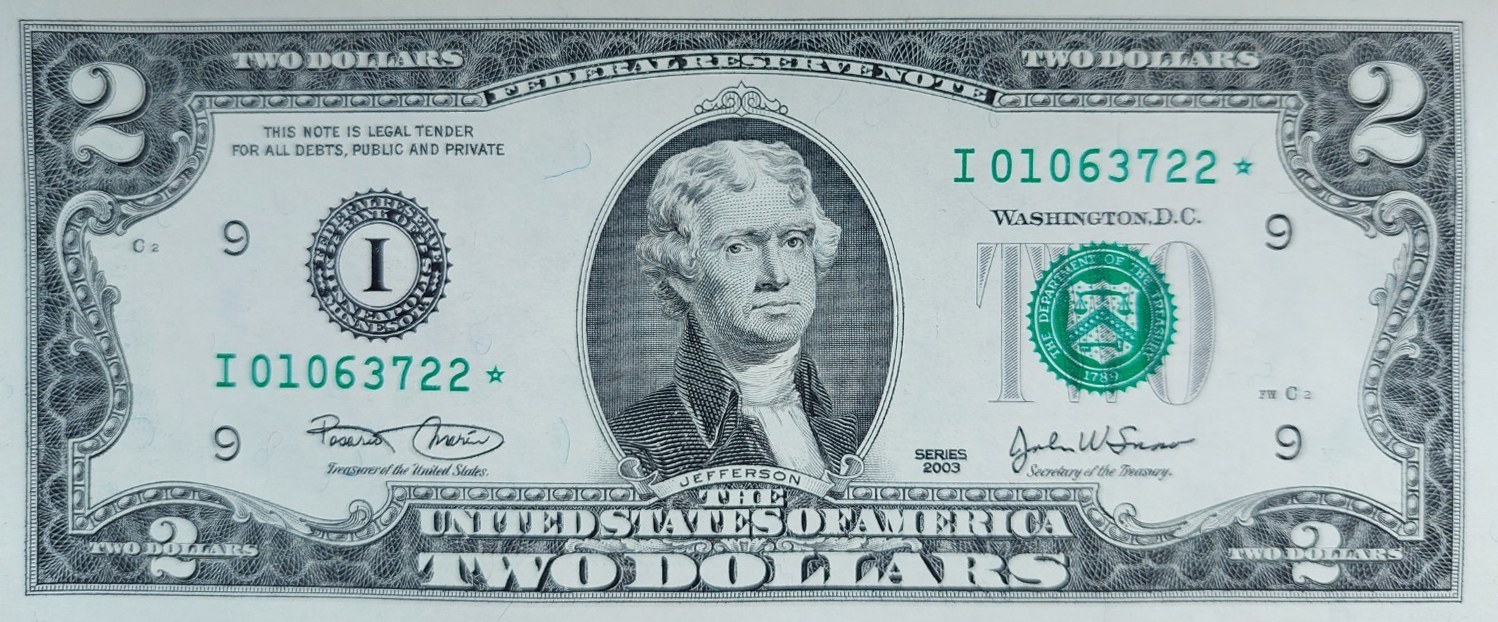
Sources: BEP, Serial Numbers · star position history per MyCurrencyCollection · tables at USPaperMoney.info
S 00000000 *
Star Run Lookup
Choose the series year printed to the right of the portrait and the district letter that starts the serial. The result is the run's size, its serial range where our sources state one, when it was printed, whether the run is confirmed, reported, a collector product, or a phantom, and what stars of that series have brought, each with its type, grade, date, and source.
Every Modern $2 Star Run
Compiled from the BEP's monthly production reports as tabulated by USPaperMoney.info. The star rate is stars as a share of the series total.
| Series | District | Printed | Star Notes | Note |
|---|---|---|---|---|
| 1976 | All twelve | Dec 1975 to Sep 1979 | 15,360,000 | 640,000 each for Richmond (E), Minneapolis (I), Kansas City (J); 2,560,000 for New York (B). Kansas City is the scarcest. |
| 1995 | F Atlanta | Aug and Oct 1996 | 1,280,000 | Star rate 0.83 percent. Stars for the other eleven districts exist only from the 1999 millennium uncut-sheet program. |
| 2003 | I Minneapolis | Aug and Sep 2003 | 3,840,000 | Star rate 3.16 percent, the highest of any modern $2 series. |
| 2003A | F Atlanta | Sep 2006 | 320,000 | Star rate 0.14 percent. The only 2003A stars issued. |
| 2009 | K Dallas | Feb 2012 | 512,000 | |
| 2009 | B New York | Apr 2012 | 128,000 | One of the two smallest confirmed runs. |
| 2013 | F Atlanta | Nov 2013 | 640,000 | |
| 2013 | L San Francisco | Nov and Dec 2015 | 1,408,000 | Two runs; the first was 128,000. Serials past the reported end have been seen. |
| 2013 | B New York | Jun 2016 | 3,200,000 | The common 2013 star. |
| 2017A | C Philadelphia | Aug and Sep 2019 | 960,000 + 80,000 as reported | Collectors report full straps far beyond the reported range; the true size is unknown. |
| 2021 | J Kansas City | Mar 2025 | Two runs reported | The first Series 2021 $2 notes the BEP reported were these stars, months before any regular notes. |
Sources: USPaperMoney.info tables for 1976, 1995, 2003, 2003A, 2009, 2013, 2017A · Series 2021 stars per the BEP March 2025 production report (PDF) · 1976 scarcity per CoinWeek · 1995 sheet stars per Wikipedia
Phantom Runs
Two star runs appear in BEP reports but were never issued. A 384,000-note run of Series 2003A San Francisco stars was reported in January 2012, but a Freedom of Information Act request produced documentation that "these notes were destroyed with none issued." A 128,000-note Series 2009 San Francisco star run for April 2012 was "never printed, but were reported in error." Anyone offering an L-district 2003A or 2009 $2 star is offering something that does not exist.
Sources: USPaperMoney.info, Series 2003A · Series 2009
What $2 Star Notes Are Worth
Run size sets the floor, condition and serial number set the ceiling. Dealer guidance from GovMint: "Some print runs, especially those under 640,000, are small enough to command a premium over larger print runs. However print runs of 16,000 or less are especially desirable." No regular circulation-replacement $2 star run for a modern series is anywhere near 16,000, so those stars are affordable collectibles rather than rarities, with a few exceptions. Collector-product stars are a separate case: the 1999 millennium sheet program printed 9,999 Series 1995 stars for each of the twelve districts, sold as sheets and sets rather than issued to circulation, and they trade on the sheet-note market. The uncut-sheet page covers them.
| Star Note | Reported Price | Source and Date |
|---|---|---|
| 1953 red seal star, VF/XF | $29.55 | Dealer stock price, Collectibles Currency |
| 1976 common district star | Higher premiums, unstated | CoinWeek, 2024 |
| 1976 San Francisco star, serial 00000001, PCGS 64 PPQ | $35,250 | Heritage Auctions, January 2016 |
| 1995 Atlanta star | About $18.50 | Silver Recyclers price guide |
| 1995 star, any other district (sheet notes) | About $45 | Silver Recyclers price guide |
| 2003 star, MS 63 | $45 to $75 | Silver Recyclers price guide |
| 2003A Atlanta star, MS 63 | About $100 | Silver Recyclers price guide |
| 2013 Atlanta star | $25 to $160+ | Dealer guide; a PMG 67 sold for $49, a low serial for $160 |
| 2013 New York star | $5 to $15 | Dealer guide |
These are dealer and price-guide figures, not auction records, and they move. For any star with a real premium, check the PMG Population Report, which "shows for any given catalog number exactly how many notes PMG has graded at each grade level," before you pay up. As of July 2024, PMG had recorded 6,040 star notes among 18,830 Series 1976 $2 grading events.
Series by series, the star runs, documented sales, and the grade ladder are on the year guides: 1976, 1953, 1928, 1963, 2003 and 2003A, 2013, and 2017A.
Sources: GovMint, "What Is a Star Note?" · Collectibles Currency, star notes · CoinWeek · Heritage, The Intelligent Collector · Silver Recyclers, 1995 $2 · Silver Recyclers, 2003 $2 · 2013 $2 value guide · CoinWeek on the PMG Population Report