F 00000001 A
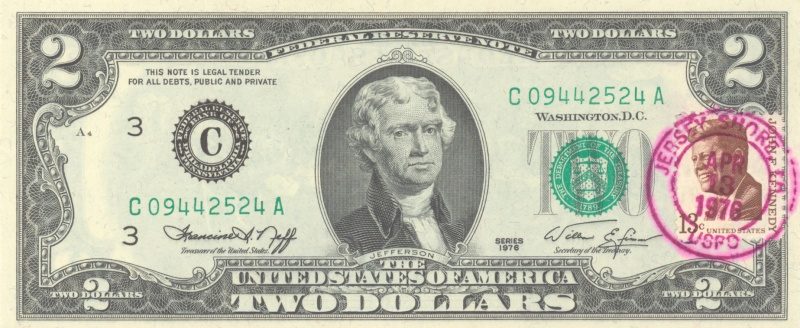
1976 First Day Postmarks
The most common "rare" $2 bill in America, and the one with the best story.
What Happened on April 13, 1976
The new $2 Federal Reserve Note went on sale at banks on Thomas Jefferson's birthday, and the Postal Service turned it into a stamp-collecting event. Post offices nationwide were authorized to postmark a 13-cent stamp affixed to the face of the note that day. People bought their twos at the bank, walked to the post office, stuck a stamp on Jefferson's shoulder, and had it cancelled with the date. By the end of the day the Postal Service estimated more than 10 million postmarked $2 notes were in the hands of the public.
Money magazine's retelling has a Virginia postmaster's staff stamping 25,000 bills, a Boston bank saying the notes sold "like hotcakes," and a Houston banker comparing the crowd to "a bank run." The enthusiasm "wore off in a matter of days."
Sources: CoinWeek, "The Bicentennial $2 Bill: First of a Kind" · Money, "America's Very Brief Love Affair With the $2 Bill"
How to Recognize One
- Series 1976 printed to the right of the portrait, with the Neff and Simon signatures.
- A postage stamp on the face, usually a 13-cent stamp of the period. Bicentennial commemoratives were popular choices.
- A circular post office cancellation over the stamp reading APR 13 1976 with the town name. Some have a second strike on the note itself.
- Notes postmarked on later dates exist too. They were stamped by people who missed the day, and collectors value them less than a true April 13 strike.
Source: CoinWeek. Observation of the note pictured above.
How Much Is a 1976 $2 Bill With a Stamp Worth?
The Honest Number
With more than ten million made in a single day, a first-day postmarked $2 is a keepsake, not a rarity. They typically change hands for about twice face value. A crisp note with a clean, fully legible strike from a small-town post office does better than a folded one with a smudged big-city cancel, and the stamp itself matters to some buyers.
For comparison, CoinWeek puts an ordinary uncirculated 1976 note at $3 to $4. The postmark adds a story and a little value, not a fortune. If a listing asks $50 for a plain first-day note, keep scrolling. What does move the needle on a 1976 note is the serial number: a star, a low number, or a pattern. Check valuable serial-number patterns. Every documented Series 1976 sale, by district, serial, and error, is on the 1976 $2 bill value guide.
Sources: Wikipedia, "United States two-dollar bill" (postmarked notes trade for about twice face; none are especially rare) · CoinWeek (uncirculated values)
Why the Treasury Did Not Want a Souvenir
The postmark craze cut against what the Treasury was trying to do. The Richmond Fed's 1976 article stressed that "the reissue of the bill is not intended as simply a commemorative act for this year, but rather it signifies the permanent addition of another U. S. denomination. Printing of this bill will continue in subsequent years, and there will be no 'collector's' or other special issues of it." Ten million people took the note home and put it in a drawer anyway, which is a decent summary of the $2's whole modern life.
Source: Federal Reserve Bank of Richmond, "The $2 Bill Returns" (PDF)