L 00000007 *
How Much Is a 2003 $2 Bill Worth?
Two dollars, with a short list of exceptions. There are two series with 2003 on them, printed three years apart for different districts, and their star notes are not alike. This page sets them side by side, lists the runs, and puts the $2,400 sale that made the news in context, each figure with its source and evidence type.
The Fast Answer
Every figure below is quoted from the source in its row. The evidence column uses the tiers on the Editorial Standards page: a realized sale is what somebody paid, with the venue and date; a dealer asking price is what a dealer lists; a secondary figure is a press summary, an aggregator, a price guide, or an estimate. Where sources disagree, both are shown. Heritage's and Stack's Bowers' own archives could not be reached when this page was written, so the aggregator's records are labeled as such and never as house results.
| Note | Reported Figure | Evidence Type | Source |
|---|---|---|---|
| Circulated, ordinary serial, either series | "The majority of these bills in circulated condition will only be worth their face value of $2"; a second dealer goes further: "Even in uncirculated condition, these modern two dollar bills do not carry any premiums above the face value of $2" | Dealer asking price; secondary (dealer summary) | Silver Recyclers, Old Currency Values |
| Uncirculated, Series 2003 | "around $5 in uncirculated condition with an MS 63 grade"; an aggregator's figures are $6.58 at UNC-63 (56 records), $9.25 at GEM-65 (14 records), and $170.50 at GEM-69 (6 records) | Dealer asking price; secondary (aggregator) | Silver Recyclers, Serial Worth, 2003 |
| Uncirculated, Series 2003A | "around $5-10 in uncirculated condition with an MS 63 grade"; an aggregator's figures are $8.99 at UNC-63 (79 records), $29.95 at GEM-67 (21 records), $168.00 at GEM-69 (7 records), and $1,200.00 at GEM-70 (7 records) | Dealer asking price; secondary (aggregator) | Silver Recyclers, Serial Worth, 2003A |
| Series 2003 star, Minneapolis (I) | "Most 2003 series $2 star notes are worth around $45 in uncirculated condition with an MS 63 grade"; an aggregator gives "$27.00 - $28.00" circulated and "$33.00 - $148.50" uncirculated; a price guide gives "$5.-$7." in F-XF and "$11.+" uncirculated | Dealer asking price; secondary (aggregator, price guide) | Silver Recyclers, Serial Worth, U.S. Currency Auctions |
| Series 2003 star, any other district (premium-set star) | Atlanta stars "sell for around $75 each in uncirculated condition with an MS 63 grade" per a dealer. These stars exist only from the Bureau's 2003 star note packages, which it sold at "$9.95 each, or $119.40" for all twelve districts | Dealer asking price; secondary (issue price, press report) | Silver Recyclers, Numismatic News |
| Series 2003A star, Atlanta (F) | "around $100 in uncirculated condition with an MS 63 grade" per a dealer; "approximately $67.00 uncirculated, ranging from $48.00 to $75.50 at premium grades" per an aggregator; "$2.25-$3.+" in F-XF and "$4.+" uncirculated per a price guide; "about $400 per pack" of 100 per a second dealer | Dealer asking price; secondary (aggregator, price guide, dealer summary) | Silver Recyclers, Serial Worth, U.S. Currency Auctions, Old Currency Values |
| Low serial number | $2,400 for a Series 2003 $2 with a low serial number (Heritage, July 2022, as reported by NBC Chicago); an aggregator records Series 2003 star serial number 1 notes at $21,600 (September 2019) and $19,200 (April 2019), and stars numbered 4 and 7 from $1,610 to $2,400 | Realized sale (press report); secondary (aggregator) | NBC Chicago, Serial Worth |
| Fancy serial number | $3,120 for K98765432B, a Series 2003A descending ladder (May 2024); $2,160 for F11111114A and $2,040 for E04440400A, both 2003A at GEM-70 (July 2022); $1,320 for I01111111A, Series 2003 (July 2022) | Secondary (aggregator) | Serial Worth, 2003A, Serial Worth, 2003 |
| Genuine printing error | No house-reported error sale for either series was found. The aggregator lists an "off-center error" on the $21,600 serial number 1 star, without saying how much of the price was the error | Nothing to cite | Errors and Auction Records |
Sources are linked in each row. The sales are repeated with dates and grades in the table further down. No figure on this page is an appraisal of a particular note; each is what another note brought or what a dealer asked.
Series 2003 and Series 2003A Side by Side
The two series share a design and a Secretary of the Treasury. Everything else about them differs: the Treasurer, the year printed, the districts, and above all the star notes. The Series 2003A Atlanta star, at 320,000 notes, is one twelfth the size of the Series 2003 Minneapolis star run.
| Feature | Series 2003 | Series 2003A |
|---|---|---|
| Signatures (Treasurer, Secretary) | Marin, Snow (Rosario Marin, John W. Snow) | Cabral, Snow (Anna Escobedo Cabral, John W. Snow) |
| Printed | August to October 2003, Fort Worth | July to September 2006, Fort Worth |
| Districts issued to circulation | Minneapolis (I) only | All twelve, A through L |
| Regular notes | 121,600,000 | 230,400,000 |
| Star notes issued | 3,840,000 (Minneapolis) | 320,000 (Atlanta) |
| Star rate | 3.16 percent, the highest of any modern $2 series | 0.14 percent |
| Collector products | Uncut sheets in the B, F, G, I, and K blocks; star note packages with serials under 16,000 for all twelve districts | Uncut sheets in every block ending in B; the Lucky Money 8.8.8 set and other premium serials |
| Friedberg number | Fr. 1937, district letter as suffix (Fr. 1937-I; stars Fr. 1937-I*) | Fr. 1938 (Fr. 1938-A through Fr. 1938-L; stars Fr. 1938-F*) |
Sources: USPaperMoney.info, Series 2003 $2 and Series 2003A $2 (print months, districts, counts, "All Series 2003 $2's were printed at Fort Worth, TX") · USPaperMoney.info, uncut sheets and collector products (sheet blocks, premium serials) · full names of the signers per Old Currency Values · star rates per the Star Notes page · Friedberg numbers as used on the worth page and the CU forum thread cited below
How to Tell Them Apart
Read the Series Line
"SERIES 2003" or "SERIES 2003A" is printed to the right of Jefferson's portrait, above the Secretary's signature. The letter is the whole difference between the two series; nothing on the back changed.
Check the Treasurer's Signature
Series 2003 carries Rosario Marin at lower left; Series 2003A carries Anna Escobedo Cabral. John W. Snow signs both at lower right. A note whose series line and signatures do not match is not genuine.
Read the District
The black seal at left and the first letter of the serial number name the district. A Series 2003 note issued to circulation is always Minneapolis (I). A Series 2003 note with B, F, G, or K came from an uncut sheet, and a Series 2003 star from any district but Minneapolis came from the Bureau's star note packages. Series 2003A notes exist for all twelve districts.
Look for FW
Every note of both series was printed at Fort Worth and carries the small "FW" beside the face plate number. A note without it is not a circulation note of either series; USPaperMoney.info records only that the 2003 premium-set stars were listed as Washington products yet observed with the FW mark.
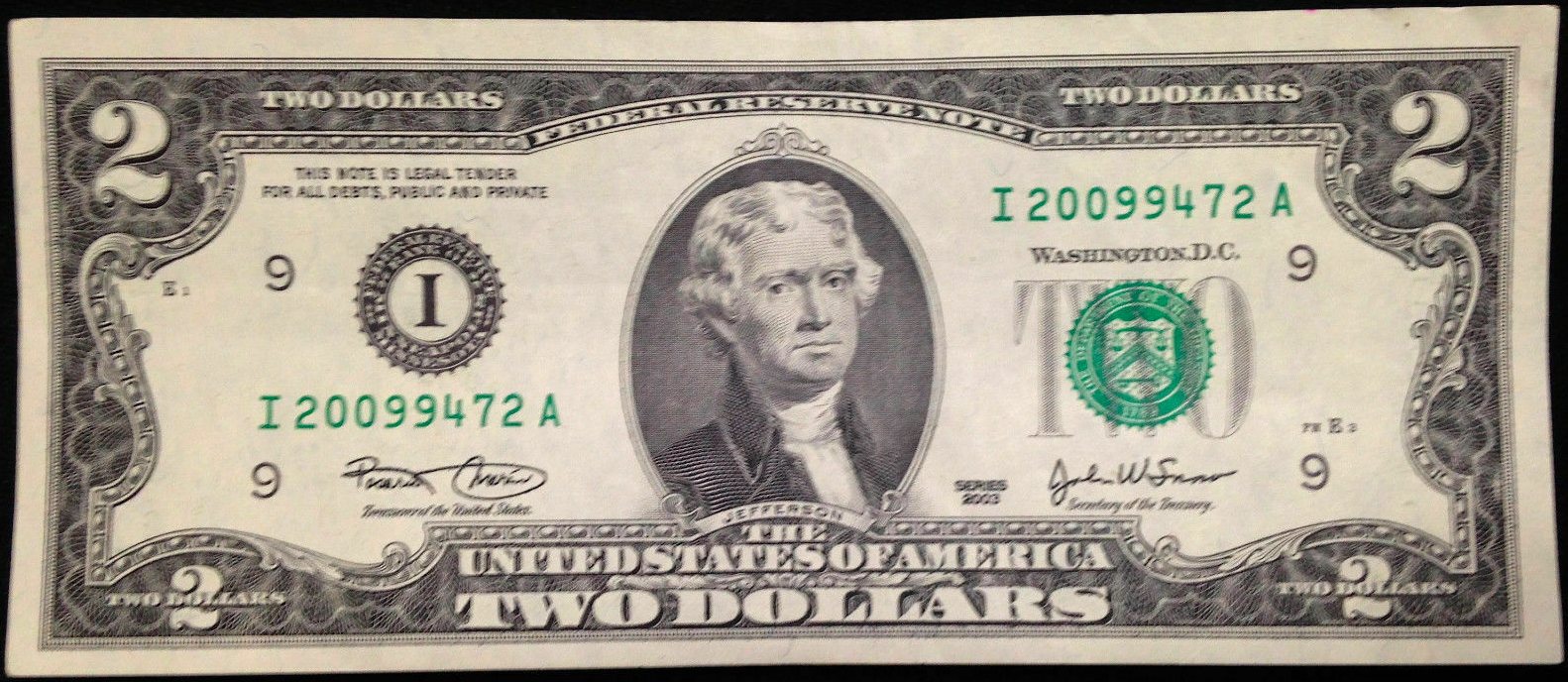
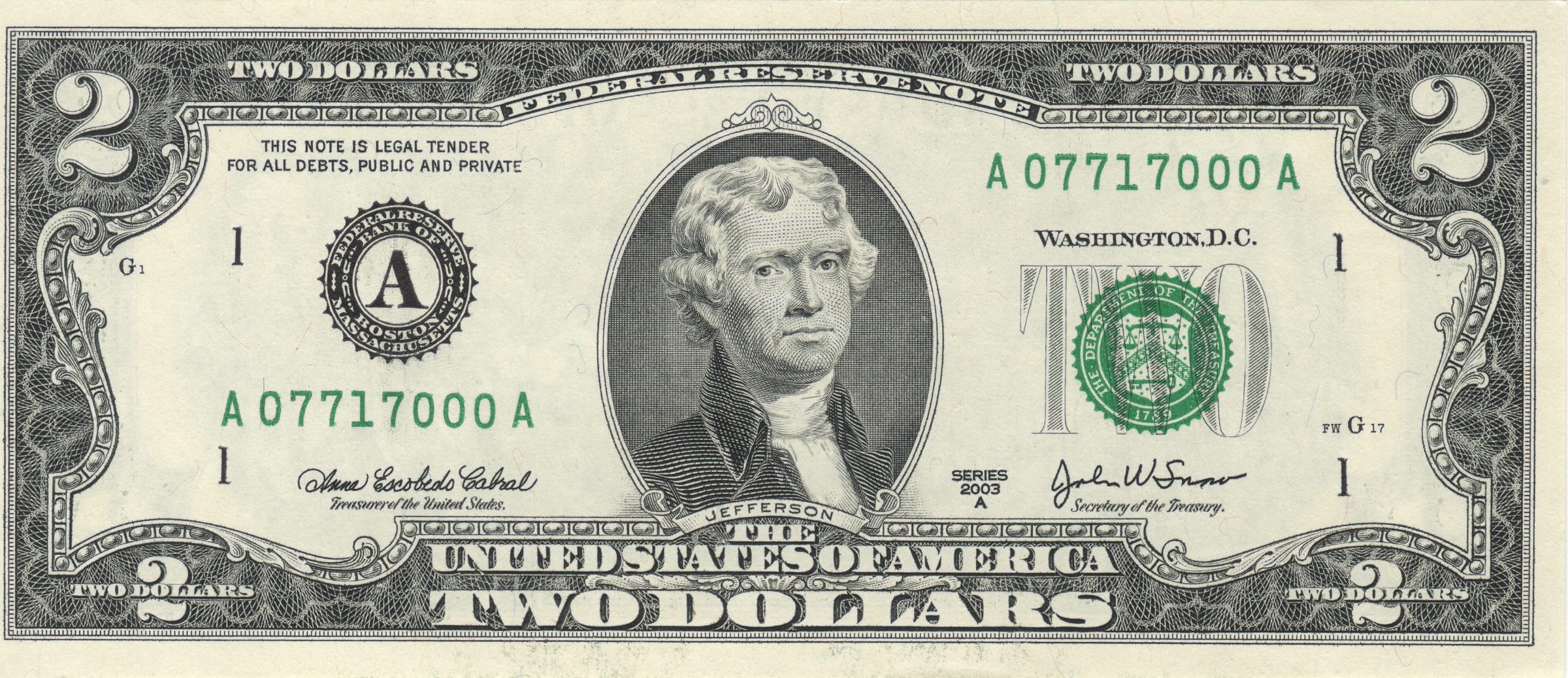
Sources: USPaperMoney.info, Series 2003 $2 · Series 2003A $2 · USPaperMoney.info, uncut sheets and collector products · BEP, Serial Numbers (district letters) · Real or Fake for the rest of the authentication checklist
Regular and Star Runs
The runs below are copied from the site's production tables, which USPaperMoney.info compiles from the Bureau's monthly reports. Series 2003 is one district and one star block. Series 2003A is twelve districts, from 6,400,000 notes for Philadelphia, St. Louis, and Minneapolis up to 64,000,000 for San Francisco, and one star run.
| Block | Serial Range | Printed | Notes |
|---|---|---|---|
| I Minneapolis, regular | I00000001A through I25600000B | August to October 2003 | 121,600,000 |
| I Minneapolis, star, run 1 | I00000001* to I03200000* | August 2003 | 3,200,000 |
| I Minneapolis, star, run 2 | I03200001* to I03840000* | September 2003 | 640,000 |
| A to L, premium-set stars | A00000001* to A00016000*, and so on through L00016000* | August 2003 | 16,000 per district |
| District | Printed | Regular Notes | Star Notes |
|---|---|---|---|
| A Boston | August 2006 | 12,800,000 | 0 |
| B New York | August and September 2006 | 25,600,000 | 0 |
| C Philadelphia | August 2006 | 6,400,000 | 0 |
| D Cleveland | September 2006 | 19,200,000 | 0 |
| E Richmond | September 2006 | 19,200,000 | 0 |
| F Atlanta | July and August 2006; stars September 2006 | 19,200,000 | 320,000 |
| G Chicago | September 2006 | 25,600,000 | 0 |
| H St. Louis | September 2006 | 6,400,000 | 0 |
| I Minneapolis | September 2006 | 6,400,000 | 0 |
| J Kansas City | September 2006 | 12,800,000 | 0 |
| K Dallas | September 2006 | 12,800,000 | 0 |
| L San Francisco | September 2006 | 64,000,000 | 0 issued; 384,000 reported in January 2012 and destroyed |
| Total | 230,400,000 | 320,000 |
Sources: USPaperMoney.info, Series 2003 $2 · USPaperMoney.info, Series 2003A $2 (per-district counts and months; the star run F00000001* to F00320000*) · USPaperMoney.info, collector products (the 16,000-serial star blocks) · the same runs, with a lookup by district, on the Star Notes page
Why the Star Issues Differ
A star note replaces a sheet the Bureau rejected, so the number of stars normally tracks the number of misprints. Series 2003 broke that pattern: 3,840,000 stars against 121,600,000 regular notes is a rate of 3.16 percent, and USPaperMoney.info notes that for this series "the BEP printed a few additional star notes for collector sales." Series 2003A ran the other way: one Atlanta run of 320,000 for a printing of 230,400,000, a rate of 0.14 percent, with the Bureau printing "a few additional premium notes with special serial numbers for collector sales" instead of stars.
The 2003 collector stars are the reason 2003 stars exist for every district. In 2008 the Bureau offered "Series 2003 $2s" with "serial numbers under 16000" from "all 12 Federal Reserve Districts," 10,000 notes per district, at "$9.95 each, or $119.40" for a set of twelve, and warned that "no effort will be made to provide matching serial numbers to customers." A matched twelve-note set with the same serial in every district was a separate, sold-out product. USPaperMoney.info adds two oddities: the notes in the premium sets carrying Minneapolis serials I00000001* to I00016000* "were not the notes from the circulation print run, being from different plate positions," so "presumably" the first 16,000 circulation stars "were destroyed unissued"; and the Bureau said the premium notes "were intaglio-printed at Fort Worth, but that these 8000 sheets were then shipped to Washington for overprinting."
Two things follow for a collector. A Series 2003 star from Boston, New York, Atlanta, or any district but Minneapolis is a product note, genuine and scarce by design at 16,000 serials, and its price is the price of the set it came from, not of a circulation rarity. And a Series 2003A star from anywhere but Atlanta does not exist: the 384,000 San Francisco stars in the Bureau's January 2012 report were, per a Freedom of Information Act response, "destroyed with none issued." The Uncut Sheets page covers the sheet blocks and the 8888 premium serials.
Sources: USPaperMoney.info, Series 2003 $2 · Series 2003A $2 (the FOIA response) · USPaperMoney.info, uncut sheets and collector products · Numismatic News, "$2 star note packages new from BEP," July 21, 2008 · star rates per the Star Notes page
Condition and Grading
For an ordinary note of either series the grade is the price. The aggregator's Series 2003A ladder runs from $8.99 at UNC-63 (79 records) to $29.95 at GEM-67 (21 records), $168.00 at GEM-69 (7 records), and $1,200.00 at GEM-70 (7 records): the same note, with an ordinary serial, is worth more than a hundred times as much at the top grade as at the bottom of uncirculated. Its three top-grade records are plain notes such as L99870759A, which brought $1,527.50 in January 2016, $1,800 in January 2020, and $1,200 in October 2022. The Series 2003 ladder is shorter, $6.58 at UNC-63 (56 records) to $170.50 at GEM-69 (6 records), with no GEM-70 record.
In PMG's definitions a 65 Gem Uncirculated "may have one or two minor distractions as a result of minor handling. The centering must be above average"; a 64 Choice Uncirculated has centering "off on one or two sides" but "no folds in the design." A raw note from a bank strap is far more likely to grade 63 or 64 than 69, which is why the dealer figures in the fast answer are for MS 63 and why the top-grade prices above belong to a handful of notes.
Sources: Serial Worth, Series 2003A · Serial Worth, Series 2003 · PMG Grading Scale
The $2,400 Sale in Context
In July 2022 NBC Chicago reported that Heritage had sold "a Series 2003 $2 with a low serial number" for $2,400, and the figure has circulated ever since as proof that a 2003 $2 bill can be worth thousands. The record behind it is narrower. The aggregator's entry for July 24, 2022, the date of Heritage's Skourtes Collection sale of fancy-serial $2 notes, is L00000007*, a San Francisco star, grade GEM-67, at $2,400; the Heritage lot page's own address names it "Low Serial Number 7 Fr. 1937-L* $2 2003 Federal Reserve Star Note, PCGS Banknote Superb Gem Unc 67 PPQ"; and a collector previewing the sale listed the same note and wrote that "67PPQ remains Top Pop for both grading services." San Francisco stars of Series 2003 exist only in the 16,000-serial premium blocks, so the note was one the Bureau sold for $9.95 in 2008, with serial number 7 and the finest grade either service had awarded.
That is the context: the price paid for the serial number and the grade on a product note, not for the year. The aggregator's other 2003 records say the same thing. Star serial number 1 notes from San Francisco and Chicago brought $21,600 and $19,200 in 2019; stars numbered 4 and 7 from six districts brought $1,610 to $2,280 between 2005 and 2022. Every one is a premium-set star with a serial under 10. The highest record for a Series 2003 note without a star is $1,320, for I01111111A, a binary serial one digit short of a solid.
Where the Sources Conflict
The Atlanta Journal-Constitution wrote on November 10, 2023 that the 2003 note "fetched $2,400" and was "resold for $4,000." The American Numismatic Association's account of the same November 2023 Heritage sale says the $4,000 note was a Series 1976 $2 with serial number 00000002, and that is how the 1976 guide records it. The two reports conflict; no source found shows the 2003 note selling twice, so this page does not adopt the resale.
Sources: NBC Chicago (the press report; the page answered HTTP 403 when this guide was written and is quoted as cited on the worth page) · Serial Worth, Series 2003 (aggregator records) · Heritage lot page (its address only; the page could not be opened) · Collectors Universe forum, the Skourtes sale · The Atlanta Journal-Constitution · American Numismatic Association
Sales on Record
The first row is the one sale reported by a news organization naming the house. The rest are an aggregator's records, which carry the serial, grade, date, and price but not the auction house, and are listed as secondary evidence for that reason. Dates that match Heritage's Skourtes sale of July 24, 2022 are marked.
| Date | Note | Grade | Price | Evidence | Source |
|---|---|---|---|---|---|
| July 2022 | Series 2003 with a low serial number, Heritage (the L00000007 star, per the records above) | Not stated in the report; PCGS 67 PPQ per the lot title | $2,400 | Realized sale (press report) | NBC Chicago |
| September 6, 2019 | Series 2003, L00000001 star, listed with an off-center error | GEM-65 | $21,600 | Secondary (aggregator) | Serial Worth |
| April 26, 2019 | Series 2003, G00000001 star | UNC-63 | $19,200 | Secondary (aggregator) | Serial Worth |
| July 24, 2022 | Series 2003, L00000007 star (Skourtes sale date) | GEM-67 | $2,400 | Secondary (aggregator) | Serial Worth |
| May 7, 2022 | Series 2003, A00000007 star | UNC-64 | $2,280 | Secondary (aggregator) | Serial Worth |
| September 28, 2007 | Series 2003, J00000004 star | GEM-65 | $2,070 | Secondary (aggregator) | Serial Worth |
| September 23, 2005 | Series 2003, B00000004 star | GEM-65 | $1,840 | Secondary (aggregator) | Serial Worth |
| May 11, 2007 | Series 2003, B00000007 star and C00000007 star, one record each | GEM-65 | $1,840 each | Secondary (aggregator) | Serial Worth |
| September 15, 2006 | Series 2003, G00000004 star | UNC-63 | $1,610 | Secondary (aggregator) | Serial Worth |
| July 24, 2022 | Series 2003, I01111111A, binary (Skourtes sale date) | GEM-66 | $1,320 | Secondary (aggregator) | Serial Worth |
| May 10, 2024 | Series 2003A, K98765432B, descending ladder | GEM-66 | $3,120 | Secondary (aggregator) | Serial Worth |
| July 24, 2022 | Series 2003A, F11111114A, binary (Skourtes sale date) | GEM-70 | $2,160 | Secondary (aggregator) | Serial Worth |
| July 24, 2022 | Series 2003A, E04440400A, binary (Skourtes sale date) | GEM-70 | $2,040 | Secondary (aggregator) | Serial Worth |
| January 10, 2020 | Series 2003A, L99870759A, ordinary serial at the top grade; the same note brought $1,527.50 on January 12, 2016 and $1,200 on October 7, 2022 | GEM-70 | $1,800 | Secondary (aggregator) | Serial Worth |
| January 10, 2017 | Series 2003A, J99917655A, ordinary serial at the top grade | GEM-70 | $1,645 | Secondary (aggregator) | Serial Worth |
| November 15, 2022 | Series 2003A, J02222222A, binary | GEM-65 | $780 | Secondary (aggregator) | Serial Worth |
| May 11, 2007 and January 14, 2008 | Series 2003A, J99952530A and L99768904A, ordinary serials at the top grade, one record each | GEM-70 | $690 each | Secondary (aggregator) | Serial Worth |
What Could Not Be Sourced
Heritage's and Stack's Bowers' lot archives, PCGS, and Greysheet answered HTTP 403 when this page was written, so no aggregator row above is confirmed against a house record and no lot numbers are given. Heritage's own description of the serial 7 star, which a search summary reported as saying the note "brought $1,175" at a 2012 sale, could not be opened and is not repeated as a figure. No realized sale was found for a Series 2003 or 2003A ladder other than the 2003A descending ladder above, none for a radar or repeater, none for a plain low serial below 00001000, and none for a printing error on either series. Population report counts for the two series were not available.
Sources are linked in each row. Serial Worth is a value aggregator; its rows are listed as secondary evidence because it does not name the auction house or lot. The July 24, 2022 date on five of its rows matches Heritage's Skourtes Collection sale, per the Collectors Universe forum thread that previewed it.
Questions About the 2003 $2 Bill
How Much Is a 2003 $2 Bill Worth?
Face value if it has been folded. Uncirculated, "around $5" for Series 2003 and "around $5-10" for Series 2003A per a dealer guide, or $6.58 and $8.99 at UNC-63 per an aggregator. The four-figure prices belong to premium-set stars with serial numbers under 10, to fancy serials such as the 2003A descending ladder that brought $3,120, and to ordinary notes graded 70.
What Is the Difference Between a 2003 and a 2003A $2 Bill?
The Treasurer's signature and the year printed. Series 2003 (Marin and Snow) was printed in 2003 for Minneapolis only; Series 2003A (Cabral and Snow) was printed in 2006 for all twelve districts. Series 2003 had 3,840,000 star notes, Series 2003A only 320,000, all for Atlanta.
Is a 2003 $2 Star Note Rare?
A Minneapolis star is not: 3,840,000 were printed, the largest star rate of any modern $2 series, and a dealer asks "around $45" in MS 63. A 2003 star from any other district came from the Bureau's 2008 star note packages, 16,000 serials per district, sold at $9.95 a note; scarce by design, and priced by its serial number. The 2003A Atlanta star, at 320,000, is the smaller circulation run and asks "around $100" in MS 63.
Why Did a 2003 $2 Bill Sell for $2,400?
Because it was serial number 7 on a San Francisco star, a premium-set note, graded PCGS 67 PPQ, the finest known, sold at Heritage's July 2022 sale of fancy-serial $2 notes. The price was for the serial number and the grade. A 2003 note with an ordinary serial from the same sale would have brought a few dollars.
Sources: as cited in the sections above, chiefly Silver Recyclers, Serial Worth, USPaperMoney.info, Numismatic News, and NBC Chicago.