G 00000001 A
Where to Get $2 Bills
There is no trick. The $2 is an ordinary denomination that every Federal Reserve Bank issues, and most bank branches can order it for a customer.
How Do I Get a $2 Bill?
Ask a Teller
Walk into a branch and ask for $2 bills. Many branches keep some in the vault for exactly this request. You will get whatever they have, which is often crisp and often a mix of series.
Have the Bank Order Them
Banks order currency from their Federal Reserve Bank, and the $2 is one of the seven denominations the Federal Reserve issues. If the branch has none, ask them to add twos to their next currency order and to call you when they arrive. Banks order $2 notes in full bundles of 1,000, so one $200 strap is a small slice of the order. If you want brand-new, consecutively numbered notes for gifts or a collection, say so: the Reserve Bank fills orders with circulated notes that are still fit to use first, so new notes are likely but not guaranteed. Consecutive numbers are not guaranteed either: the Federal Reserve said in September 2026 that $2 straps printed on new equipment may have gaps in their serial numbers, and that both kinds may arrive in an order (how to read a strap).
Buy Uncut Sheets From the Bureau
The Bureau of Engraving and Printing sells uncut sheets of 4, 8, 16, and 32 $2 notes through its public store, above face value. Sizes and pricing history.
Sources: Federal Reserve, "Which denominations of currency does the Federal Reserve issue?" · Federal Reserve Financial Services, Currency Depositing and Ordering · Federal Reserve Banks, Cash Services Manual of Procedures (PDF), sections 5.2 and 5.3 · Federal Reserve Financial Services, nonsequential $1, $2, $5, $20 straps, September 15, 2026 · BEP uncut currency store
G 00000000 A
Plan a $2 Bill Order
Enter how many bills you want, or how much you want to spend. The planner turns it into straps, tells you how the bank orders them, and gives you the words for the teller window. The only arithmetic is count times two dollars.
What to Expect When You Ask a Bank for $2 Bills
- Timing. The Federal Reserve orders new twos every two to four years and works the stock down, so a bank's order may be filled with notes printed a while ago. Reserve Banks fill orders with fit circulated notes first and take orders for new currency mainly for the holiday season and "certain cultural holidays," which is why a strap ordered in December or before Lunar New Year is the likeliest to be new.
- Series. As of 2025 you could receive Series 2013, 2017A, or 2021 notes. All are current; the series year only tells you whose signatures are on it.
- Fees. Exchanging cash for cash at your own bank is usually free for an account holder, but each bank sets its own ordering, eligibility, and fee policy, so ask before the order goes in.
- Spending them. Vending machines and self-checkouts generally accept them, cashiers sometimes hesitate, and no federal law makes a private business take one (what legal tender actually means). If one calls a $2 fake, the Real or Fake page has the answer in the government's own words.
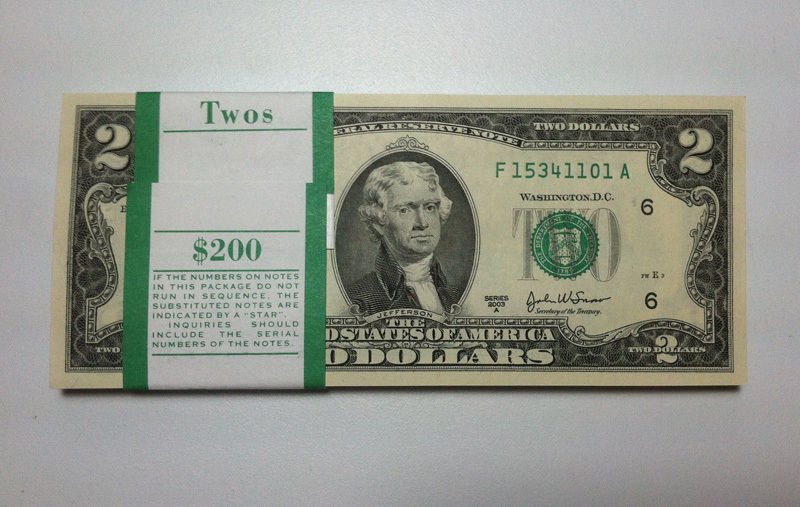
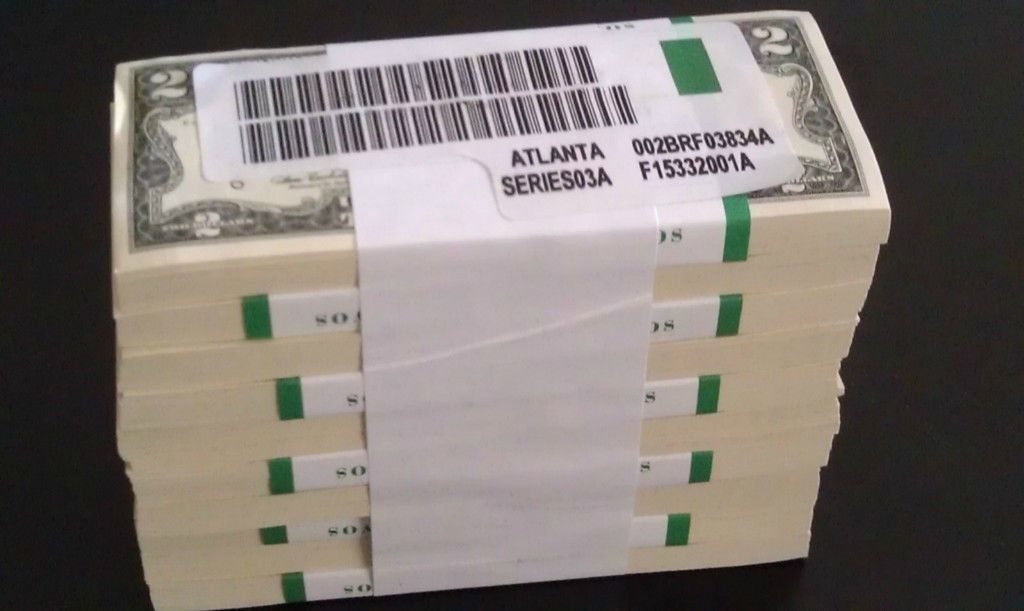
Sources: U.S. Currency Education Program podcast · series in production per Series and Production
Good Reasons to Carry Them
- Tips. A two in a tip jar gets noticed. Duncan Burch built a business on that observation. The story.
- Red envelopes. Crisp $2 bills are a favorite for Lunar New Year gifts, where amounts ending in 2 are considered lucky. Banks in some neighborhoods run short in January and February, so order early.
- Making a point. Clemson fans have spent stamped twos at away games since 1977 to show what their travel is worth to a host city. How it started.
- Kids. A $2 bill is the cheapest way to make a child think you handed them treasure. Most of them keep it, which is exactly the problem the Treasury has had since 1976.
Sources: Chase, "Lunar New Year: Red Envelope" · Clemson University, Traditions
Buying Online
For plain uncirculated notes, the bank beats every listing on price. Buy online for what a bank cannot give you: a specific series, a specific district, a star note, a fancy serial, a first-day postmark, or an old red seal. When you do, the rules from the Collecting Guide apply: photos of the actual note, serials you can check against the print tables, graded holders for anything with a real premium, and a payment method you can dispute.