D 00000001 A
Design Details
What is on the note, why it is there, and how to read it. The design has not changed since 1976, which makes it the oldest face in your wallet.
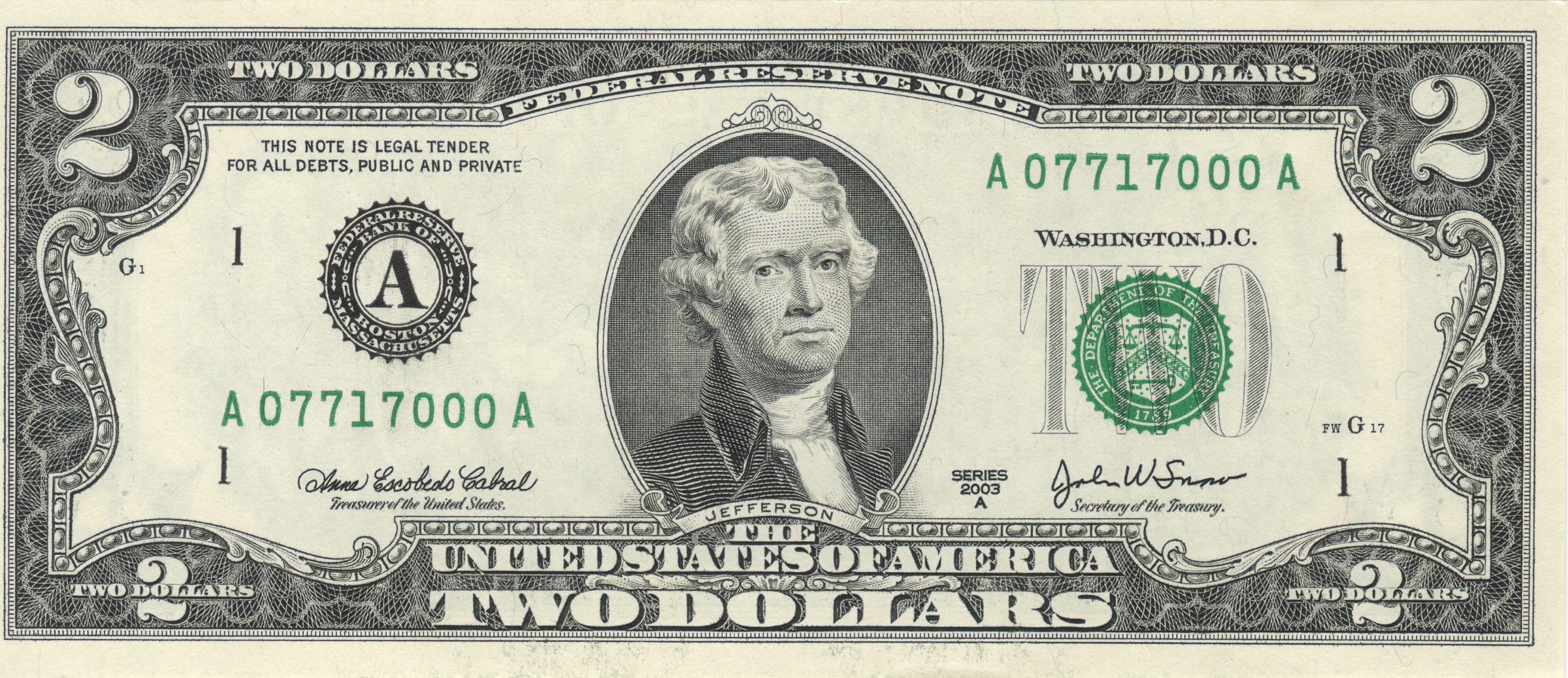
Who Is on the $2 Bill?
- Portrait
- Thomas Jefferson, engraved from a portrait "painted in the early 1800's by the American artist Gilbert Stuart." The same portrait has been on every $2 United States Note and Federal Reserve Note since Series 1869.
- Bank Seal
- "A black seal to the left of the portrait bears the name and corresponding letter of the distributing Federal Reserve Bank." The district's number also appears four times in the corners.
- Treasury Seal
- "A green seal to the right of the portrait represents the U.S. Department of the Treasury. The design of the seal was changed to incorporate an English inscription and appears on all Federal Reserve notes of the 1969 series year or later."
- Serial Numbers
- "A combination of eleven numbers and letters appears twice on the front of the note." How to read them is below.
- Series Year
- Printed to the right of the portrait. It changes when the signatures change: the Treasurer of the United States signs at left, the Secretary of the Treasury at right.
- Plate Marks
- Small letters and numbers identify the printing plate positions. Notes printed at Fort Worth carry a small "FW" beside the face plate number, which is every $2 since Series 1995.
Sources: U.S. Currency Education Program, "$2 Note Issued 1976 to Present" (PDF) · Richmond Fed 1976 · BEP, $2 Note · FW mark per Wikipedia

What Is on the Back of the $2 Bill?
The vignette is an engraving after John Trumbull's painting of the Declaration of Independence, the one that hangs in the U.S. Capitol Rotunda. The engraving was adapted by BEP engraver Peter Cocci for the 1976 reissue, replacing Monticello, which had been on the back since 1928.
It is not a faithful copy, and the Bureau says why: "The original Trumbull painting portrayed 47 people, 42 of whom were signers of the Declaration (there were 56 total). However, because of a limited amount of space on the note, five of 47 men in the painting were not included in the engraving." The Bureau's longer fact sheet tells a more precise story: there are two Trumbull versions, the 1786 original at Yale with 48 figures and the 1817 Capitol Rotunda mural with 47, and the note's six standing figures at far left show it was based on the Yale version, minus "four seated figures on the far left and two seated figures on the far right." The Richmond Fed named them in 1976: George Wythe, William Whipple, Josiah Bartlett, and Thomas Lynch Jr. on the left; Thomas McKean and Philip Livingston on the right, omitted "for aesthetic and security reasons." The Bureau credits Peter M. Cocci as the designer and Frederick Girsch as the engraver of the vignette. If you have ever counted heads against the painting and come up short, that is the reason.
Sources: BEP, $2 Note · BEP, "Historical Highlights: $2 Note" fact sheet (PDF) · Richmond Fed 1976

How to Read the Serial Number
The $1 and $2 are the last notes with the old serial format, per the Bureau of Engraving and Printing: "Up through Series 1995, all Federal Reserve notes had serial numbers consisting of one letter, eight digits, and one letter, such as A12345678B; now only the $1 and $2 notes still use this form."
- First letter: the Federal Reserve Bank. "The first letter of such a serial number identifies the Federal Reserve Bank (FRB) which issued the note; since there are 12 FRBs, this letter is always between A and L." A Boston, B New York, C Philadelphia, D Cleveland, E Richmond, F Atlanta, G Chicago, H St. Louis, I Minneapolis, J Kansas City, K Dallas, L San Francisco.
- Eight digits. Counted up from 00000001 within a district and series. Modern notes are only printed to 96000000 before the suffix letter advances.
- Last letter: the block. "The last letter advances through the alphabet when all eight character serial numbers have been printed for a specific Federal Reserve Bank within the same series." The letter O is skipped because it looks like a zero, and Z is reserved for test printings.
- A star instead of a letter. "When an imperfect sheet is detected during the manufacturing process after the serial number has been overprinted, it must be replaced with a new sheet. A 'star' sheet is used to replace the imperfect sheet." Star notes have their own serial numbers, unrelated to the notes they replaced. More on stars and collectible serials.
Sources: BEP, Serial Numbers · 96000000 limit per USPaperMoney.info
Paper, Ink, and Size
- Paper
- "Federal Reserve note paper is one-fourth linen and three-fourths cotton, and contains red and blue security fibers."
- Printing
- Intaglio. "Move your finger along the note's surface to feel the raised printing, which gives genuine Federal Reserve notes their distinctive texture."
- Size
- 6.14 by 2.61 inches, like every other U.S. note since 1928. Large-size notes before that were about 7.4 by 3.1 inches.
- Durability
- Per the Bureau, "It would take about 4,000 double folds (first forward and then backwards) before a note will tear," and a note of any denomination weighs about one gram.
- Security Features It Missed
- "In the early 1990s, a security thread and microprinting were introduced to the existing design. All subsequent notes, except the $1 and $2 notes, include these features." The 1996 watermark and color-shifting ink skipped the two as well.
- Redesign
- None planned. "Because the $2 note is infrequently counterfeited, the government has no plans to redesign this note." The Treasury and Fed said the same in October 2003, and the BEP again in 2013.
Sources: U.S. Currency Education Program, $2 features (PDF) · BEP FAQ · BEP, Currency Notes (PDF) · Treasury and Federal Reserve fact sheet, October 9, 2003 · dimensions per Wikipedia